A week before 27-year-old Jang Deok-jun died, his mother Park Mi-suk pleaded with him to leave his job at a warehouse operated by Coupang, South Korea’s largest e-commerce platform.
During his year at the warehouse, Jang had lost 15 kilograms and was constantly exhausted. Yet he refused to take time off because he worried his absence would increase the workload for his colleagues, according to the BBC.
A week later, Park found her son unconscious in the bathtub. Doctors determined that he had suffered a fatal heart attack. The Korea Workers’ Compensation and Welfare Service (COMWEL) later officially recognized his death as being caused by overwork.
Jang died in 2020, when online shopping surged during the Covid-19 pandemic. Six years later, his mother continues campaigning against overnight work practices she believes contributed to his death.
His case brought wider attention to the harsh working conditions behind South Korea’s rapidly expanding logistics sector.
Trade unions say suspected deaths from overwork have continued as e-commerce companies compete to provide round-the-clock services, including deliveries that promise packages on customers’ doorsteps before 7 a.m., according to The Korea Herald.
COMWEL figures cited by the BBC show that between 2020 and May 2026, authorities recognized 46 deaths among warehouse employees and delivery drivers from strokes or heart failure as occupational accidents.
Medical experts have repeatedly warned that working through the night can raise the risk of cardiovascular disease, diabetes and serious mental health problems.
South Korea, however, does not impose a specific daily limit on night work for commercial delivery drivers. By comparison, the U.K. restricts such night shifts to a maximum of 10 hours a day.
Higher earnings remain a powerful incentive for workers to accept the demanding schedules.
Kim, a delivery driver in Incheon, typically works from 9 p.m. until 7 a.m., five or six nights each week. His monthly income of about US$4,600 is nearly twice the national average, but his shifts leave almost no room for rest.
|
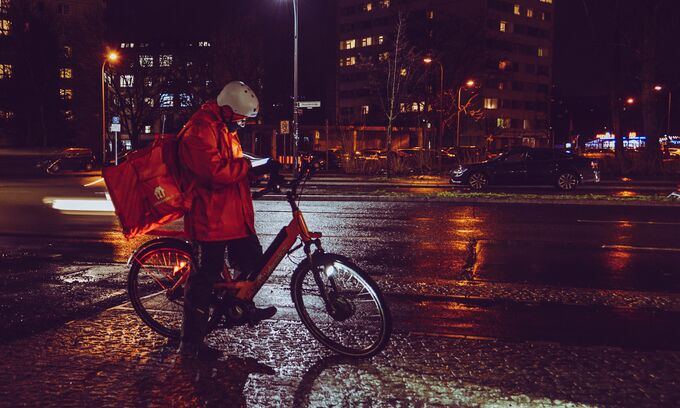
A bicycle delivery worker checks his phone on a rain-slicked street at night. Photo from Pexels |
For 10 hours, he moves continuously between his truck and customers’ homes. Because his earnings are tied to the number of deliveries completed, failing to meet the 7 a.m. deadline could put his assigned route at risk.
His wife worries that exhaustion could cause him to fall asleep behind the wheel. Kim, however, says he has become accustomed to the punishing routine. “We choose to deliver overnight for the money,” he told the BBC.
The death of 34-year-old delivery driver Oh Seung-yong further highlighted the risks. Oh was killed when his truck crashed into a utility pole during a nighttime delivery run. His death was later classified as a workplace fatality.
He had been working more than 11 hours a day, six days a week. Even on the night his father died, Oh continued delivering packages for another four hours before going to the hospital.
For Jang’s mother, the loss of her son transformed her life. After his death, Park closed her woodworking shop, moved into a small rented apartment in Daegu and packed her son’s remaining possessions into cardboard boxes.
She has since continued campaigning for changes to overnight working conditions, hoping other families will not suffer the same loss. “I hope we don’t become a society where we close our eyes to others’ sacrifice for a little convenience,” she said.