
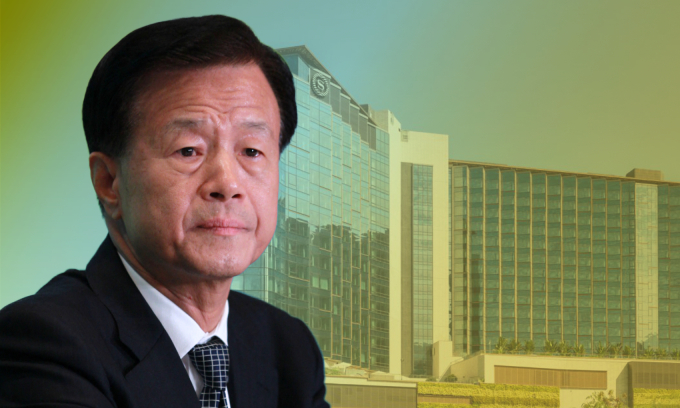

A Sheraton-branded hotel in Hong Kong controlled by billionaire Hui is set to be seized by several banks after his company defaulted on a HKD4.5 billion (US$574 million) loan, according to a recent report by Bloomberg.
This is only the latest in a long list of assets seized in recent years to cover the debts of Shimao Group, a property developer which has been struggling amid China’s property crisis, sending founder Hui’s net worth down from a peak of $10.3 billion in 2021 to $1.9 billion this year.
Hui, 75, also known in Mandarin as Xu Rongmao, built Shimao Group into one of China’s better-known private property developers, with a business spanning residential projects, commercial buildings and hotels.
Hui Wing Mau (Xu Rongmao), chairman of Shimao Group, attends the BFA Overseas Chinese Business Roundtable during the Boao Forum for Asia Annual Conference 2013 in Qionghai city, south Chinas Hainan province, 6 April 2013. Photo by Imaginechina via AFP |
Hui emerged from Fujian province to become one of China’s most prominent private property tycoons. As a young man he reportedly worked as a doctor and provided basic medical care to villagers. In the 1970s, he moved to Hong Kong and began his career on the floor of a textile factory.
His turning point came in 1988, when he invested in a knitting venture in his hometown and redirected the project into a hotel.
His company Shimao then expanded into residential development in Fujian before moving into bigger mainland markets, according to the company’s website.
Shimao built Zhenshi Hotel in Shishi in 1992 and entered Beijing in 1994, where it developed a model focused on higher-end housing and export-oriented property sales.
The company’s rise tracked China’s urbanization boom. A breakthrough came in 2006, when Shimao Property Holdings listed in Hong Kong. The initial public offering raised HKD3.72 billion (US$480 million), making it the largest IPO by a Chinese real estate developer at that point, despite weak market conditions and cautious investor demand, FinanceAsia reported.
The listing gave Hui access to public capital at a time when Chinese developers were racing to acquire land and expand across the country. Shimao used the broader property boom to build a large land bank and diversify into residential, commercial and hotel assets.
By 2013, public company profiles described Shimao as one of China’s largest property developers, with projects in dozens of Chinese cities and a land bank of about 36.2 million square meters.
Hui also became known outside mainland China. Australian business media reported in 2013 that he debuted on the BRW Rich 200 list.
By the late 2010s, Shimao was near the top tier of China’s private developers. The company said annual contracted sales exceeded RMB300 billion (US$44 billion) in 2020, ranking eighth in the industry.
In 2020, Shimao Property was renamed Shimao Group, and Shimao Services was separately listed in Hong Kong, reflecting the group’s effort to turn its property-management arm into a separate growth business. In 2021, Hui’s net worth rose to a historic high of $10.3 billion.
Empire falls
But the first major warning signs emerged during China’s property liquidity crunch, which began in 2021 after the government tightened financing for developers.
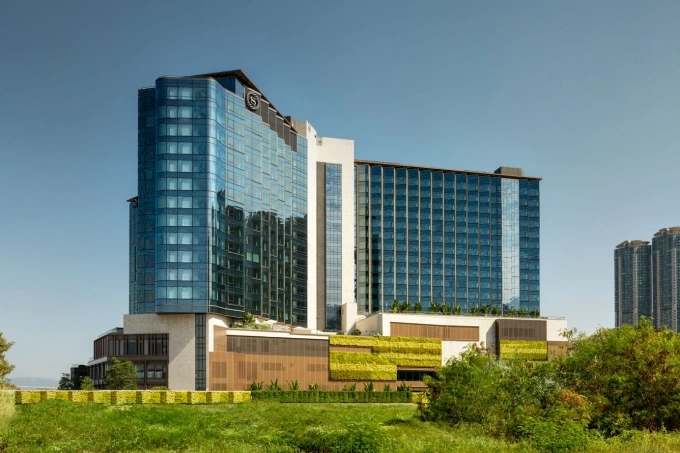 |
Sheraton Hong Kong Tung Chung Hotel. Photo courtesy of the hotel |
Analysts at the time began questioning Shimao’s financial health, when JPMorgan described a related-party transaction involving Hui-controlled entities as a “governance red flag,” as reported by financial data platform Investing.com.
The bank’s analysts said the deal “not only implies tight liquidity conditions for Shimao but is also a corporate governance red flag,” because it appeared to move cash from the property-management arm to the developer level.
The crisis had spread from weaker developers to names previously seen as higher quality, including Shimao, whose shares and bonds came under pressure as investors reassessed the sector. Credit rating agency S&P downgraded it from investment grade, citing “tough business conditions.”
By early 2022, Hui was already moving to dispose of personal Hong Kong assets. He and his daughter Hui Mei-mei were seeking HKD1.6 billion for two floors in The Center, as reported by the South China Morning Post.
Hui’s wealth had fallen to about $4.3 billion from as much as $13 billion in August 2020, while Shimao’s shares had dropped about 79% over the previous year, data from Bloomberg showed.
Shimao’s crisis deepened in 2022 when the company defaulted on around $11.5 billion of offshore debt, triggering prolonged negotiations with bondholders and bank creditors.
In March 2024, Reuters reported that a major bondholder group “firmly opposed” Shimao’s proposed offshore debt revamp, objecting to the scale of losses, the lack of an upfront payment and long delays before cash repayment.
Pressure intensified when China Construction Bank (Asia), part of a major state-owned Chinese bank, filed a liquidation petition in Hong Kong over unpaid loans of about HKD1.58 billion.
The case was consider as a rare move by a state-owned bank and a sign of growing impatience among creditors in China’s property downturn, The Financial Times reported. Shimao’s shares plunged after the petition, with the company’s stock down heavily amid losses and debt worries.
Hui’s personal unwinding has continued alongside Shimao’s corporate restructuring. Earlier this year, Singapore’s largest bank DBS agreed to buy six floors in The Center from entities linked to Hui for HKD2.62 billion, according to real estate news platform Mingtiandi.
The report said the price was about half the 2017 level paid by the consortium that acquired the tower from CK Asset, underlining how far Hui’s position had fallen.

Comments are closed.