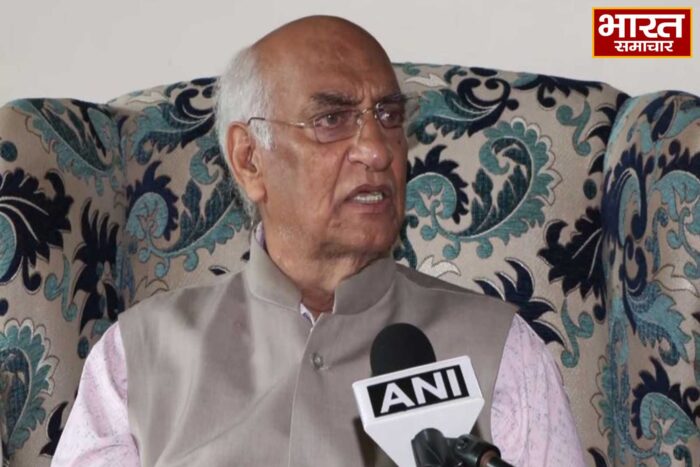
Recently, discussions have intensified in political and diplomatic circles after America welcomed the Mecca Joint Defense Agreement between Saudi Arabia, Turkey and Pakistan. Meanwhile, former senior diplomat Vidya Bhushan Soni has offered a critical analysis on this entire incident. He says that Washington's acceptance of this agreement is a clear indication that America's regional influence in the Middle East is gradually decreasing, and by taking advantage of this situation, US President Donald Trump can focus his entire attention on Iran.
While discussing with the media on Monday, former Ambassador Soni said that this agreement is a strong proof that America is no longer in a position to single-handedly stabilize those sensitive areas of the world where it once played a major role. He specifically mentioned the biggest challenge facing Saudi Arabia i.e. the 'Huthi factor'. According to him, the Houthi rebels remain the biggest headache for Riyadh, constantly disrupting maritime trade, especially cargo movement around the Bab-el-Mandeb Strait, and destabilizing the region. Although the international community focuses mostly on the Israel-Palestine conflict and Iran, for Saudi Arabia the activities of the Houthis are directly related to national security.
Soni also reminded that a similar agreement was signed between Saudi Arabia and Pakistan last year, but it did not have any significant impact on the activities of the Houthis because Pakistan could not effectively participate in it. Regarding Trump's stance on the new defense pact, he said it should be seen in the context of Washington's priorities against Iran. If any other regional source is able to deal with the challenge of the Houthis, it will reduce the pressure on America to a great extent.
Apart from this, he also linked this development to Trump's old strategy under which he wants to include more and more countries in the Abraham Accords. Although Pakistan cannot openly support it for domestic and political reasons without abandoning the Palestine issue, such regional defense arrangements ultimately strengthen Israel's security. This new agreement does not involve any direct financial or military spending by the US; Rather, it will see a combination of Saudi Arabia's money, Türkiye's modern technology and Pakistan's ground forces. Overall, this agreement will allow the US to focus more strongly on its main strategic goal of containing Iran by lightening the burden of its regional responsibilities.