


Praveen Trivedi, teacher
For us Indians, understanding the size of the word “trillionaire” is a challenge in itself. If Elon Musk’s wealth is considered to be around 1 trillion dollars, then in Indian currency it comes to around Rs 85 to 90 lakh crore. That is, how many zeros will we Indians have to put in this zodiac sign, it will be a fun task to use our intelligence. This amount is bigger than the Union Budget of the Government of India for an entire year, but the more interesting thing is that while reading this news, the common man starts remembering a different mathematics of his life. When the status was in hundreds, the dreams were in thousands. When it reached thousands, it started talking about lakhs. When the figure of lakhs was touched, the focus was on crores. Millions of people started dreaming of billions and now the world is at such a stage where the wealth of any one person is being measured in trillions of dollars. This is not just a story of wealth, it is also a story of human ambition, which seems to have no end in sight.
The history of human civilization is not only the history of new inventions, but also the history of changing centers of power. Power once resided in the ownership of land, then passed to armies, then to industries and capital and now appears to be concentrated in the hands of technology, data, artificial intelligence, space research and global digital networks. Musk becoming a trillionaire has emerged as the biggest symbol of this change.
It has to be acknowledged that Elon Musk’s success is not a mere coincidence.
From electric vehicles to space technology and artificial intelligence, he took risks in areas where most people would avoid even imagining. Therefore, to consider their wealth as merely the result of inequality would be to lose sight of reality. Rewarding talent, innovation and entrepreneurship is a need for any progressive society.
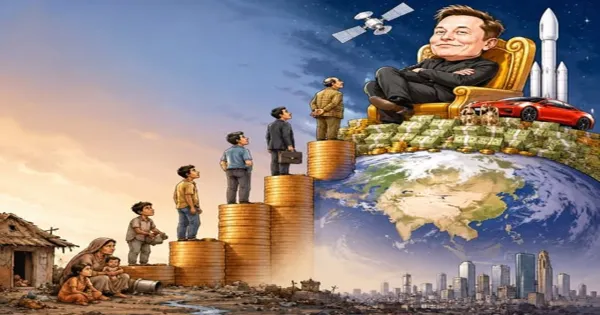
The problem lies not in earning wealth, but in the unprecedented concentration of wealth. The matter of concern is that today’s money is not just money kept in bank accounts. This is the power of influence. It can influence governments, change the direction of the media, influence electoral discourse, dictate the pace of artificial intelligence development, and even affect mankind’s future in space. When a person has enough resources to run his own private space agency, establish his own satellite system and influence the global communications infrastructure, then the discussion is no longer just about wealth, but about the balance of power.
In history, kings were also very wealthy, but their power was limited to geographical boundaries. Today’s technological assets know no boundaries. A digital platform can reach billions of people. An AI model can change the way the entire world works. A private space company can enter areas that were once considered the sole prerogative of nation-states. This is why the rise of trillionaires is not only an economic phenomenon but also raises political, social and ethical questions.
It is also an irony that in a world where crores of people are still struggling for clean water, better education, quality health services and a respectable life, in the same world the wealth of a few individuals is reaching such a level that it is being compared with the economies of entire countries. This is not a criticism of any individual, but a study of a system that is simultaneously creating both extraordinary opportunity and extraordinary inequality. Most importantly, the question is not Elon Musk. Today it is Musk, tomorrow it will be someone else.
The real question is whether the next chapter of human civilization will be written by a few hundred highly influential individuals or whether the benefits of technology and wealth will reach broader society. In the future, will the wealth of some people become bigger than that of countries and their influence will exceed that of governments? Or will human societies develop institutions that balance excessive centralization of power while encouraging innovation?
The birth of a trillionaire is certainly an economic record in human history, but more than that it is a philosophical and social question. This forces us to ask not just how much wealth a person has acquired, but also what direction the future of humanity will take with such great economic power. This journey from hundreds to thousands, thousands to lakhs, lakhs to crores and crores to trillions is not just about numbers. This is the story of a changing world in which money is no longer just an asset but also the ability to shape the future. (These are the personal views of the author.)

Comments are closed.