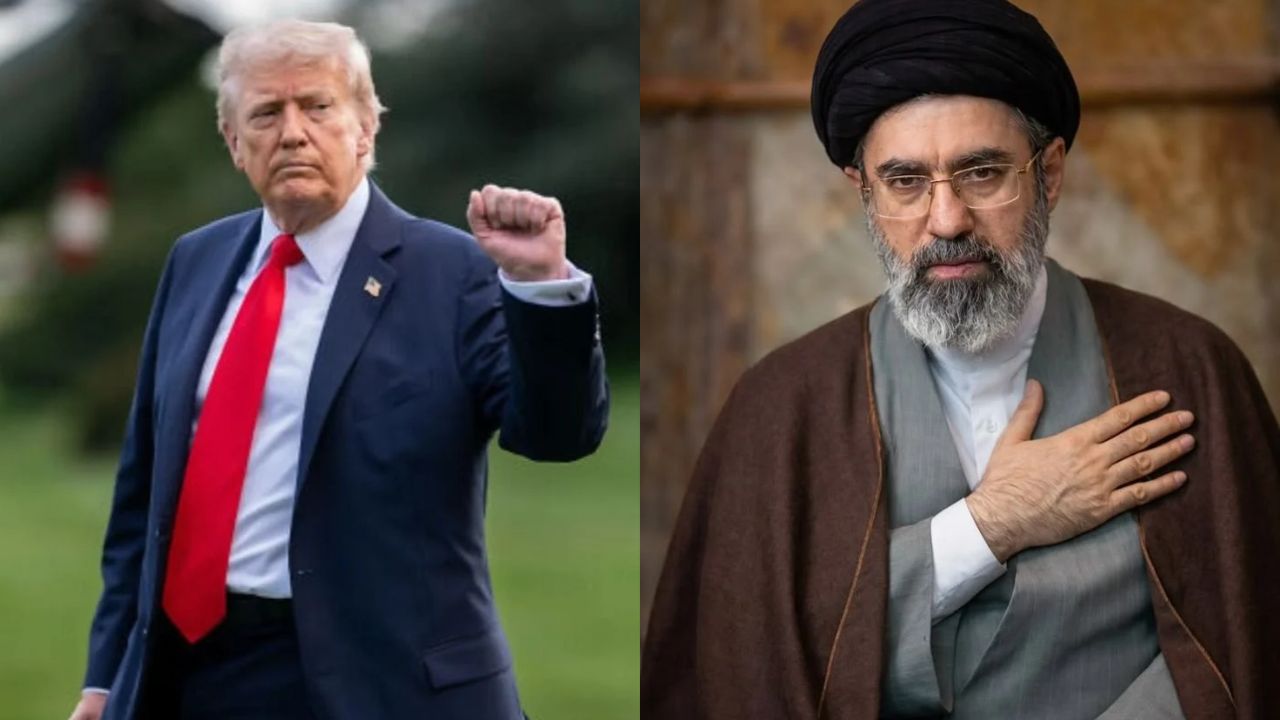
Washington: US President Donald Trump has signaled a possible de-escalation in the military confrontation with Iran, declaring that the conflict is effectively over from a military standpoint while warning that Washington remains fully prepared to resume operations if circumstances change. His latest remarks have raised hopes of a diplomatic breakthrough, even as the United States continues to exert strategic and economic pressure on Tehran through a naval blockade and a newly announced initiative targeting its overland trade routes.
The apparent shift in Washington’s military posture triggered a sharp reaction in international energy markets, with crude oil prices extending their losses amid expectations that the risk of renewed hostilities could diminish. Brent crude futures fell more than USD 7 per barrel in post-settlement trading, reflecting growing market optimism over the possibility of a negotiated resolution to the conflict.
Speaking during an impromptu White House press briefing on November 9, Trump indicated that the United States intended to maintain the existing military and economic arrangements rather than immediately pursue another round of strikes against Iran. The President also suggested that regional allies preferred the continuation of the current pressure strategy, which combines maritime restrictions with measures aimed at disrupting Tehran’s land-based trade connectivity.
Trump Keeps Military Options Open
Trump’s assessment that Iran’s military capabilities had been effectively neutralized was accompanied by another warning that American forces remained prepared for any escalation. He indicated that Washington hoped to reach an agreement with Tehran but would respond decisively if negotiations failed or the situation deteriorated.
The US President maintained that American military capabilities remained at the highest level of preparedness, with advanced weaponry and substantial operational resources available if required. However, he suggested that Washington did not currently anticipate circumstances necessitating their deployment.
Trump also pointed to Iran’s economic difficulties, highlighting an inflation rate of approximately 301 per cent as evidence of the pressure confronting the Iranian economy. His remarks underscored the administration’s strategy of combining military deterrence with economic isolation to influence Tehran’s negotiating position.
The President further indicated that Iran was communicating with American representatives in a more constructive manner, expressing optimism that a diplomatic arrangement could eventually resolve the confrontation. He suggested that there was a reasonable possibility of reaching an agreement, although the prospects for a lasting settlement remained uncertain.
Fresh Strikes Deferred After Qatar’s Diplomatic Intervention
The latest indications of restraint followed reports that Trump had deferred a decision on renewed military strikes against Iran after a conversation with Qatar’s Prime Minister Mohammed bin Abdulrahman Al Thani.
The development assumes significance against the backdrop of Trump’s earlier threats to resume attacks, particularly after the US President indicated that fresh military action remained an option following last week’s midterm elections.
Washington’s decision to maintain the existing pressure campaign rather than immediately escalate military operations appears to reflect a combination of diplomatic consultations and regional security considerations.
Trump identified Qatar, Saudi Arabia, the United Arab Emirates, Bahrain and Kuwait among the regional countries that favored maintaining the current arrangement. According to his assessment, these governments preferred the continuation of the American naval blockade and other restrictions rather than an abrupt change in the military posture.
The US President also indicated that withdrawing American forces or relaxing the pressure prematurely could expose regional allies to security risks. He maintained that Washington wanted a long-term resolution rather than a temporary arrangement that could leave the underlying security concerns unresolved.
Operation Iron Gate: US Expands Pressure on Iran Through Land and Sea
A central component of Washington’s strategy is Operation Iron Gate, a newly announced initiative intended to sever Iran’s overland trade connections with other countries. The initiative complements the ongoing US naval blockade, creating a broader economic containment strategy targeting Tehran’s maritime and land-based commercial networks.
By restricting access to critical trade routes, Washington is seeking to intensify pressure on Iran’s external commerce, supply chains and economic connectivity. The combined measures could further complicate Tehran’s access to international markets and increase the challenges confronting its already strained economy.
Trump described the strategy as a comprehensive restriction of Iran’s land and sea connectivity, suggesting that the United States intended to preserve the existing arrangements while diplomatic engagement continued.
The President also reiterated that preventing Iran from acquiring nuclear weapons remained a non-negotiable objective of American policy. He maintained that this position was understood by Tehran, although Iran had not publicly acknowledged accepting the American demand. The nuclear issue therefore remains a central obstacle in any prospective agreement, alongside questions concerning military security, regional influence and the future of economic restrictions.
Nuclear Dispute Remains Central to Negotiations
The possibility of a diplomatic breakthrough remains closely linked to the longstanding disagreement over Iran’s nuclear programme. Trump has repeatedly maintained that Tehran must never acquire a nuclear weapon and has presented this objective as a fundamental condition for ending the confrontation.
The administration’s approach combines military deterrence, economic sanctions, maritime restrictions and diplomatic engagement. However, the extent to which these measures can translate into a sustainable agreement remains unclear.
The US President’s latest comments suggest that Washington is willing to maintain negotiations while keeping its military capabilities on standby. Such a strategy allows the administration to signal openness to diplomacy without abandoning its broader security objectives.
Iran, meanwhile, has warned that any renewed military escalation would invite retaliation against American and Israeli targets. This raises concerns that even limited military action could trigger a wider regional confrontation.
Oil Prices Crash as Trump Signals Restraint on Iran
International crude oil markets reacted sharply to Trump’s remarks, with investors reassessing the geopolitical risk premium associated with the US-Iran conflict. Brent crude futures settled at USD 92.57 per barrel, declining USD 5.75 or 5.85 per cent during the session. The benchmark extended its losses after settlement, falling more than USD 7 per barrel from its previous close and touching its lowest level since late August.
US West Texas Intermediate (WTI) crude futures settled at USD 86.85 per barrel, registering a decline of USD 3.98 or 4.38 per cent. The American benchmark subsequently extended its losses by more than USD 5 per barrel in post-settlement trading.
Separate market updates also reflected substantial intraday weakness, with Brent quoted at USD 94.83 and WTI at USD 88.17 during an earlier trading snapshot. The different quotations reflected changes across trading sessions and reporting times.
The latest decline followed an already significant correction in international crude markets. Brent had fallen approximately 16 per cent during the preceding week, marking its steepest weekly decline since the onset of the Covid-19 pandemic.
The fall in oil prices reflects investor expectations that reduced military escalation could eventually restore energy flows and ease supply disruptions across the Middle East. However, market participants remain cautious because diplomatic optimism has yet to translate into a confirmed peace agreement.
Fresh Attacks Near Strait of Hormuz Complicate Oil Market Outlook
Despite the decline in crude prices, security concerns across the Middle East remain significant. Reports of attacks near the strategically important Strait of Hormuz and on Saudi targets have highlighted the continuing vulnerability of regional energy infrastructure and maritime transportation routes.
The Strait of Hormuz is one of the world's most critical oil transit corridors, connecting major Middle Eastern energy producers with international markets. Any sustained disruption to shipping through the waterway could affect crude supplies, tanker movements, freight costs and global energy prices.
Iran has warned that it would retaliate against American and Israeli targets if military operations resume, adding another layer of uncertainty to the regional security environment.
The possibility of renewed attacks on shipping infrastructure and energy facilities continues to pose risks to global oil supply chains, even as traders respond positively to signals of diplomatic restraint.
Oil Supply Glut Concerns Add Pressure on Crude Prices
Beyond geopolitical developments, the global oil market is also confronting concerns over a potential supply surplus. Saxo Bank analyst Ole Hansen attributed the weakness in crude prices to growing expectations of a US-Iran peace agreement rather than concrete evidence of diplomatic progress.
UBS analyst Giovanni Staunovo pointed to weakness in the physical oil market, supported by continued elevated flows from the Middle East. JPMorgan, meanwhile, projected that the global oil market could move toward a renewed supply glut as Middle Eastern exports recover, production increases in other regions and demand remains relatively weak.
The bank estimated that the global oil supply surplus stood at approximately 1.1 million barrels per day in September and could widen to 1.4 million barrels per day in October. A sustained surplus would place additional downward pressure on crude prices, particularly if geopolitical tensions ease and disrupted supplies return to international markets.