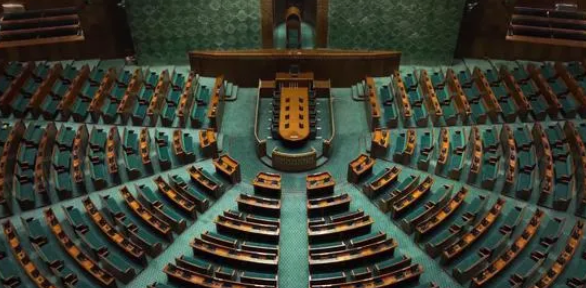
The government’s primary objective is believed to be ensuring the passage of the Delimitation Bill before heading into the elections scheduled for five states next year.
Uncertainty has emerged regarding the Winter Session of Parliament, as the Monsoon Session has yet to be formally prorogued. For the first time in the history of Parliament, the time for convening the Winter Session has arrived while the Monsoon Session remains technically ongoing.
Typically, the Winter Session begins around the third week of November; however, last year, the NDA government convened it on December 1. The fact that the Monsoon Session has not yet concluded has now raised questions about the Winter Session.
Although the Monsoon Session was adjourned sine die on August 13, it has not been officially brought to an end even after three months. Government ministers have indicated that the Monsoon Session may be reconvened specifically to pass the Delimitation Bill. Yet the absence of an official date from the government has led to continued confusion.
According to sources, the Lok Sabha Secretariat is fully prepared, regardless of whether the government decides to reconvene the Monsoon Session or proceed directly to the Winter Session.
Sources suggest that the final decision on whether to resume the Monsoon Session rests with Prime Minister Narendra Modi.
The government’s current strategy appears to be to reconvene the Monsoon Session for two days to pass the Delimitation Bill, followed by the Winter Session. Lok Sabha sources indicate that the Winter Session could potentially begin on November 30 and continue until December 18. Furthermore, sources suggest that the government might call a two-day session before November 25.
The government’s primary objective is believed to be ensuring the passage of the Delimitation Bill before heading into the elections scheduled for five states next year. Prime Minister Modi’s current strategy appears to be as follows: first, secure the passage of the Delimitation Bill, and then, after bringing new allies on board, undertake a cabinet reshuffle. It is likely that the Akali Dal will soon rejoin the National Democratic Alliance (NDA).
According to sources, an agreement regarding an alliance with the Akali Dal has been reached, and a formal announcement could be made soon. Shiromani Akali Dal leader Sukhbir Singh Badal has held several rounds of talks with Union Home Minister Amit Shah, and there are indications that a final consensus on seat-sharing has been reached.
The Akali Dal is expected to take the lead—potentially securing 60 to 65 seats—while the BJP would take 45 to 50. Following the formation of this alliance in Punjab, Harsimrat Kaur Badal, wife of Sukhbir Singh Badal, is expected to be given a position in the Union Cabinet.
Meanwhile, efforts are underway in Maharashtra to reunite the two factions of the NCP. It is anticipated that once the political situations in Punjab and Maharashtra are settled, the government may reconvene the Monsoon Session of Parliament.
In fact, given the current state of Congress politics, the BJP is confident about the passage of the Delimitation Bill. The BJP’s optimism has been bolstered by the stance of the DMK, the tacit consent of Sharad Pawar, and a shift in the position of Samajwadi Party leader Akhilesh Yadav.
Akhilesh is reportedly displeased following the submission of a list of 200 seats by Congress leader in-charge Rajendra Pal Gautam; since that incident, he has maintained a distance from the Congress.
Furthermore, Akhilesh is reportedly unhappy with Sonia Gandhi’s book and Rahul Gandhi’s political approach. Consequently, the Samajwadi Party’s stance could potentially shift when it comes time to vote. Notably, Akhilesh has no objections regarding the delimitation process.