

Politics over Urdu in Jammu & Kashmir has intensified following allegations by the opposition Peoples Democratic Party (PDP) that the language has been removed as a mandatory requirement in recruitment for posts in the Revenue Department.
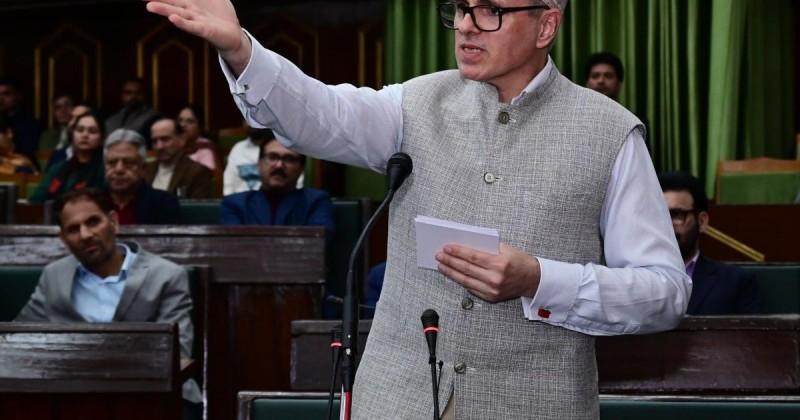
Two days after PDP leader Iltija Mufti staged a protest against the alleged removal of Urdu, Chief Minister Omar Abdullah accused the opposition party of peddling lies on the contentious issue to divert attention from cross-voting in the Rajya Sabha elections.
“No such decision has been taken on this issue. The PDP is spreading misinformation to create confusion among the masses,” the chief minister told reporters on the sidelines of a function in Pampore.
He said the government had only invited public feedback on a proposal and that no final decision had been approved.
“There is no question of dropping Urdu. People should not spread lies. It is unfortunate that some cannot distinguish between seeking feedback and making a decision,” Abdullah said.
He added that the government had asked critics to produce any official order indicating that Urdu had been removed. “They only showed the order inviting public comments. If one cannot understand the difference between seeking feedback and dropping a subject, it is unfortunate,” he said.
Referring to Iltija Mufti’s protest, Abdullah remarked, “She is educated, but perhaps still needs to understand the difference between asking for public comments and actually dropping a subject. The file regarding any such proposal is still on my table. I have neither approved it nor do I intend to.”
He further stated that while a proposal may have originated from the department, it has not been cleared. “As an elected government, it is our responsibility to seek public feedback. The order issued was only for that purpose. Those who have nothing constructive to offer are trying to pursue politics based on falsehoods,” he said.
Hitting out at the PDP, Abdullah alleged that the party was attempting to divert attention by raising the issue. He also referred to its past political positions, claiming it had supported the BJP during Rajya Sabha elections and was now resorting to “false narratives” to regain relevance.
“The attempt is to create confusion among people by focusing on emotive issues like Urdu instead of engaging constructively,” he added.
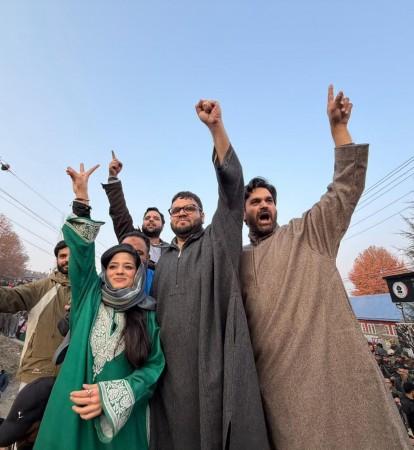
Iltija accuses government of sidelining Urdu
Earlier, Iltija Mufti accused the Omar Abdullah-led government of attempting to “gradually remove” Urdu from the administrative system, citing recent decisions on digitisation of revenue records and changes in recruitment rules.
Mufti claimed that efforts to sideline Urdu began in July 2025 when, according to her, an order was issued under the Revenue Department—headed by the Chief Minister—to digitise all revenue records in English.
“For over a hundred years, revenue records have been maintained in Urdu. Despite that, Urdu was pushed aside in the digitisation process,” she said.
The PDP leader also referred to a notification dated April 14, 2026 (SRO-74), alleging that recruitment rules for the Revenue Department were amended to remove the requirement of knowledge of Urdu.
“Now, one only needs to be a graduate. Knowledge of Urdu is no longer mandatory,” she said, questioning the move.
Mufti alleged that the decisions amounted to “order after order” weakening the position of Urdu, which she described as a shared language across communities in Jammu and Kashmir.
“I want to ask the Chief Minister why he is doing what was not done even during the Maharaja’s time and what even the BJP could not do—removing Urdu from our system,” she said, adding, “Why this allergy to Urdu?”
She said Urdu is widely spoken and forms an integral part of the region’s culture and identity, and questioned whether the public mandate in 2024 was meant to “erase our language, identity, and collective culture”.

Comments are closed.