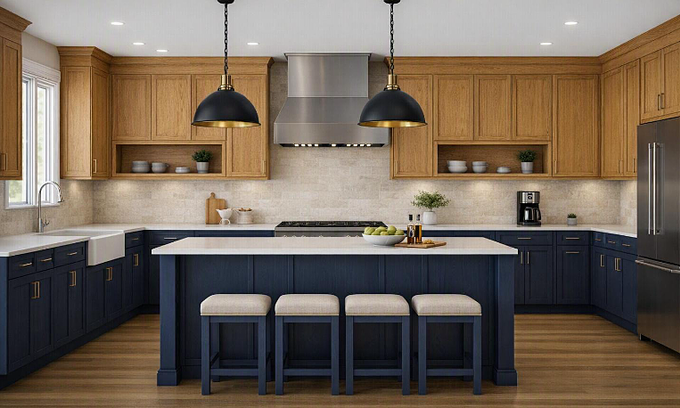
According to AkzoNobel, the Dutch paints and coatings company, the U.S. kitchen cabinet market is becoming more diverse in terms of finishes and colors. Pigmented cabinets still account for around half of the market, while clear-coated natural wood grain has grown in popularity and, for the first time in nearly a decade, overtaken white as the leading look. Industry research published for 2026 found that design professionals identified wood grain as a growing trend, with white oak the most requested wood species.
|
Natural wood grain brings warmth and contrast to kitchens where painted finishes set the tone. Photo courtesy of AkzoNobel |
The shift does not necessarily mean one finish is replacing another. Instead, painted and natural wood finishes are increasingly being used together. Two-tone kitchens, such as painted perimeter cabinets paired with a wood island or painted base cabinets with clear-coated upper cabinets, have become more common in 2026.
For manufacturers, this trend can require them to produce both pigmented and clear-coated cabinets within the same order while maintaining consistency across the finished kitchen.
Cabinet colors are also shifting from traditional white and gray to black, green and deeper saturated tones. These finishes require higher pigment loading to achieve full opacity. Metallic finishes such as gold, silver and bronze are also gaining attention.
At the same time, demand for natural and lighter wood tones presents a different technical challenge: achieving a consistent finish across boards with variations in natural color.
 |
|
Two-tone kitchens take the lead as muted tones replace stark white in the US market. Photo courtesy of AkzoNobel |
These changes are creating opportunities for kitchen cabinet and furniture manufacturers in Southeast Asia as the region expands its role in the global wood and wood products supply chain. Manufacturers in the region have established production capabilities, developed supply networks and experience serving international markets, including the US, the world’s largest kitchen cabinet market.
The changing demand could also support movement into higher-value segments. As buyers place greater emphasis on color, design, surface quality and durability, manufacturers’ ability to provide a wider range of consistent finishes while meeting technical requirements is becoming increasingly important.
The broader trade environment is also changing. Imported kitchen cabinets and vanities have been subject to a 25% US tariff since October 2025, with a planned increase deferred until January 2027. For regional manufacturers, the tariff environment may make competition based solely on price more challenging. Product quality, color consistency, surface performance, reject rates and compliance with industry standards can therefore become important factors in maintaining competitiveness.
Vietnam is a major supplier of wooden furniture to the U.S. market.According to Vietnam Customs data, exports of wood and wood products to the U.S. reached US$9.46 billion in 2025, up 4.4% from 2024 and accounting for around 55% of the sector’s total export turnover.
However, growth in export value does not necessarily indicate a shift toward higher-value products. In the first half of 2026, wood exports increased 4.4%, while exports of deeply processed products declined 2.7%, with growth concentrated in segments including wood chips, pellets and industrial panels.
As competition increasingly involves quality, design and compliance alongside production costs, manufacturers face pressure to move further up the value chain.
For large orders, maintaining consistent color and surface quality across production batches can be challenging, particularly when a kitchen combines painted and wood-grain components or when a single color needs to be reproduced across solid wood and engineered wood panels. Manufacturers must also balance these requirements with production schedules, productivity and costs.
The changing U.S. market is placing greater emphasis on color accuracy, durability and consistency. For export manufacturers, these requirements extend beyond the appearance of finished cabinets.
Products need to maintain consistent colors across different materials and production batches while providing resistance to everyday wear, including scratches, abrasion and household cleaning chemicals. Finishes may also need to meet requirements under standards established by the Kitchen Cabinet Manufacturers Association (KCMA).
Manufacturers are simultaneously balancing finish performance with production efficiency and environmental considerations. Improving processing efficiency while maintaining surface quality and responding to evolving environmental requirements can affect export readiness and competitiveness.
According to Janson Leong, Regional Commercial Director, AkzoNobel Wood Finishes and Adhesives Asia, meeting these requirements involves factors beyond the coating itself.
“For Southeast Asian manufacturers, having the right coating solution is only part of the equation; they also need the technical expertise and local support to translate market expectations into consistent results on the production line,” Leong said.
 |
|
Janson Leong, Regional Commercial Director, AkzoNobel Wood Finishes and Adhesives Asia. Photo courtesy of the company |
AkzoNobel provides coatings and color solutions alongside technical support in Vietnam, working with customers on color development, product trials, production and post-application support.
“Our goal is to build long-term partnerships that help manufacturers strengthen their capabilities and grow in the global kitchen cabinet supply chain,” Leong added.
The company’s portfolio includes coatings designed for durability, surface quality and resistance to factors such as scratches, household cleaning chemicals, and color retention. AkzoNobel said its products can also support manufacturers seeking to meet KCMA finishing requirements, including mar-resistance and chemical-resistance tests.
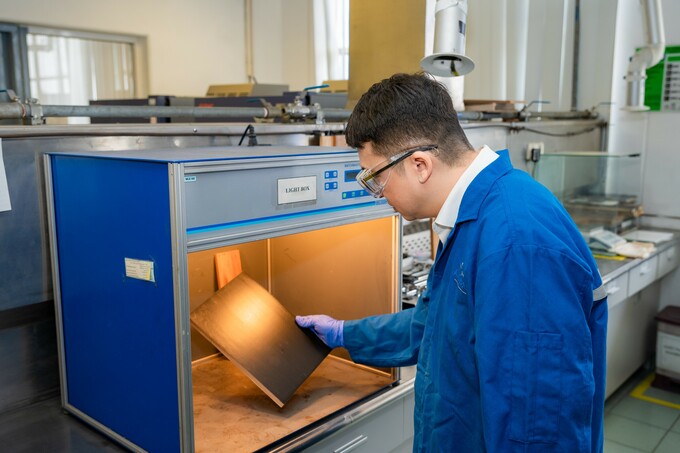
Its AC system supports different pigmented finishes ranging from matte to gloss. The company said its color-matching capabilities can be used across solid wood and engineered panels to help manufacturers achieve consistent finishes for large export orders.
 |
|
Color matching and assessment help manufacturers maintain color consistency across different materials and finishes. Photo courtesy of AkzoNobel |