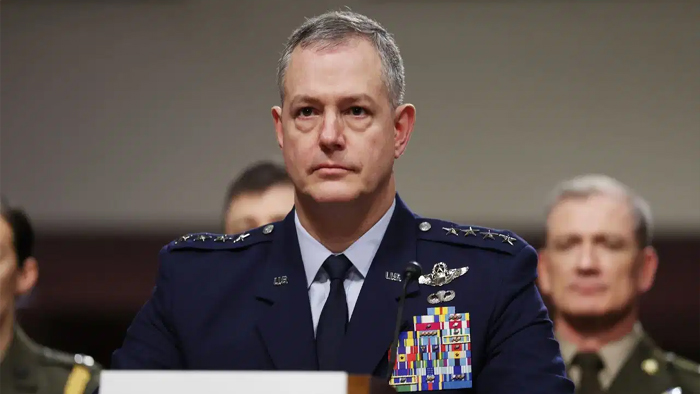
Washington: A top US military commander stationed in Europe has warned the Pentagon that the ongoing conflict with Iran is putting significant pressure on US military stocks, forcing Washington to make difficult decisions regarding missile defense resources. According to a report in The Washington Post, General Alexis Grinkevich, chief of the US European Command, told Pentagon officials this week that the US does not have sufficient naval resources to deter Iranian ballistic missile attacks on Israel. This revelation comes at a time when tensions are growing over the depletion of America’s stockpile of advanced interceptor missiles following months of military activity in the Middle East.
According to the report, General Grinkevich warned that if another US Navy destroyer is not sent to the region, European Command will ultimately have to choose between protecting US interests and maintaining missile defense operations for Israel against Iranian attacks. The Pentagon declined to comment on the report, while US European Command did not respond to a request for comment. A spokesperson for the Israeli Embassy in Washington could not immediately be reached.
Tensions over dwindling missile stocks have surfaced before. Earlier this month, The New York Times reported that one of President Donald Trump’s primary reasons for halting attacks on Iran was the risk of a significant depletion of US air defense stocks. The report stated that Chairman of the Joint Chiefs of Staff, General Dan Kaine, had advised that while escalating military operations against Iran was operationally feasible, it could significantly deplete US Central Command’s interceptor missile stock.
An internal Department of War report, cited by CNN, revealed that the Army has heavily used a variety of precision-guided missiles during the war with Iran, which could pose a “near-term risk” in the event of a major conflict. According to CNN, many of these systems could take years to replenish. According to an analysis by the Center for Strategic and International Studies, the US has used a significant portion of its advanced missile stockpile in the past seven weeks of fighting: approximately 45 percent of precision strike missiles, at least half of THAAD interceptors, approximately 50 percent of Patriot interceptors, approximately 30 percent of Tomahawk cruise missiles, more than 20 percent of Joint Air-to-Surface Standoff Missiles, and approximately 20 percent of SM-3 and SM-6 interceptor missiles.
The Washington Post also reported that the US has deployed more advanced interceptor missiles to protect Israel from Iranian ballistic missile attacks than Israel itself possesses. This report highlights the growing strategic challenge facing Washington, which must both support regional allies and maintain adequate missile stocks for possible future needs.