

The U.S. introduced the FIFA Priority Appointment Scheduling System (PASS) earlier this year, granting World Cup visitors priority access to visa interviews.
FIFA Pass will allow those who have purchased World Cup tickets through FIFA to get expedited visa appointments, as the administration continues to balance President Donald Trump’s tough-on-migration stance with an influx of global travelers for the tournament.
“If you have a ticket for the World Cup, you can have prioritized appointments to get your visa,” said FIFA President Gianni Infantino, who was in the Oval Office with Trump on Monday to explain the new system, AP reported.
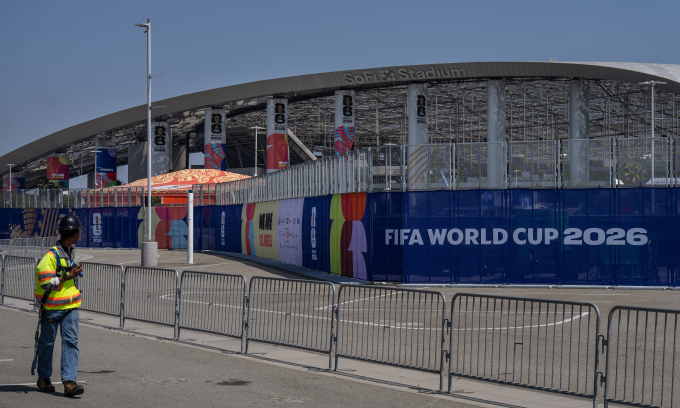
A worker walks past temporary fencing with FIFA World Cup 2026 signage outside SoFi Stadium, June 5, 2026, in Inglewood, Califoria. Photo by AP |
While the U.S. State Department traditionally prioritized international student applications, experts say this new system has pushed student and exchange visa applicants further down the queue.
Zuzana Cepla Wootson, deputy director of federal policy at the Presidents’ Alliance, described the shift as “very concerning” for higher education, as cited by The PIE News.
She warned the policy could accelerate future enrollment declines, bringing broader consequences for both universities and the economy.
Echoes of past suspensions
Wootson compared the situation to the nearly month-long student visa interview suspension announced last year. That disruption caused significant delays across key recruitment markets throughout the summer.
Between June and August 2025, overall student visa issuances—including academic (F-1), vocational (M-1), and exchange (J-1) programs—dropped 36% year-on-year, according to State Department data.
This peak-season drop was widely cited as a primary driver behind last year’s 17% decrease in international enrollment.
These shifting visa priorities are compounded by a series of existing travel restrictions, making U.S. study increasingly difficult for international applicants.
In June 2025, President Trump issued a proclamation restricting entry from 19 countries. According to Reutersthe measure imposes a full ban on 12 nations and limits several visa categories—including F-1 and J-1 visas—for nationals of seven others. Alongside these bans, the administration has introduced tighter student visa restrictions and screening measures, with Chinese students facing particularly strict scrutiny.
Pushback from education advocates
Organizations across the higher education sector are sounding the alarm. NAFSA: Association of International Educators recently warned that World Cup demands will severely strain consular resources, leaving “ample reasons to be concerned” about visa processing capacity during the upcoming student season.
NAFSA has joined the American Council on Education and 31 other higher-education organizations in a joint letter, urging the State Department to restore priority processing for international students and scholars.
Data released last month by the Global Enrollment Benchmark Survey shows international student enrollment at U.S. universities for the 2026 spring semester fell 20% year-on-year for bachelor’s programs and 24% for master’s programs, with visa restrictions and government policy changes officially emerging as the sector’s dominant concern.
Comments are closed.