A joint analysis by NAFSA: Association of International Educators and education technology firm JB International warns that visa bans and processing disruptions could severely impact local economies across the country.
The report draws on the Institute of International Education’s (IIE) Spring 2026 Snapshot, which surveyed 585 U.S. higher education institutions.
The IIE projects a 9.5% decline in overall international student enrollment for the 2026-27 academic year. This drop is driven heavily by “visa delays, policy uncertainties, and growing global competition.”
Based on this data, roughly 111,000 fewer international students are expected to enroll at U.S. colleges and universities next year. Total enrollment is projected to drop to 1.057 million, down from an estimated 1.169 million in 2025-26.
This expected decline would erase an estimated $3.4 billion in spending and eliminate more than 39,000 jobs in a single academic year.
|
NAFSA’s projections on the number of international students to the U.S. and their impacts on the economy. |
California faces the steepest potential loss at $499.6 million, followed by New York at $470.3 million. Massachusetts and Michigan risk losing $284 million each, while Texas could see a $199.1 million shortfall.
The financial toll will extend far beyond university campuses. International students inject billions into local communities through spending on housing, food, transportation, and daily living expenses.
This downturn threatens to reverse the strong post-pandemic recovery the U.S. higher education sector had recently achieved.
During the Covid-19 pandemic, enrollment plummeted to roughly 914,000, but rebounded to nearly 1.18 million by the 2024-25 academic year. During the 2023-24 academic year, international students contributed a record $43.8 billion to the U.S. economy and supported more than 378,000 jobs.
However, prospective students are now facing mounting administrative hurdles that delay or prevent them from entering the country, including travel bans and a lack of available visa appointments.
A Dec. 16, 2025 executive order imposed entry restrictions on nationals from 39 countries, offering no exemptions for student or exchange visitor visa applicants.
The U.S. State Department prioritized visa processing for FIFA World Cup 2026 ticket holders this summer. This disrupted the traditional May-through-August peak period, a time when the U.S. typically prioritizes student and scholar visas to ensure they arrive on campus by the fall semester.
Adding to the uncertainty are sweeping changes to the regulations governing how long international students can remain in the country, with the duration set at four years maximum starting Sept. 15.
This change will make academic planning more difficult, particularly for students pursuing longer degree programs or whose career plans may evolve.
The administration has also signaled plans to reform the Optional Practical Training (OPT) program, a crucial pathway for international graduates, especially in STEM fields, to gain temporary work experience in the U.S.
 |
|
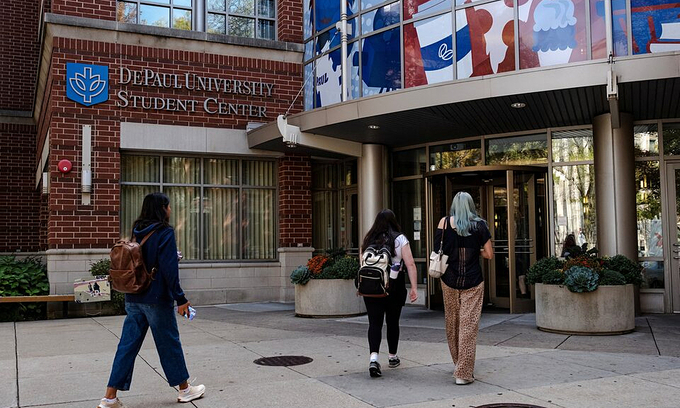
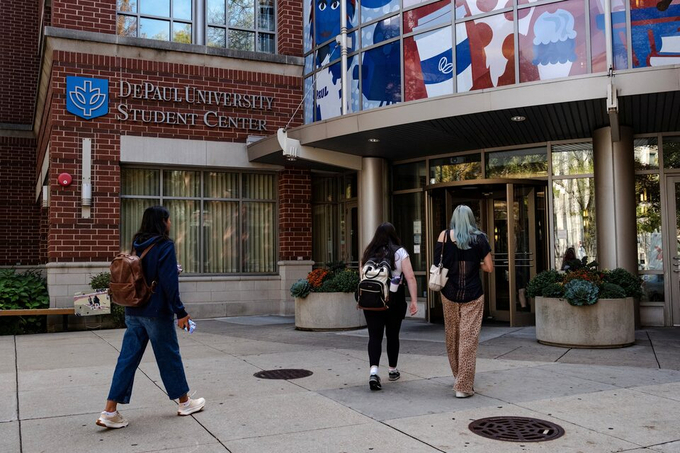
Students walk into the student center on the campus of DePaul University in Chicago, Illinois, U.S., October 2025. Photo by Reuters |
NAFSA warns that the stakes go far beyond immediate tuition losses. Pushing scholars toward competing nations could permanently weaken U.S. universities, research laboratories, and industries that rely on global talent.
“The projections underscore what we’e long warned: U.S. policy and regulations affect where international students plan to invest their future—and their decisions carry significant short- and long-term consequences for U.S. society and economy,” said Fanta Aw, Executive Director and CEO of NAFSA.
“All Americans lose when international students and scholars are driven to more welcoming countries. Forfeiting the U.S. position as the top destination for global talent hurts students, hospitals, research laboratories, the economies, and carries the real risk that the next big invention will not happen on U.S. soil,” she added, as quoted on the association’s website.
To mitigate this decline, NAFSA is urging the administration to prioritize visa interviews for students, grant student exemptions to the current travel ban, and fully preserve the OPT program.