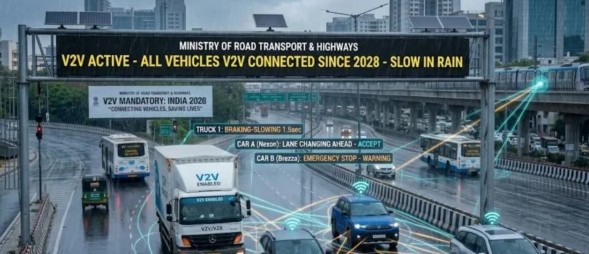
V2V Communication: The greatest danger on the road is often the one that remains unseen. Often, a vehicle ahead might brake suddenly, a car might appear around a blind curve, or an accident risk might arise during a lane change. Imagine if your car could warn you about these hazards in advance. To address this, the Indian government is preparing to make V2V (Vehicle-to-Vehicle) communication mandatory in new vehicles. Let us explore how this technology works, its benefits, potential challenges, and its impact on India’s automotive sector.
What is V2V Communication?
V2V, or Vehicle-to-Vehicle communication, is a smart technology that allows nearby vehicles to share information wirelessly. This data goes beyond just speed; critical details such as vehicle direction, location, acceleration, and movement are shared in real-time.
Its standout feature is that it does not rely solely on cameras or radar. Even if a hazard is out of your line of sight or beyond the range of standard sensors, the V2V system can issue an early alert. It acts like an invisible safety net on the road, constantly monitoring the surrounding area.
How This New Technology Will Help
Consider a scenario in which the vehicle ahead suddenly applies its emergency brakes. Under normal circumstances, the driver behind might take a few seconds to react, but a V2V system would transmit an immediate warning. Similarly, it can provide advance notice of vehicles approaching blind corners, ambulances suddenly changing lanes, or potential collisions.
The government states that this feature will not replace existing ADAS (Advanced Driver Assistance Systems) but will instead enhance their effectiveness, paving the way for future vehicles to be far more intelligent and safe.
Government Networks
It is worth noting that making V2V communication successful requires not just the vehicles themselves, but also a robust network infrastructure. With this in mind, the telecommunications sector has already designated the 5.875-5.925 GHz frequency band for V2V and other Intelligent Transportation Systems (ITS).
Privacy
As you may be aware, every new technology brings certain questions. In V2V systems, personal information such as the driver’s name, mobile number, or vehicle identification details will not be shared. Nevertheless, the company believes that if records of these signals are maintained over a long period, it could be possible to map out a driver’s travel patterns.