


In a recent interview with VnExpressDr. Malladi, Senior Vice President and General Manager of Technology Planning, Edge Solutions and Data Centers at at Qualcomm Technologies, Inc, discussed the evolution from 5G to 6G, the preparations Vietnam may need to make for the next generation of wireless technology, and the opportunities that could emerge for Vietnamese engineers.
Dr. Durga Malladi, Senior Vice President and General Manager, Technology Planning, Edge Solutions, and Data Centers, Qualcomm Technologies, Inc. Photo by VnExpress/Tung Dinh |
In March, experts from the International Telecommunication Union (ITU) released the technical performance requirements for 6G, laying the foundation for the next generation of wireless networks. How do you view this milestone?
Every generation of wireless technology begins with the industry aligning on a common vision before moving on to standards and commercial products. The recent milestone signals that 6G is transitioning from a concept to defining the capabilities required in the AI era.
The standardization process is expected to be completed in the first half of 2029.
Qualcomm has been contributing to the evolution of wireless technologies from 3G through 5G, and today continues to contribute to 6G research and industry collaboration. Our focus is to build a 6G foundation that supports the next generation of AI-powered experiences and applications, focusing on 3 core pillars. The first is connectivity, continuing to improve network capacity, coverage, and user experience.
The second is high-performance computing within the network, enabling AI processing across devices, the network, and data centers.
The third is sensing capability. The network will be able to create digital models of the surrounding environment, identifying pedestrians, vehicles, buildings, and aerial devices to support more efficient operations.
You have described 6G as an AI-native technology. How will an AI-native 6G device in 2030 differ from today’s devices?
With 5G, most AI processing still takes place in data centers. Some AI capabilities have moved onto devices, but users typically have to open individual applications and provide instructions step by step.
6G aims to deliver an AI-centric experience. Smartphones, smart glasses, and other devices will be able to understand context, proactively coordinate tasks, and communicate with one another as intelligent assistants.
To achieve this, AI must run continuously across devices, networks, and data centers. This is what we mean by an AI-native network – a network designed from the ground up to support AI. Users will notice the difference through faster, more intuitive, and increasingly proactive interactions.
 |
Dr. Durga Malladi, Senior Vice President and General Manager, Technology Planning, Edge Solutions, and Data Centers, Qualcomm Technologies, discusses the future of 6G networks. Photo by VnExpress/Tung Dinh |
Which devices do you think will demonstrate the greatest impact of 6G?
My personal choice would be smart glasses connected directly to the network, equipped with cameras, microphones, and the ability to process multiple AI tasks.
However, a single device will not define the future.
Smartphones, computers, vehicles, robots, and industrial systems can all be equipped with AI agents. The biggest difference is that these devices will be able to communicate, collaborate, and make decisions together as part of an intelligent ecosystem.
In Vietnam, we have been investing across AI, advanced connectivity, edge computing, automotive, industrial IoT, robotics, and data center technologies.
Vietnam and many other countries are still expanding 5G networks. Why should Vietnam start preparing for 6G now?
Deploying 5G and preparing for 6G are not competing priorities.
Every generation of mobile technology builds upon the previous one, and preparing for 6G does not mean replacing existing networks.
You can already develop high-performance computing and AI capabilities within the network on top of 5G infrastructure. Companies can also begin developing devices, prototypes, and demonstrations in preparation for commercial deployment, which is expected from 2029 onward.
Our partnerships with local companies such as Viettel, VNG, and FPT in next-generation technology partnerships reflects how the country has already begun contributing to shaping the future of connectivity.
What should Vietnam prioritize over the coming years to prepare for 6G?
What we have witnessed around the world is that AI leadership and next-generation connectivity do not come from a single breakthrough. It requires sustained investment in talent, research and development, and innovation ecosystems. Countries that capture the greatest value are those that has the ability to move beyond technology adoption to developing, commercializing, and scaling innovation.
We believe Vietnam should continue developing AI for both data centers and edge devices and invest appropriately in physical AI applications such as robotics, autonomous vehicles, and automated systems. As the same time, investing in talent, fostering innovation ecosystem and strengthening public-private-academy collaborations are also crucial to help Vietnam play a greater role in the development future technologies, particularly 6G.
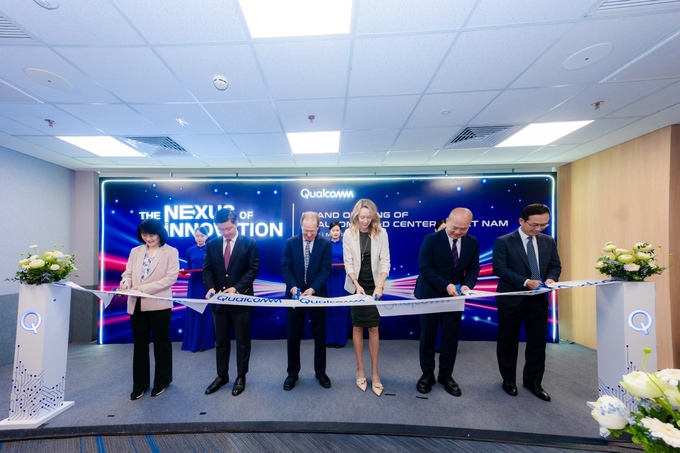 |
Qualcomm officially inaugurated the Hanoi R&D Center in May 2026, aiming to support the development of a future-ready technology workforce and strengthen local innovation capacity. Photo courtesy of the company |
How do you assess Vietnam’s technology talent today?
From a global perspective, Vietnam has become one of the markets attracting increasing attention with a compelling combination of young engineering talent, strong technical education, and a vibrant startup ecosystem.
These are significant advantages in rapidly evolving fields such as 6G, AI and next-generation communications technologies.
Through many years of collaboration with Vietnamese universities, businesses, and startups, and initiatives such as the Hanoi R&D Center, the AI Residency Program, and Qualcomm Vietnam Innovation Challenge, we have seen the country’s technical capabilities and innovation ecosystem continue to mature.
Given these strengths, Qualcomm believes Vietnam is well positioned to contribute to the development of 6G, rather than simply deploying technologies developed elsewhere. We remain committed to supporting Vietnam’s long-term technology ambitions through continued investment, collaboration, and innovation.
What should young Vietnamese engineers do to prepare for careers in 6G development?
6G will require much more than telecommunications expertise. It will also need professionals specializing in AI, computing, semiconductors, software, and signal processing.
Young engineers should build a strong technical foundation while maintaining curiosity and a willingness to keep learning. Knowledge of AI combined with an understanding of wireless technologies is certainly an advantage, but even more important are adaptability and problem-solving skills.
They should also seek opportunities to work on real-world challenges through research projects or industry collaborations. Hands-on experience, independent thinking, and the ability to propose new ideas are qualities we highly value.
How does the 6G collaboration between Qualcomm and Viettel build on the foundation established through 5G?
Our 6G collaboration builds on many years of cooperation in 5G, radio technologies, baseband processing, and Open RAN. It represents the next step in advancing Vietnam’s wireless infrastructure.
Together, we have contributed to the deployment of Viettel’s commercial 5G Open RAN network powered by Qualcomm technologies. The network now comprises thousands of base stations and is expected to reach approximately 6,000 by the end of this year, demonstrating that Open RAN can meet requirements for performance, reliability, and large-scale deployment.
As networks expand capacity and incorporate more AI capabilities, performance per watt becomes increasingly important. We are leveraging the experience gained from our 5G collaboration to develop proof-of-concept results for 6G.
What can Vietnam expect from Qualcomm going forward, in R&D, talent, or partnerships?
Vietnam is an important market in Qualcomm’s long-term strategy, and we see significant opportunities to deepen our collaboration as the country advances its ambitions in AI, semiconductors, and next-generation connectivity.
We will continue investing in areas where we can create sustainable impacts. Our recently inaugurated R&D Center in Hanoi is one of Qualcomm’s global research centers, where technologies developed in Vietnam can be applied across multiple international markets.Meanwhile, our Qualcomm Vietnam Innovation Challenge supports startups developing AI and other technology applications as we leverage our global expertise to support local partners in building solutions for both domestic and global markets.
We intend to continue expanding our presence in Vietnam by recruiting and training more engineers while strengthening collaboration with businesses, universities, and ecosystem partners.
Our goal is to become Vietnam’s long-term innovation partner, working alongside the country to build a more resilient, innovative, and future-ready technology ecosystem.

Comments are closed.