Imports outpaced exports, resulting in a trade deficit of $20.52 billion, largely driven by stronger demand for imported raw materials, machinery and production inputs.
Merchandise exports totaled $319.53 billion between January and July, a 21.7% year-on-year increase, according to the National Statistics Office.
The domestic economic sector contributed $63.64 billion, up 5.8% and accounting for 19.9% of total exports, while the foreign-invested sector, including crude oil, generated the remaining $255.89 billion, up 26.4%.
Some 31 export items recorded turnover exceeding $1 billion each, accounting for 93% of the total export value. Of these, seven products each generated more than $10 billion, making up 69.7% of total exports.
Manufactured goods remained dominant, reaching $287.91 billion and accounting for 90.1% of exports. Agricultural and forestry products earned $22.79 billion (7.1%), seafood exports totaled $6.86 billion (2.2%), while fuel and mineral exports reached $1.97 billion (0.6%).
|
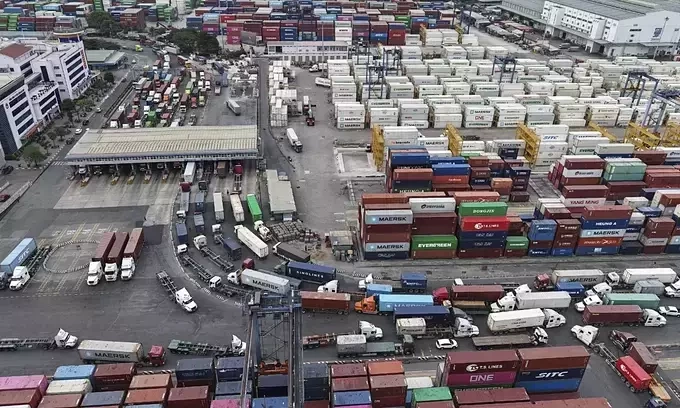
Containers seen at Cat Lai Terminal in HCMC, Feb. 4, 2026. Photo by VnExpress/Thanh Tung |
Meanwhile, merchandise imports rose 34.8% year-on-year to $340.05 billion. Imports by the domestic sector reached $92.14 billion, up 24.1%, while the foreign-invested sector imported goods worth $247.91 billion, an increase of 39.2%.
A total of 40 imported products exceeded $1 billion in value each, accounting for 93% of the total imports. Two products each recorded import turnover above $10 billion, representing 52% of the total.
Production inputs accounted for 94.1% of imports, equivalent to $319.95 billion. Machinery, equipment, tools and spare parts made up 56.9% of imports while raw materials and fuels accounted for 37.2%. Consumer goods imports totaled $20.1 billion, or 5.9% of the total.
The U.S. remained Vietnam’s largest export market, with exports valued at $104.7 billion in the seven-month period, while China continued to be the country’s largest source of imports, supplying goods worth $138.6 billion.
Vietnam recorded a trade surplus of $91.4 billion with the US, up 22.6% year-on-year, while its trade deficit with China widened 39.7% to $93 billion.
To further boost exports, Nguyen Thi Huong, the office’s director, recommended the government to continue implementing measures to promote exports, step up trade promotion activities, diversify supply chains, production networks and export markets while improving product quality and integrating more deeply into regional and global supply chains.
She also called for better utilization of existing free trade agreements, stronger exports to key markets, and greater efforts to tap into emerging markets, including Halal, Latin American and African markets, with the aim of achieving a sustainable trade surplus.
In addition, she proposed providing businesses with timely market information, helping them comply with new export standards, supporting them in anti-dumping cases, facilitating access to finance, and encouraging the adoption of advanced technologies to improve product quality, enhance added value and expand export markets.