|
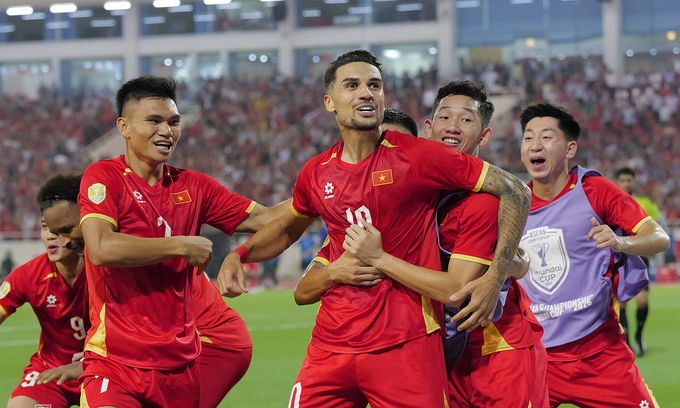
Brazilian-born midfielder Do Hoang Hen (number 10) celebrates the equalizer in Vietnam’s 2-2 draw against Thailand in the second leg of the ASEAN Cup final, at My Dinh Stadium, Hanoi, on Aug. 26, 2026. Photo by Read/Ngoc Thanh |
The national team are currently formed by three distinct talent pools, including domestically trained players, overseas-born Vietnamese players, and foreign players who have met the standard five-year residency requirement.
During the recent 2026 ASEAN Cup, Vietnam fielded three Brazilian-born players: Nguyen Xuan Son, Do Hoang Hen, and Nguyen Tai Loc, marking a significant shift in the federation’s previously restrictive policy on naturalized players.
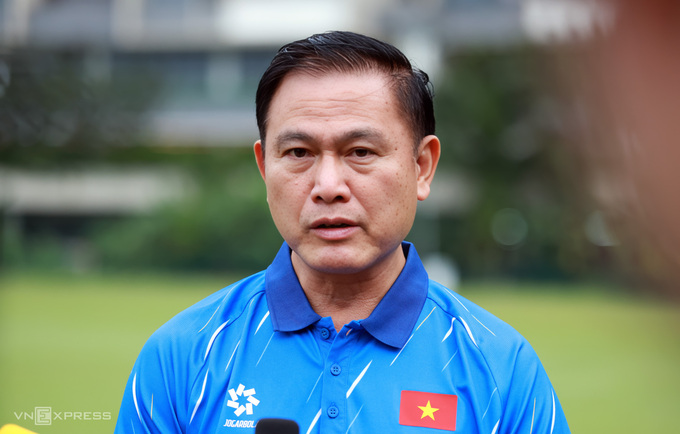
Speaking to the media at the federation’s headquarters on Sept. 10, Tu explained that Vietnam is now taking advantage of this talent resource just as many other teams do.
“The VFF has not set a limit, nor have we ever set a specific number of naturalized players to be called up,” Tu said. “There are many naturalized players available, but the decision of whom to call up rests with the head coach. He will consider choosing individuals who suit the team’s playing style and the Vietnamese identity.”
Once the head coach finalizes his selections, the federation thoroughly reviews the roster to ensure domestically trained players continue to receive playing chances, Tu said.
He added that during the recently concluded ASEAN Cup, Kim usually fielded only one or two naturalized players at a time, relying on domestic talent to create decisive moments, like during the group stage victory over Indonesia and the two-legged final win against Thailand. The naturalized players also contributed in the semifinals, where Xuan Son scored a hat-trick to sink Malaysia.
Vietnam currently have two other notable naturalized prospects competing in the domestic leagues: center-back Do Phi Long of Brazilian origin and Nigerian-born striker Olaha Manh Duc, though Olaha will remain ineligible under FIFA’s residency rules until 2027.
The national squad also feature a group of overseas-born players with Vietnamese blood, including Vietnamese-Slovak goalkeeper Patrik Le Giang alongside Vietnamese-Russian keeper Dang Van Lam. Ahead of the 2026 FIFA ASEAN Cup, the coaching staff will have additional options, including Vietnamese-Czech goalkeeper Filip Nguyen, Vietnamese-French defenders Cao Pendant Quang Vinh and Adou Minh, Vietnamese-Australian forward Nguyen Dang Khoa, and Vietnamese-British attacker Williams Minh Hoang.
 |
|
Tran Anh Tu, vice president of the Vietnam Football Federation and head of the Vietnam national team at the 2026 ASEAN Cup, speaks to the press at the training ground in Kuala Lumpur, Malaysia on Aug. 14, 2026. Photo by Read/Duc Dong |
Vietnam have been drawn into Group B of Division 1 for the upcoming tournament, the FIFA ASEAN Cup, with matches scheduled against the Philippines on Sept. 26, Thailand on Sept. 29 and Pakistan on Oct. 2. The team aim to dominate the group stage and advance to the final to face the winner of Group A, which is expected to be host Indonesia.
Coach Kim will not have his full squad available until Sept. 21, as key players from Cong An Ha Noi and The Cong Viettel are currently competing in the AFC Champions League Elite and AFC Champions League Two.
The national team also face personnel setbacks. Left-back Nguyen Van Vi has been sidelined for a month due to injury. Key midfielder Nguyen Hoang Duc recently suffered a muscle tear, although he is expected to recover just in time for the tournament.
After the FIFA ASEAN Cup, Vietnam are scheduled to gather in November for international friendlies against Taiwan and Kyrgyzstan. The squad will assemble again on Dec. 21 before traveling to Qatar on Jan. 1 for a training camp ahead of the 2027 Asian Cup in Saudi Arabia.