
Duong Thi Hong Nhung, 25, won the prestigious Chinese Government Scholarship (CSC) with an HSK 8 certificate, just seven points short of the highest level’s 390.
The lecturer at the Department of Chinese Language at Phenikaa University in Hanoi learned about the scholarship in May. She will study at Beijing Normal University (BNU), which describes itself as a “key university” directly under China’s Ministry of Education and being “among the country’s leading institutions for teacher education.”
Under the CSC scholarship, Nhung’s tuition, accommodation and health insurance will be fully covered, and she will receive a monthly living allowance of 3,500 yuan (US$487).
Nhung said she was not surprised by the result, as she had anticipated it following her interview with the admissions panel.
“They kept asking in depth about my research topic, which I considered a positive sign,” she said.
|
Duong Thi Hong Nhung in a photo she provided. |
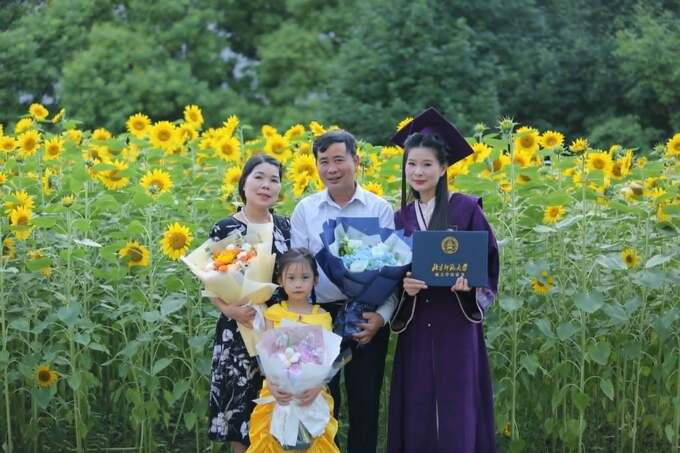
Nhung earned a master’s degree in International Chinese Language Education at BNU on a CSC scholarship two years ago. To pursue a PhD, she applied to become a lecturer at Phenikaa University’s Department of Chinese Language, where she could gain teaching experience, supervise students’ research, write academic papers and spend time building her application profile.
Pham Thuy Hong, deputy head of the Department of Chinese Language at Phenikaa, said Nhung is a highly regarded young lecturer with expertise, research capabilities and a strong sense of responsibility.
“She uses modern teaching methods, inspires students and is very enthusiastic about all the department’s work,” Hong said.
All of Nhung’s choices at the time were aimed at pursuing higher education. Preparing her application was also the busiest period of her life as a lecturer. At times, she slept only three to four hours a day.
“The pressure was so intense that sometimes I busted into tears while working,” Nhung said.
She said research ability is what admissions panels care about most when evaluating PhD applications. She therefore invested heavily in her research proposal.
Nhung initially planned to study the Chinese phonetics of Vietnamese speakers. After months of reading materials and discussing the topic with lecturers, she shifted her focus to the cognitive processes involved in vocabulary acquisition among Chinese language learners. She believes the topic offers long-term research potential and still contains many gaps.
“The research direction I choose for my PhD will affect my entire academic career, so I want to make the choice carefully,” Nhung said.
She subsequently prepared a detailed research plan outlining the procedures and specific methodologies, along with a reference list of 40 to 60 sources.
Nhung also traveled to China to take the HSK, an international Chinese-language proficiency test with nine levels. Despite studying for only about 10 days, she scored 383 on HSK 8, just seven points short of the highest level.
She believes differences in Chinese proficiency among learners mainly stem from vocabulary. To reach HSK levels 7, 8 or 9, learners need to acquire around 12,000 words while also practicing with test papers to become familiar with the exam structure and time allocation.
For the essay section, she practiced writing from a native speaker’s perspective and used AI tools to evaluate and revise her writing.
For students hoping to win scholarships, she recommends preparing early rather than waiting until their final year of university. In addition to GPA and language certificates, applicants should invest in a research proposal if they plan to pursue a master’s or doctoral degree.
Thai Linh, also a Chinese language lecturer at Phenikaa, said she was not surprised that her colleague had won the PhD scholarship.
“What I admire most about Nhung is her discipline and commitment to self-study. Outside teaching hours, she almost exclusively reads materials, writes and conducts research,” Linh said.
In early September, Nhung will move to Beijing to begin her studies. She plans to take two years of unpaid leave to focus on her studies and research.
She hopes to pursue postdoctoral research with the goal of becoming an associate professor.
“There are currently no professors and only a very small number of associate professors in my field in Vietnam. As I am still young, I want to devote as much time as possible to research so that I can later contribute to teaching and research in the Chinese language,” Nhung said.
 |
|
Duong Thi Hong Nhung (R) in a photo with her family as she graduates with a master’s degree at Beijing Normal University. Photo courtesy of Nhung |