Through “High-Energy Physics Research through Selected International Experiments in Japan,” the Vietnamese scientists have joined two of the world’s most advanced particle physics experiments: Belle II and T2K.
Run from 2024 to 2026, it is part of an international research collaboration led by Dr. Nguyen Anh Ky of the Vietnam Academy of Science and Technology’s Institute of Physics.
Belle II and T2K are high-energy physics experiments based in Japan.
Belle II uses the SuperKEKB particle accelerator to study collisions between electrons and their antimatter counterparts, positrons.
T2K uses the J-PARC accelerator and Super-Kamiokande detector to investigate neutrinos—fundamental particles with extremely small masses that can pass through ordinary matter almost without interacting.
According to Ky, both experiments are helping scientists move closer to understanding the fundamental nature of matter as well as the origin and evolution of the universe.
To conduct the studies, researchers accelerate elementary particles to extremely high speeds before colliding them and observing how they interact and decay.
These observations are then compared with theoretical predictions. “Our team has the opportunity to work on some of the most important questions in modern fundamental physics while strengthening Vietnam’s scientific and technological capabilities,” Dr. Ky said.
He said Vietnamese researchers previously participated in international experiments primarily by learning from collaborators or assisting with data analysis, but now they have taken on a number of core technical responsibilities.
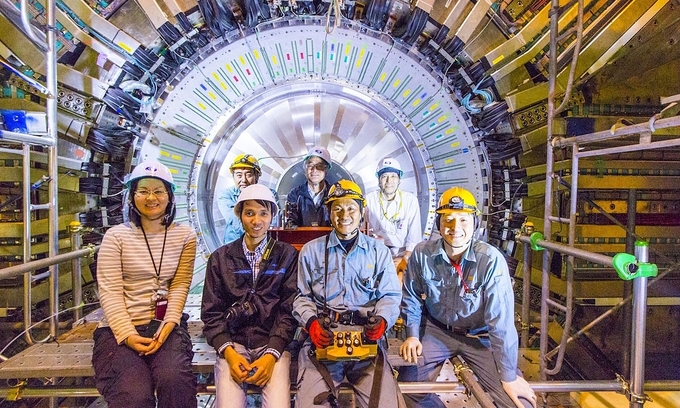
For Belle II, the Vietnamese team, established and led by Ky and with Dr. Dong Van Thanh of the Hanoi University of Science and Technology serving as a key member, has contributed to the construction, installation, testing, and calibration of the central drift chamber (CDC).
|
Dr. Dong Van Thanh (second from left) after connecting the central floating chamber at Belle-II. Photo courtesy of Dr. Dong Van Thanh |
As one of Belle II’s core detector components, the CDC precisely measures the trajectories and momenta of charged particles produced during collisions.
It has electrons and positrons accelerated and then brought into head-on collisions.
Antimatter particles possess the same mass as ordinary matter but carry opposite electric charges.
When matter and antimatter meet, they annihilate each other, releasing energy.
Belle II seeks to answer one of the greatest puzzles in modern physics: why matter was not completely annihilated by antimatter after the Big Bang and enough material was left to form galaxies, stars, planets, and, ultimately, life.
The Vietnamese team plays an important role in operating and calibrating several detector systems, helping ensure the precision and quality of the experiment’s data.
The SuperKEKB accelerator used by Belle II has repeatedly set world records for instantaneous luminosity, a measure of how frequently particle collisions occur, making Belle II one of the most advanced particle physics experiments in the world.
In the T2K experiment, Vietnamese researchers, led by Associate Professor Nguyen Thi Hong Van of the Institute of Physics and Dr. Cao Van Son of the International Center for Interdisciplinary Science and Education support the operation of the neutrino beam accelerator, manage the near-detector systems that monitor the neutrino beam, and contribute to simulations and data analysis.
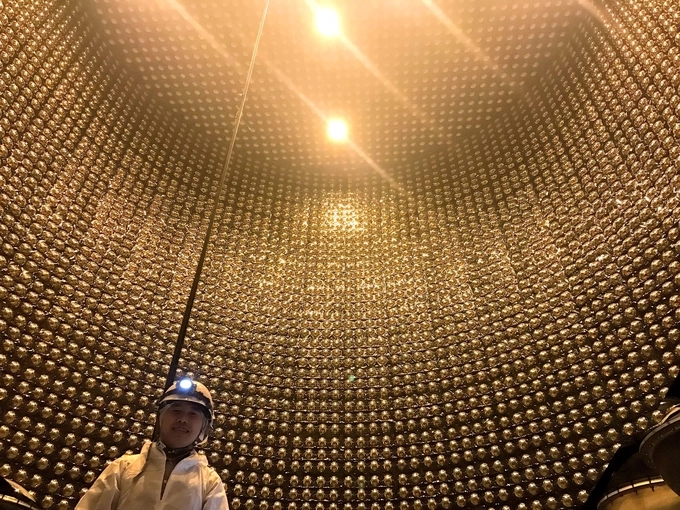
T2K generates a beam of neutrinos by directing high-energy protons onto a target. The resulting neutrinos then travel 295 kilometers to the Super-Kamiokande detector, located approximately 1,000 meters underground, where scientists observe their interactions.
The experiment’s large scale is designed to study neutrino oscillation—the phenomenon in which one type of neutrino transforms into another as it travels over long distances. The existence of neutrino oscillation demonstrates that neutrinos possess mass, contradicting the original assumption of the Standard Model that neutrinos are massless or have masses so small that they can effectively be ignored.
 |
|
Dr. Cao Van Son at the Super-Kamionkande neutrino detector located 1,000 meters underground. Photo courtesy of Dr. Cao Van Son |
The Vietnamese team works on the upstream end of the experiment, monitoring the direction and interactions of neutrinos immediately after they are produced. These measurements allow researchers at the detector 295 km away to determine how many neutrinos should arrive and how they have changed during their journey.
“Our responsibilities directly affect the operation and scientific outcomes of the entire experiment. Few research groups from other countries are entrusted with such a position,” Dr. Ky said.
According to the research team, high-energy physics, which explores the deepest structures of matter, has important implications for many other scientific fields, including nuclear physics, astrophysics, cosmology, electronics, and materials science.
Participation in cutting-edge international experiments also enables Vietnamese scientists to acquire interdisciplinary knowledge and technical expertise that can later be applied in Vietnam.
Ky added that international collaborations make it possible to share resources and slash research costs.
High-energy physics requires sustained, long-term investment to develop highly skilled researchers and maintain participation in experiments that often span several decades, he said, calling for funding mechanisms lasting at least five years per cycle to support long-term scientific planning and the development of Vietnam’s fundamental research workforce.
Professor Nguyen Quang Liem, chairman of the evaluation council at the Vietnam Academy of Science and Technology, praised the project for exceeding its original targets in both the quantity and quality of publications in leading international journals.
He added that particle physics experiments deserve continued long-term investment to strengthen Vietnam’s future scientific and technological development.