When Nguyen Van Bau arrived in Germany at 19 to begin vocational training at a hotel in Bavaria, he expected to learn the hospitality business.
Instead, he found himself delivering bread for his boss and doing manual work such as clearing broken tiles from holiday apartments during the pandemic.
“I felt like cheap labor,” Bau says.
Thu Trang, 23, had a similarly difficult start at a hospital in Leipzig.
She says some colleagues gave her tasks outside her job description, refused to guide her and at times blocked her opportunities to learn.
“Seeing that I was a foreigner, many colleagues dumped tasks outside the job description on me,” she says. “When no one was around, they glared at me, bullied me, and blocked my learning opportunities.”
Bau and Trang are among more than 16,000 Vietnamese pursuing vocational training in Germany, according to the country’s 2024 Migration Report.
For many, the biggest challenges go beyond tuition or living costs. Limited German, unfamiliarity with labor rights and difficulty adapting to a less hierarchical workplace culture can leave trainees vulnerable to exploitation or exclusion.
|
Nguyen Van Bau, 26, works at an X-ray imaging center in Bavaria, Germany. Photo courtesy of Bau |
Bau’s family spent €7,500 (US$8,400) on agency fees in 2019 and another €11,300 on language courses, housing and financial requirements.
“My parents said it was an advance on my inheritance,” he says. “With such a huge sum invested, failure meant there was no way back.”
Although vocational trainees are supposed to receive professional instruction, Bau says he was instead assigned manual work for less than €5 an hour, around half the minimum wage at the time, while being routinely scolded and belittled.
After others warned him that he was being exploited, he began studying German labor law. With support from a hospitality workers’ union, he sued his former employer over excessive overtime during peak periods and won.
In 2022, he moved to another hotel where he received structured training. A year later, he graduated with top marks, was promoted to shift supervisor and was earning three times his previous salary. “The biggest change wasn’t the salary, but my standing at work,” he says. “I am no longer a passive placeholder.”
Trang took a different route. Before choosing an agency, she first selected her school and later joined a state-supported program costing about €4,000.
She began nursing training at Leipzig University Hospital in June 2024 and was the only Vietnamese student in her class.
The program proved demanding. Half of the original 30 students dropped out after the first semester.
Trang says fast speech, technical vocabulary and subjects such as medical ethics forced her to work much harder than local classmates.
She began carrying a notebook everywhere, writing down unfamiliar medical terms and the names of equipment she encountered.
Before lessons, she searched for materials in Vietnamese and then translated them into German to prepare herself. “You can’t just blindly stumble through the medical field,” she says.
As her language skills improved, so did her confidence.
She began refusing tasks she considered unreasonable and says she learned that speaking up often led to greater respect from colleagues. “I learned that daring to speak up earns you respect in this environment,” she says.
Taking control
In 2024, Bau and two colleagues founded a company that recruits young Vietnamese for vocational training in Germany without charging them agency fees.
Instead, the company receives €5,000 from German employers for each successful recruit.
Applicants are expected to hold at least a B1 German certificate, or A2 combined with strong communication and problem-solving skills.
Bau says the company places more emphasis on practical ability and how candidates respond to real situations than on qualifications alone.
Language remains one of the biggest weaknesses among Vietnamese trainees.
Christopher Gnadt, a lecturer at the University of Vechta with more than a decade of experience recruiting and managing nursing-home staff, says two issues often put Vietnamese workers at a disadvantage: weak German and a tendency to remain too deferential.
“German employers do not expect an employee who simply knows how to obey,” he says. “Timidity and reluctance to ask questions are often perceived as lack of competence.”
Nguyen Thi Loan, a nurse in her 30s in North Rhine-Westphalia, says her own experience shows how much language can change a migrant worker’s position.
Born into a low-income family in Hanoi’s Soc Son District, she won a place in an affordable vocational training program in Germany because of her strong academic record.
Today, she works as a practical instructor at four elderly-care facilities and operates a support hotline for Vietnamese trainees.
She also helps her husband recruit Vietnamese workers for German employers and runs an SOS service for trainees facing problems with study, work or integration.
Loan says she was once treated differently because her German was weak.
Doubts from supervisors about her language ability made her withdraw and question herself.
Things began to change after she met the man who would become her husband and started using German regularly with his family.
Gradually, the language became part of her everyday life rather than just something she studied.
Eight years after arriving in Germany, Loan says she no longer sees herself as someone who came simply to perform manual work. “I have a voice and the right to determine my own future,” she says. “That is true integration.”
 |
|
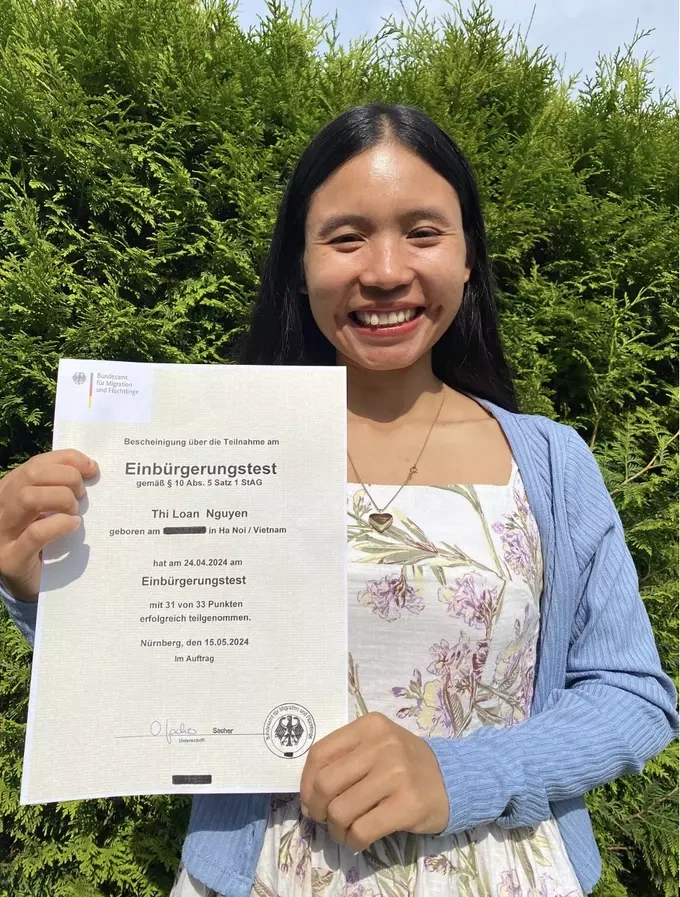
Nguyen Thi Loan receives her German citizenship test certificate in May 2024. Photo courtesy of Loan |
Loan says she was once treated differently because her German was weak. Doubts from supervisors about her language ability made her withdraw and question herself. Things began to change after she met the man who would become her husband and started using German regularly with his family.
Gradually, the language became part of her everyday life rather than just something she studied.
Eight years after arriving in Germany, Loan says she no longer sees herself as someone who came simply to perform manual work. “I have a voice and the right to determine my own future,” she says. “That is true integration.”
Trang hopes to follow a similar path. After completing her training, she is considering specializing in surgical assistance or anesthesiology, or eventually becoming a clinical instructor. “Once I have a goal,” she says, “even if I have to crawl, I must reach the finish line.”