
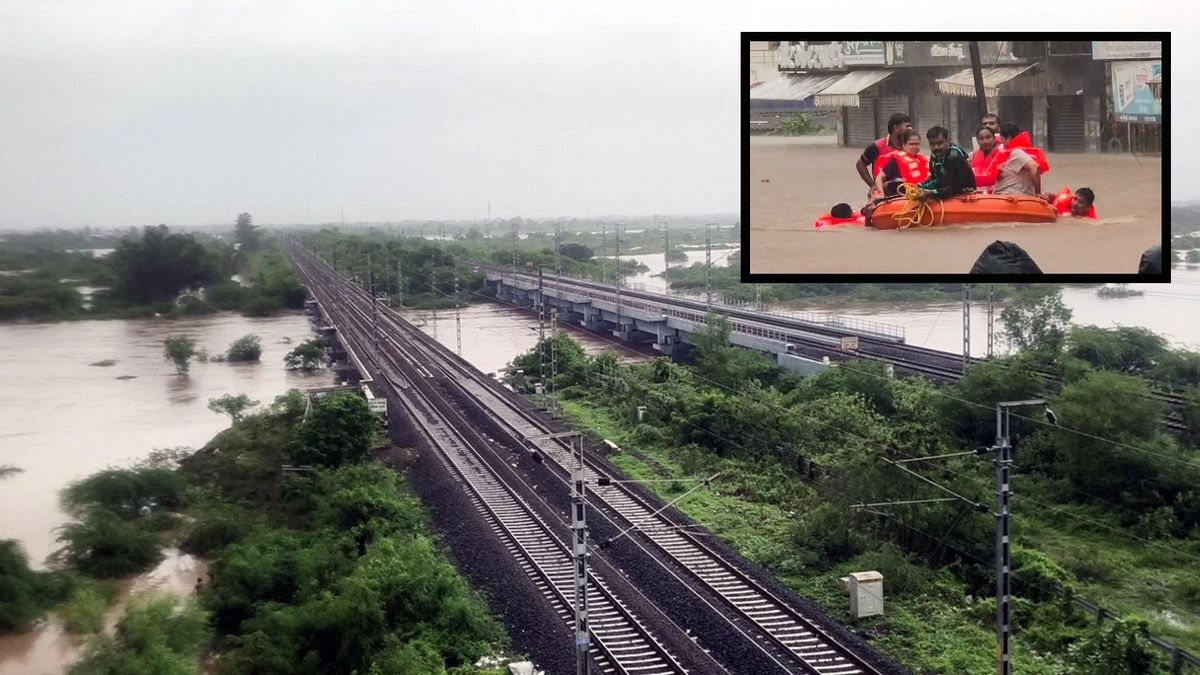

What is PDO: These days monsoon has shown its extremely severe and frightening form in Gujarat. In many parts of the state, it is not normal rain, but a disaster causing huge destruction. Within just 14 hours, more than 400 mm of water has rained in many areas of the state. 451 mm rainfall has been recorded in Chikhali of Navsari, 440 mm in Dholka of Ahmedabad, 431 mm in Khergam, 405 mm in Umarpada of Surat and 365 mm of rain has been recorded in Umargaon of Valsad. Only from these figures it can be estimated how dangerous the pace of rain has been.
Due to this torrential rain, the rivers are in spate and are submerging the surrounding areas. Main roads have been completely submerged, due to which traffic has come to a standstill. The flourishing fields of the farmers have been ruined by drowning in water. Normal life has become completely disrupted and people are forced to stay in their homes. This rain is proving to be more intense, dangerous and destructive than the normal monsoon season. Amidst this sudden devastation, a new debate has started among meteorologists, researchers and social media.
Drought prediction and ground reality
In fact, till a few months ago, there was so much fear of El Nino that people across the country were completely scared of the possibility of drought. From the country’s weather forecasters to big American scientific institutions, they had made definite predictions of drought in India by running computer models. However, the ground reality has turned out to be completely opposite to these predictions. Monsoon not only gave normal rains but also caused havoc in many states including Gujarat due to excessive rains. Now the biggest question that arises is why scientists around the world underestimated the Pacific Decadal Oscillation (PDO) so much.
What is Pacific Decadal Oscillation (PDO)?
The Pacific Decadal Oscillation, or PDO, is actually a large pattern of long-term changes in sea surface temperatures in the Pacific Ocean. This is a decadal cycle which lasts for a long period of about 20 to 30 years. This is a similar ocean change like El Nino and La Nina, but its time cycle is much longer than them. The effect of El-Nino and La-Nina lasts for a few months to two years, while PDO maintains its impact on the climate of the entire world for decades.
There are two main forms of PDO, called positive and negative. On the positive side, the waters off the coast of the north-eastern Pacific Ocean become quite warm and the central North Pacific remains cooler. On the negative side, exactly the opposite pattern is seen, where the north-eastern coast remains cold and the central part is relatively hotter. Presently PDO is running in a very strong negative form, whose value has been recorded quite high.
/filters:format(webp)/newsnation/media/media_files/2026/07/24/gujarat-flood-2026-07-24-18-45-47.jpg)
Direct impact of PDO on India’s monsoon
This change not only changes the temperature of the ocean, but also deeply affects air pressure, wind direction and the entire global weather cycle. It is also considered to have a very deep and direct connection with the monsoon of India. Scientific studies clearly prove that negative PDO always makes the Indian monsoon much stronger. In this, the flow of moisture filled sea winds over India becomes much better.
It greatly strengthens the monsoon by drawing a lot of moisture from the western Pacific and Indian Ocean. The direct result of this is that the country receives much more rainfall than normal and in some areas extremely heavy rainfall. On the contrary, positive PDO often leads to weak monsoon and drought in India. If we look at the records of the last few decades, India has always recorded more rainfall during negative PDO.
The real scientific reason for the devastation in Gujarat
The heavy rains in Gujarat are not an isolated incident but part of a larger weather cycle. The negative PDO helped the monsoon shift southwards, bringing continuous moisture from the Arabian Sea. Areas like Chikhali and Umargaon of Gujarat are geographically such where hilly terrain and proximity to the sea further increases heavy rainfall. It is not normal for more than 400 mm of rain to fall in 24 hours. This is an extreme weather event which is becoming more common in this era of climate change.
It is not right to depend only on El Nino in weather forecasting. It is very important to give equal importance to other factors like PDO, changes in the Indian Ocean and patterns of the Atlantic Ocean. Farmers, administration and common people should also be aware of these big patterns. If PDO remains negative, there will be a possibility of heavy rains and floods in the coming years also.
Also read: Flood havoc in Gujarat! House, Panchayat, petrol pump submerged in water, 67 people rescued

Comments are closed.