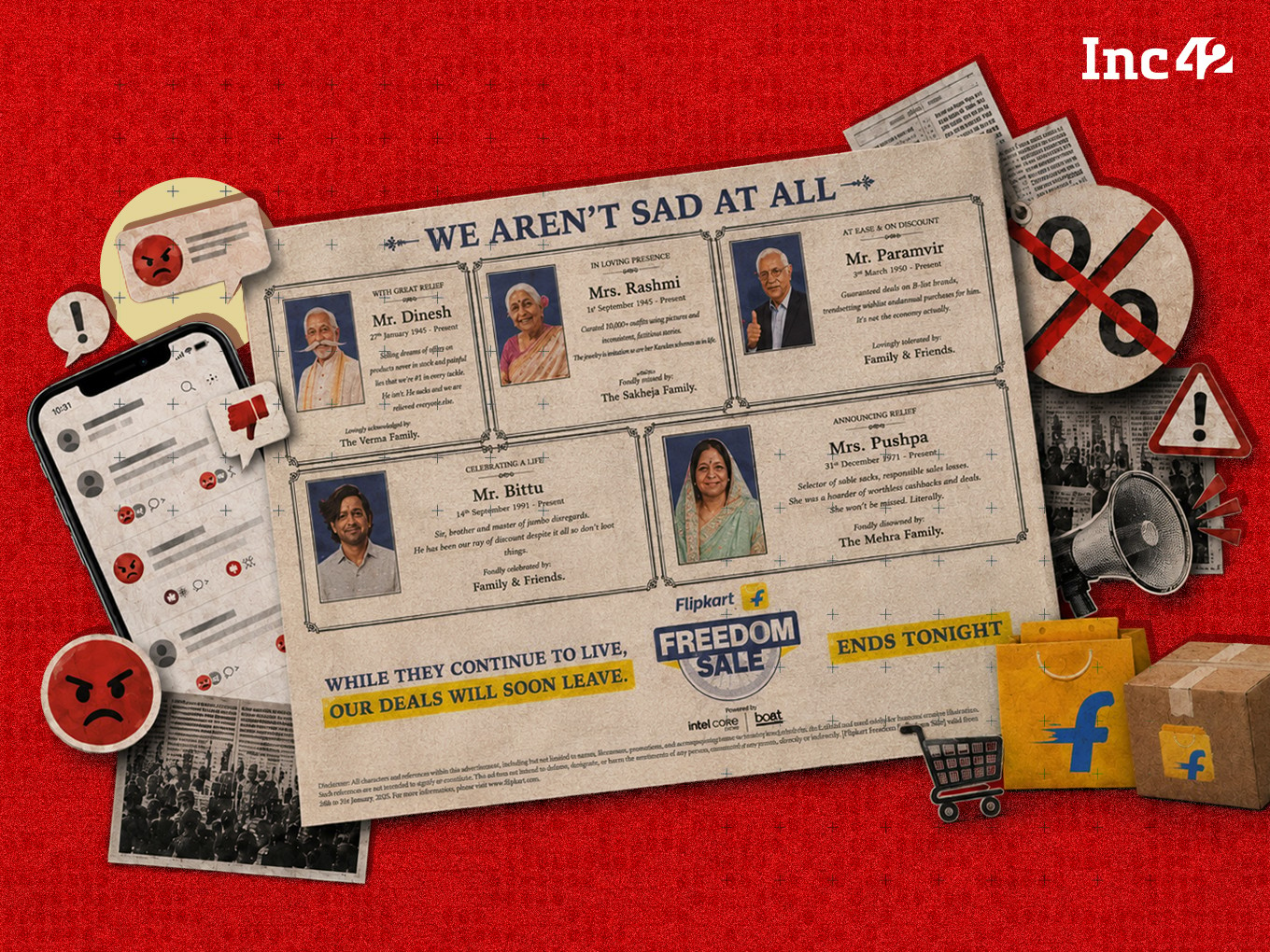
Flipkart’s obituary-style advertisement for its Freedom Sale has drawn criticism online, dividing brand experts over whether it was clever subversion or an insensitive use of imagery associated with death
The controversy highlights the trade-off brands face when provocative campaigns generate immediate attention but risk hurting trust and long-term brand perception
While experts agreed that the advertisement grabbed attention, they differed on whether its obituary-style approach strengthened Flipkart’s campaign or overshadowed the sale itself
Flipkart wanted to draw attention to the final day of its Freedom Sale. Instead, its obituary-style print advertisement has triggered a debate over dark humour and how far brands should go to grab eyeballs.
The advertisement borrowed the visual language of obituary notices, placing photographs and personal details of individuals inside memorial-style boxes. However, it was Flipkart’s deals, and not the people featured, that were supposedly nearing their end.
“We aren’t sad at all,” the advertisement said, adding that while the people featured would continue to live, Flipkart’s deals would soon disappear.
The advertisement was released as Flipkart’s Freedom Sale, which began on August 8 after early access opened a day earlier, approached its conclusion on August 16. The sale offered discounts across smartphones, laptops, televisions, appliances, fashion, and household products.
The creative quickly drew criticism online, with several users calling it insensitive and inappropriate.
Author and columnist Shobhaa De described the campaign as “self-serving, disgusting and insensitive” and called for consumers to boycott Flipkart.
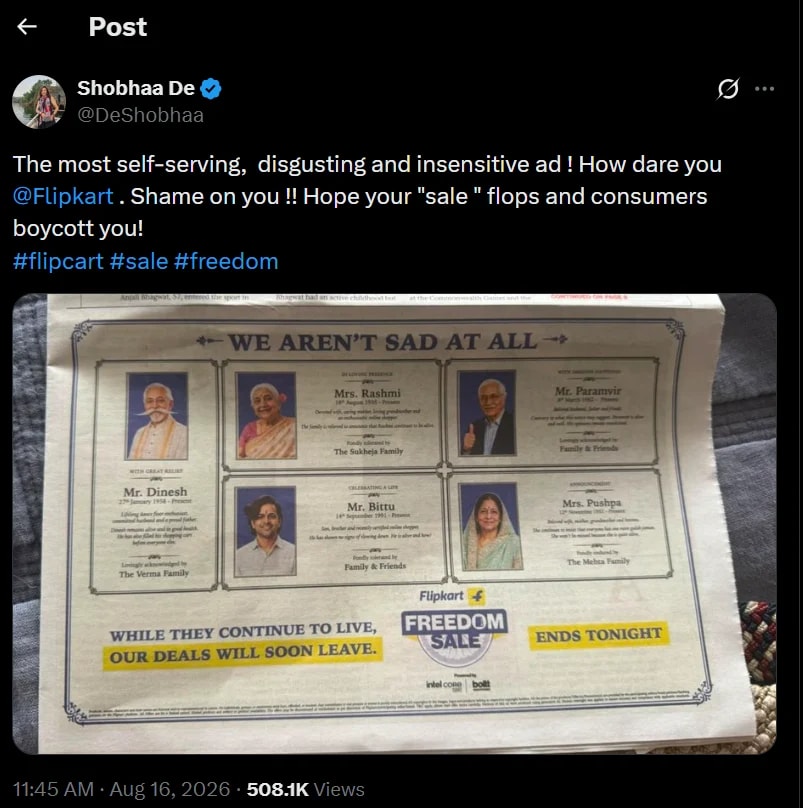
Another user said, “We should leave normal people with dignity in death. This ad is insensitive and inhuman.”
The criticism also prompted questions about whether the people featured in the advertisement were real or the images had been generated using AI. Flipkart has not clarified how the images were created.
However, the reaction was not uniformly negative. Some users argued that the advertisement was clearly a parody and did not present an identifiable real person as having died. Others described it as a “non-obit” celebrating fictional people while they were alive.
“These are AI-generated images, not real people. Personally, I didn’t find this insensitive at all,” one user said.

The divided response raises a larger question for advertisers: does grabbing attention make a campaign effective if the controversy overshadows the product or proposition being promoted?
Flipkart has not publicly responded to the criticism. Questions sent by Inc42 to the ecommerce major remained unanswered till the time of publishing.
Attention Without Conversion?
Harish Bijoor, founder of brand consultancy Harish Bijoor Consults, believes the campaign succeeded in generating awareness but questioned whether it could move consumers further down the advertising funnel.
“The first (purpose of advertising) is to gain awareness, and I think this piece of advertising gets that awareness bang on right—100 on 100,” Bijoor said.
However, he argued that the campaign’s reliance on dark humour could prevent that attention from translating into interest or sales.
“After attention, nothing much happens. The prime purpose of good advertising is to convert into an actual sale. If your advertising isn’t doing this, then you’re failing,” he said.
Although Bijoor does not believe the campaign warrants the scale of criticism it has received, he said Flipkart may have underestimated the sensitivity attached to obituary-style imagery.
“When ads of this kind rub shoulders with real obituaries, if at all, it is insensitive to the dead, the grieving and the mourning,” Bijoor said.
Communications consultant Karthik Srinivasan disagreed, arguing that the advertisement does not feature real people or attempt to pass itself off as a genuine obituary.
According to Srinivasan, Flipkart’s branding is prominently displayed and the campaign uses what he described as imaginary, AI-generated characters who remain alive within the advertisement’s premise.
He called the creative an example of “elementary subversion”, briefly leading viewers to interpret the advertisement one way before revealing its actual message.
However, Srinivasan acknowledged that death remains a sensitive subject in Indian advertising and said brands should rigorously scrutinise such ideas internally before releasing them.
Independent brand and digital advisor Ashok Lalla was more critical of the execution.
Lalla noted that Flipkart has historically used unconventional advertising, including campaigns featuring children portraying adults and its “SASA LELE” campaign around the festive sale season.
However, he said the latest campaign lacked the creative strength of Flipkart’s earlier work. “The current sale announcement using mock obituary-style callouts seemed very contrived and devoid of any real creative idea.”
He added that the response to the advertisement may be better described as rejection than outrage, particularly among advertising and marketing professionals. Provocative campaigns can generate immediate reactions, he said, but may not necessarily build a brand favourably over the long term.
When Attention Backfires
Flipkart’s campaign is the latest example of an Indian consumer internet company using a provocative marketing device to cut through an increasingly crowded media environment.
In 2024, home salon startup Yes Madam drew criticism after circulating a purported internal email claiming that employees who reported high stress levels in a survey had been fired. The company later said no employees had been dismissed and that the episode was part of a campaign intended to highlight workplace stress.
The same year, actor and model Poonam Pandey staged a fake announcement of her death from cervical cancer as part of an awareness campaign. The stunt drew widespread criticism for using death and grief as marketing devices.
These campaigns share an underlying strategy: creating something that audiences are unlikely to ignore. However, they also highlight the distinction between generating conversation and building trust.
“Attention, memory and love are three different things,” said Dr Sanjay Arora, founder of Shells Advertising.
Arora believes the insight behind Flipkart’s campaign – that people are often celebrated only after they die – had creative potential. However, he questioned the decision to express it using the visual language of an obituary.
“An obituary is not merely another visual format. It is culturally associated with death, grief and the loss of a human being, a family member,” he said.
Arora described the campaign as a blunder that generated visibility at the cost of civility. He added that provocative advertising can deliver diminishing returns if the controversy becomes more memorable than the product, sale, or brand proposition.
“Being talked about is not the same as being liked, trusted or remembered for the right reason,” he said.
Flipkart’s advertisement succeeded in making people stop, look, and argue. The question now is whether consumers remember the Freedom Sale or only the controversy surrounding its promotion.