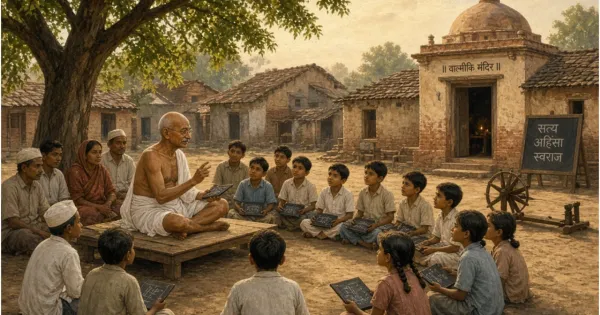
Lucknow: The world knows Gandhiji as a messenger of peace, a leader of the freedom struggle and a social reformer. Very few people know that at one time he had also become a real master. While staying at the Valmiki Temple on Mandir Marg near Connaught Place in the capital, he taught Hindi and English to the children of Valmiki Colony and their parents. Perhaps this was the first and last time when Gandhiji became a teacher in the true sense of the word. Step into Bapu's room and you see old sepia photographs on the walls – with Lord and Lady Mountbatten, Acharya Kripalani, Seemant Gandhi, C. Rajagopalachari, Sardar Patel, Maulana Azad and Pandit Nehru. Amidst all this, a faded painting tells the story of this room. Many children are talking to Bapu in it, their faces are lively. The name of the painter was not found, but the picture still captures the mood of that place.
There is carpet in the room. In the middle is the wooden table on which Gandhiji used to write. On the right is the cot on which he slept. A small spinning wheel is kept nearby. Krishna Vidyarthi, the priest and keeper of the temple, says that everything is at the same place where Bapu had left it.
Dr. Om Prakash, a Dalit activist whose father and brother were Gandhiji's students, says, “Gandhiji chose this place so that he could live with the so-called untouchables. In those days, many families lived in slums in Valmiki Colony, adjacent to the temple. People used to do cleaning work in Gol Market, Irwin Road, today's Baba Kharak Singh Marg, and Connaught Place. Bapu had a deep affection for our community.”
Even today many Valmiki families live here, now in permanent flats. The slums have been erected long ago. In 1946, Gandhiji asked the elders of the colony if he could live with him for two-four months. People said yes. He stayed for exactly 214 days – from April 1, 1946 to June 10, 1947.
He never missed morning and evening classes. He was so regular that even the meeting of big leaders of the freedom movement would often be postponed till the end of the class. The class would start before prayers. There were no guests at the time of study and prayer. Biographer Louis Fischer writes in his book The Life of Mahatma Gandhi, “I went to the Valmiki temple from my Hotel Imperial to talk to him, but he met me only after prayers.” Fischer stayed in Delhi for more than a month in 1946 to collect notes for the book.
Krishna Vidyarthi says, “When Bapu came to the colony, he started meeting the families. He was shocked that everyone was illiterate. No one had even seen a school. Then he said send the children, I will teach them. The elders agreed.” The student's father and uncle also sat in those classes. Gandhiji wanted people to read and write simple Hindi and English.
Master was very strict. Anyone coming to class without bathing would be scolded. Only the children of Valmiki Colony did not come. Children from Harcourt Butler School, Raisina Bengali School and Delhi Tamil Education Association i.e. DTEA School also came. The class was open to everyone. It is said that Bapu knew the name of every student.
Those students are no longer there to tell their stories, but their children are. The student says, “When Bapu was taken from here to Birla House due to security reasons, it was a big shock. Our elders were heartbroken. Sadly, they were killed where security was tight.” Dr. Om Prakash later continued teaching at the Indian Law Institute. He says, “I heard the stories of Bapu's school from Babuji. Father was sitting in his class. At that time our house was also near the temple. Because of Gandhiji, many people in the house became somewhat educated. The best thing was that father, son and mother and daughter used to come to class together.”
As education continued in the temple, children from Gol Market, Paharganj, Irwin Road and nearby areas also joined. Initially there were about thirty children. Then there were seventy-five in the morning and seventy-five in the evening. As the crowd increased, classes started being held in the open.
Gandhiji had an old connection with this Delhi. He came for the first time from 12th to 14th April 1915. Principal of St. Stephen's College, Kashmiri Gate, S. Of. Stayed at Rudra's house. Father George Solomon says that Rudra Saheb was Gandhiji's friend Deenbandhu C.F. Andrews, who was a teacher at St. Stephen's College. A photograph of that first visit is still displayed in the principal's office of the college.
That school of Valmiki temple does not feature much in history books. Leaders used to come, talks took place, but Bapu used to sit near the plank in the morning and evening. Children would come after bathing and adults would also sit. No fees. Just that it should be read.
Today there is the same table, the same small spinning wheel and the same cot in the room. The colony outside has changed. The slums are gone, the flats have come, but the old things remain. Master ji used to come, call by name. Delhi saw Gandhiji as a leader. Delhi also saw him as a master in this small school on Mandir Marg. This is what makes this room worth remembering.
– Vivek Shukla, senior journalist
Also read: What is the future of Hindi in the era of AI and technology? The challenge is big, but the opportunity is even bigger