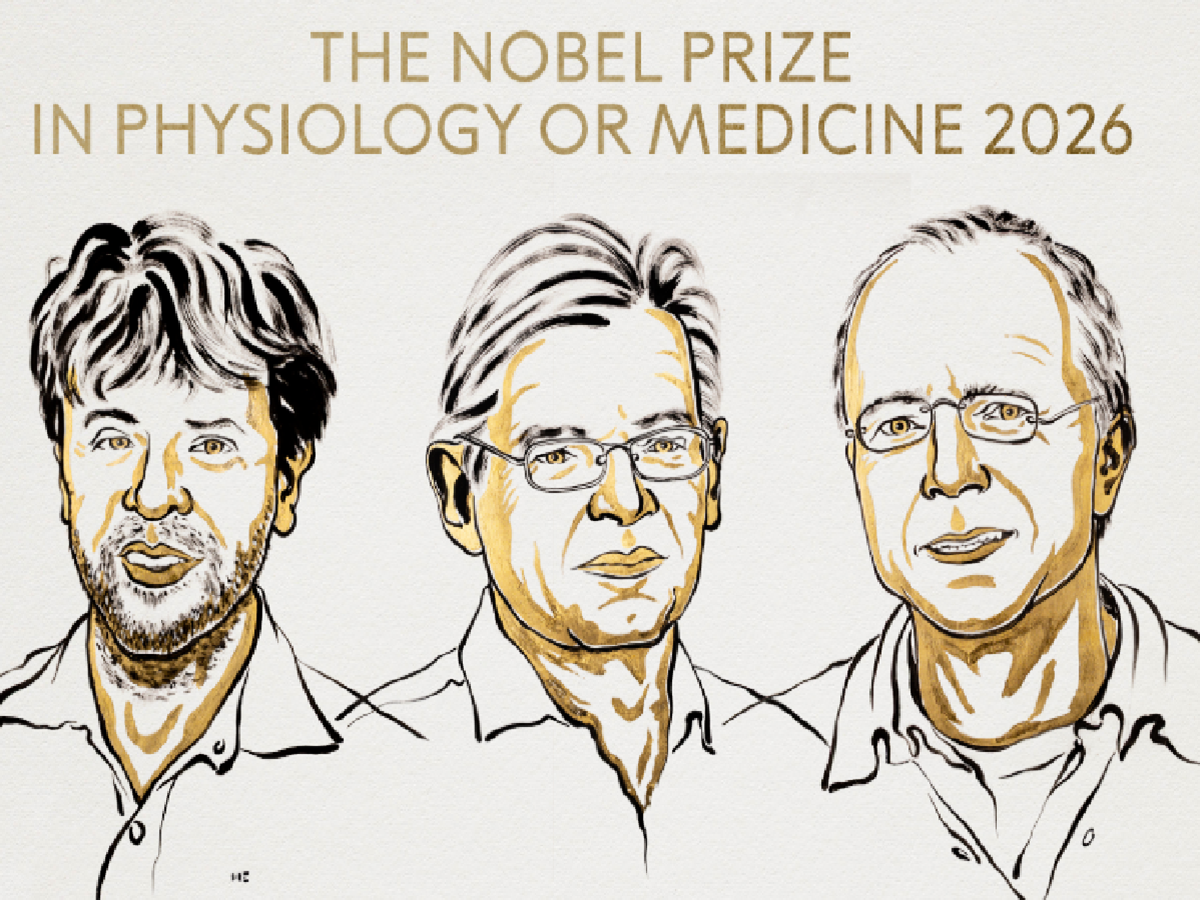
A simple query about the behaviour of an algae under light stimulus has paved the way for discoveries that have revolutionised brain studies. American scientist Karl Deisseroth and German scientists Peter Hegemann and Georg Nagel have received the joint Nobel Prize for their research on light-activated ion channels and optogenetics in the year 2026. According to the Nobel assembly, their discovery has allowed researchers to turn individual neurons in living brains on and off by means of light stimuli.
But who are these three scientists whose vastly differing paths converged into this single discovery?
Who Is Peter Hegemann? The Scientist Who Found the Light-Sensitive Protein in Algae
Peter Hegemann is a biophysicist from Germany working at Humboldt University of Berlin. Being born in 1954, he developed his curiosity around a very simple, yet interesting question: how does a one-cell alga called Chlamydomonas manage to feel light and move towards it? In the course of his investigations, Peter Hegemann discovered the existence of the protein called channelrhodopsin, which was located on the surface of the algal cell.
After that, he started collaborating with another German scientist, Georg Nagel and tried to find out what the protein does. Under the influence of blue light, channelrhodopsin opens a channel, and charges come inside, creating an electrical impulse.
This discovery laid a foundation for something more important – if the protein can react to light and change the behaviour of algae, why not try to use it on other cells?
Who Is Georg Nagel? The Biophysicist Who Helped Turn Light Into a Cellular Switch
Georg Nagel, a German biophysicist at the University of Würzburg, became a key part of answering that question. Working with Hegemann, Nagel showed that channelrhodopsin could make different types of cells sensitive to light. Their research demonstrated that the protein could effectively act as a biological switch controlled by blue light.
The discovery was published in the early 2000s. It meant scientists now had a way to influence electrical activity inside cells using light rather than conventional electrical stimulation. But the discovery still needed to reach the place where its potential was greatest: the brain.
Who Is Karl Deisseroth? The Neuroscientist Who Used Light to Control Brain Cells
The next advance was made by Karl Deisseroth. He is an American neuroscientist, bioengineer, and psychiatrist who studied at Stanford University.
By building upon the discoveries of Hegemann and Nagel, Deisseroth created a technology for controlling neurons with the help of light. In 2005, he proved that neurons with light-sensitive proteins inside were able to become active when blue light was shone on them. In 2007, he performed the experiment in the brain of living mice.
The technology received its name – optogenetics. For decades, neuroscientists have been striving for such a technology. It has developed the ability to precisely control individual neurons and observe what happens when specific brain circuits are switched on or off.
How Did Their Discoveries Lead to Optogenetics and Transform Brain Research?
Optogenetics has since become an important tool in neuroscience. Researchers have used it to investigate neural circuits linked to memories, feelings and behaviour, including processes relevant to neurological and psychiatric disorders. The technique is also being explored in clinical research. Scientists are studying whether light-sensitive proteins can help restore vision in people with certain visual impairments.
The three Nobel laureates reached the breakthrough from very different directions. Hegemann began with the behaviour of a microscopic alga. Nagel helped establish how its light-sensitive protein worked in other cells. Deisseroth then transformed that discovery into a tool for controlling neurons.
Together, their work turned light into a switch for the brain, opening a new way to investigate one of science’s biggest mysteries: how the brain produces memories, feelings and behaviour.
Sudeep Singh Rawat is a Copy Editor at NewsX Digital with over five years of experience in digital journalism. He covers national and international news, with a focus on politics, crime, technology, public affairs, and trending topics. Before joining NewsX Digital, he worked with Business Standard, The Sunday Guardian, and other digital media organisations. His reporting focuses on breaking news, enterprise stories, and explainers that inform readers through accurate, balanced, and context-driven journalism.
The post Who Are Karl Deisseroth, Peter Hegemann and Georg Nagel? 3 Scientists Who Won the 2026 Nobel Medicine Prize for Controlling Brain Cells With Light appeared first on NewsX.