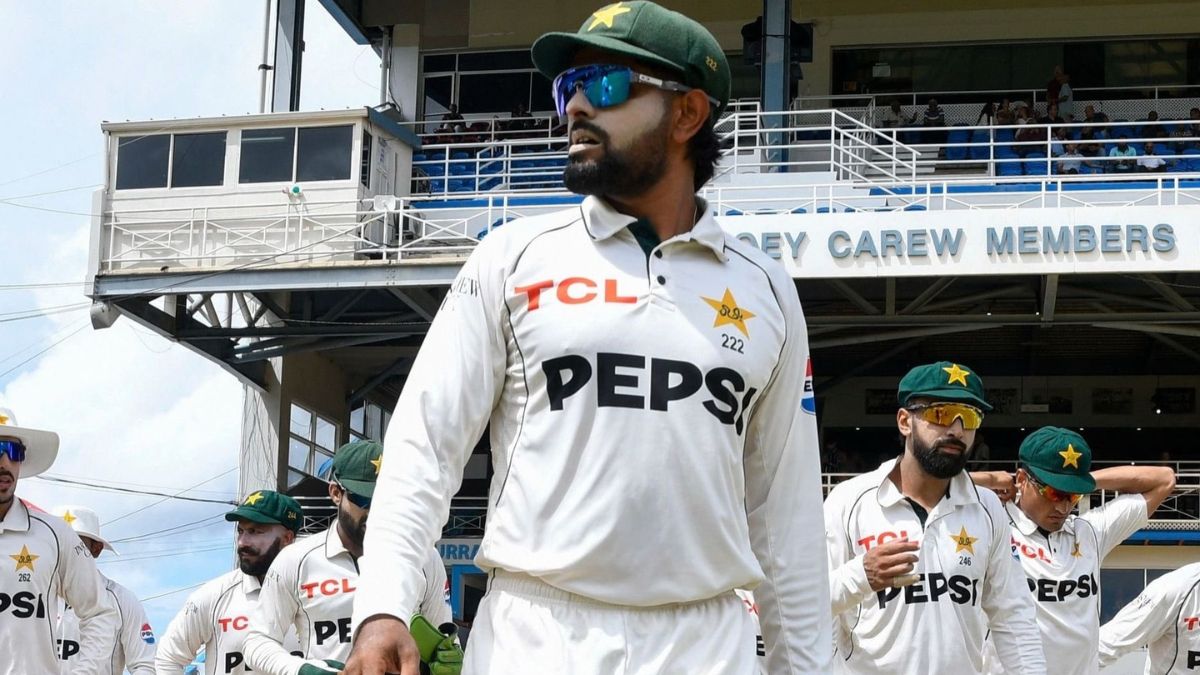
Scyld Berry declared them the worst for half a century. Stuart Broad suggested that England's victory in an emphatic whitewash should be straightforward. And following a near-identical capitulation at Headingley, it is difficult to disagree with either.
The task of diagnosing the malaise is as pointless as it was in Alastair Cook's team, which spent a year being systematically dismantled at the same venue. A fortnight ago, the talk was of Pakistan's alarming tendency to collapse miserably with the bat. This week's chastening exertion in Leeds was little different, except that, on this occasion, Pakistan rarely offered the required opportunities for their tormentors.
The easiest task by far was the fielding. There was the near-capture of the first lbw, a glorious chance to run out Root in the slips, and a misjudged dive from a fast single which saw the ball roll through two sets of gloves. And yet, even when Pakistan got out of their own way, they still made it alarmingly simple for England to score.
They won't finish bottom of the World Test Championship again. Or so Pakistan believes. But who exactly is to blame for this catalog of misery?
The Myth of the Franchise Mercenary: Pakistan
In the present-day context, every expert seems to be blaming T20 franchise leagues, labeling them greedy, mercenary, and selfish, etcetera.
Now this team is mostly made of the big names in Pakistan's first-class circuit: Azan Awais, Imam, Masood, Shafique, Salman Agha, Saud Shakeel- the usual suspects.
The bowling attack is spearheaded by the best red-ball bowlers of the land. None of them are big names in the T20 leagues, and several of them have little to no contract at all. T20 riches have not tainted these men, because technically, they should have the skill to last long in the longer formats, which Pakistan needs right now.
Also read: Afghanistan vs India T20I Series Schedule May Change; New Dates Proposed
But if the fundamentals are in place, why does this team look so lost?
The Cost of Constant Chaos
Well, let's take inspiration from the Bangladesh cricket board, who recently scripted one of the biggest upsets in test cricket, a week after losing badly to Zimbabwe. They did not sack their coaches and selectors, and most importantly, did not panic, while Pakistan is going through one of the worst phases since their 1990s renaissance.
They nurtured a core of players that had been steadily performing over the years, and eventually the payoff came spectacularly.
While the Pakistan Cricket Board went all out for a complete revamp of the system in the last couple of years, with little or no results, Bangladesh did not change a winning formula that had already been in place for quite some time.
The same goes with Pakistan's coaching staff, as they have gone through a complete overhaul in the last couple of years, with head coaches and specialist coaches being replaced more often than the toothpaste in a dentist's office, only to bring chaos, rather than order, in Pakistan's testing cricket.
The selectors have been replaced by a myriad of different committees, and the PCB's pitch curators have been alternating between completely flat tracks, as seen under the Ramiz Raja era, which saw Pakistan go winless at home for two years, followed by minefields, upon which England was humbled, but Pakistan had no answer to ordinary pitches in Bangladesh, South Africa, or England.
As we can see, Pakistan's cricket governance has been completely dysfunctional in the last two years, and the results are right in front of us.
Governance without patience
The fault cannot be entirely blamed on the players, as the PCB chairman Mohsin Naqvi is also a politician who takes orders from the country's interior minister, who in turn takes orders from President Zardari.
When Naqvi appointed Sumair Ahmad, a highly inexperienced bureaucrat who has spent most of his career in the PM's office, as the COO of the Pakistan Cricket Board, many questioned his suitability for the post.
Administrative heads can neither bowl half-volleys nor fall for the temptation of playing outside the off stump, but it is also unfair to completely ignore the onus on the players, who have already displayed their technical soundness in the domestic and county circuit.
Testing cricket is a game of patience, both within an innings, a day, a series, or a campaign.
There are limits to how much the game can be revolutionized by a constant shake-up of the system. The PCB needs to realize that there are only so many ways you can improve a 150-year-old game, and patience is the key.
That is, after all, the most basic quality they were lacking in the Pakistan team, as well as the administrators. A body as dysfunctional as the Pakistan Cricket Board has no business in being in such a hurry, which is why they keep losing the same battle, over and over again.