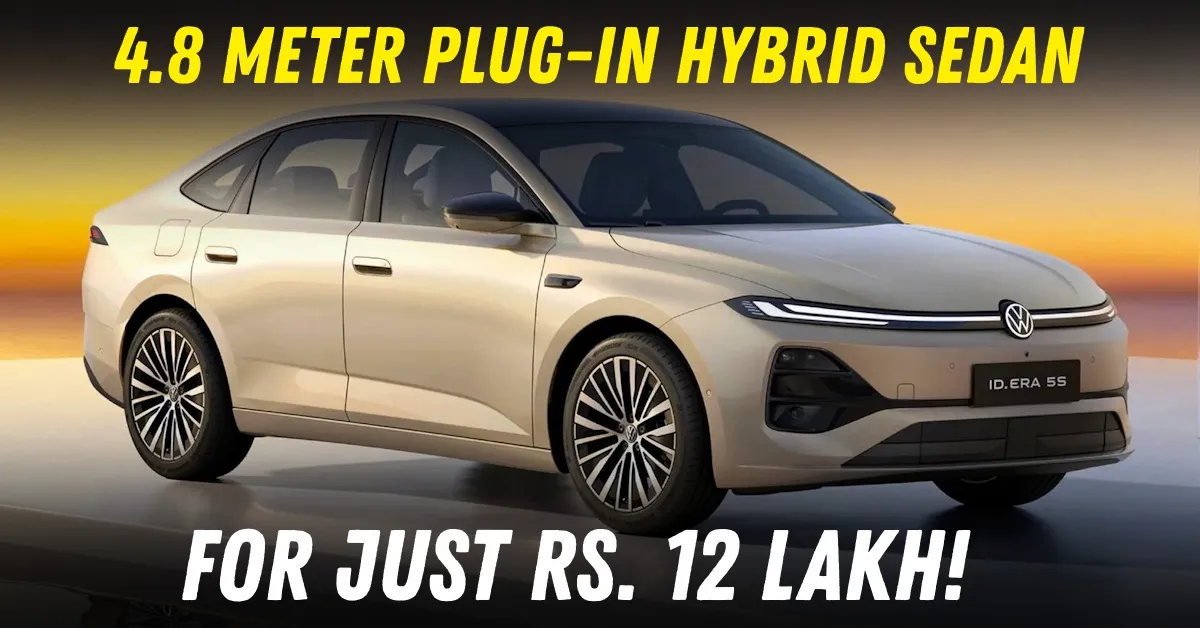
Volkswagen has just launched a large plug-in hybrid sedan in China at a limited-time starting price of 89,900 yuan. At current exchange rates, that works out to roughly Rs 12.7 lakh. The official list price starts higher, at 119,900 yuan, or roughly Rs 17 lakh equivalent.
Either way, the specification looks absurd by our standards. The Volkswagen ID. ERA 5S is 4,836 mm long, gets 160 km of claimed electric range, more than 2,000 km of combined range, fast charging, a 15.6-inch touchscreen and an advanced driver-assistance system capable of supervised city and highway navigation.
There are no India launch plans. The price is also a China-market price, not something Volkswagen could simply copy here. But the car neatly explains why China has become such a difficult place for global manufacturers to compete.
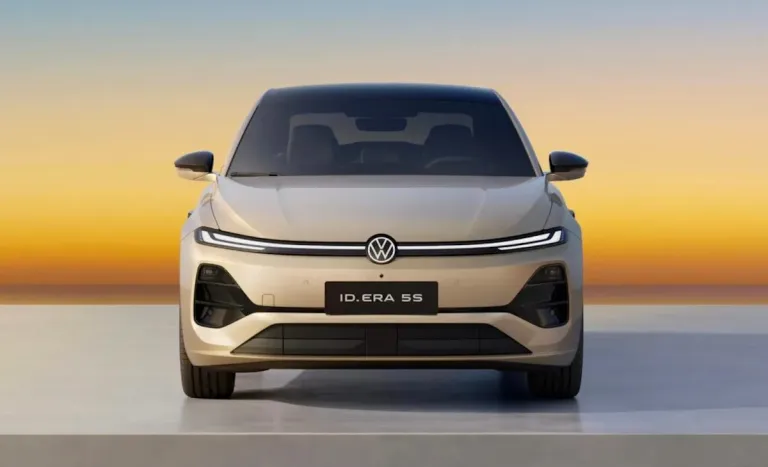
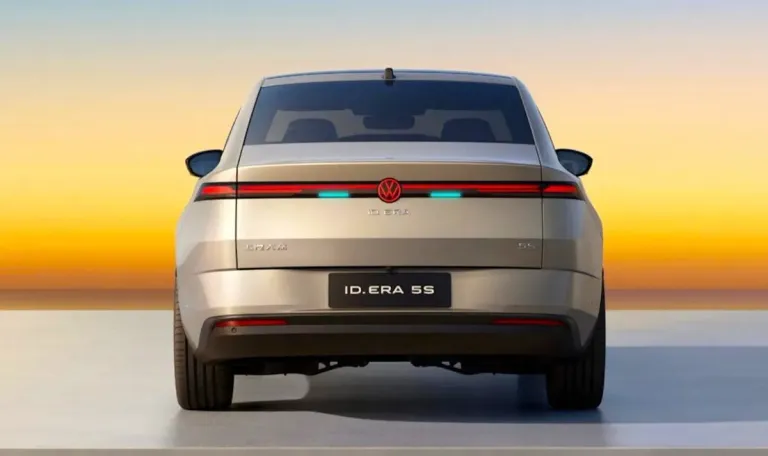
The headline comparison needs some context. The ID. ERA 5S is 4,836 mm long, 1,880 mm wide and 1,505 mm tall, with a 2,766 mm wheelbase. India’s BMW 5 Series LWB is much longer at 5,175 mm.
So the Volkswagen is closer to a Passat or Superb in footprint than the stretched 5 Series sold here. The point is that this is still a proper executive sedan, not a tiny budget car.
Its plug-in hybrid system combines a 1.5-litre petrol engine producing 80 kW with a 130 kW electric motor. A 19.1 kWh LFP battery provides up to 160 km of CLTC electric range. Once the battery is depleted, claimed fuel consumption is 2.82 litres per 100 km, and Volkswagen quotes more than 2,000 km of total driving range. Charging from 30 to 80 per cent takes around 15 minutes on a suitable DC charger.
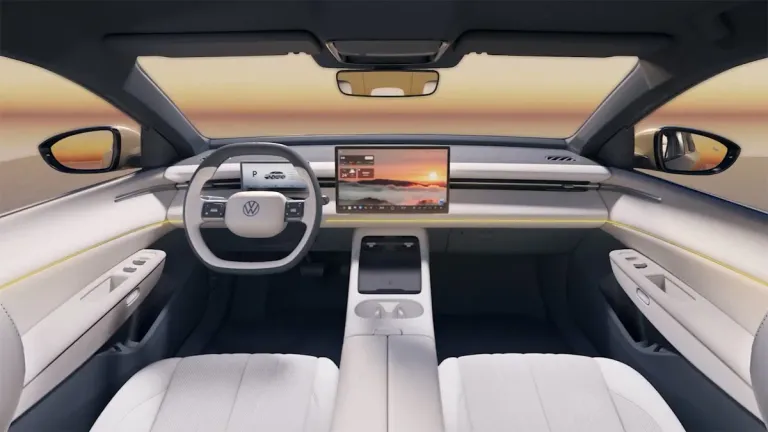
The entry car gets an 8.8-inch digital instrument display and a 15.6-inch 2.5K central screen. Higher versions add Volkswagen’s Xingyun assisted-driving system, developed with Chinese technology partners, with highway and urban Navigate on Autopilot, automated parking, valet parking and memory parking.
It also gets seven airbags, while the driver-assistance package can perform automatic emergency braking at speeds up to 140 km/h in supported conditions.
The seats can be heated and ventilated on higher trims, with massage functions also available. This is exactly the sort of equipment that would normally push a large sedan well above mass-market money here.
The answer is not one magic component. It is the ecosystem around the car. The ID. ERA 5S is built by SAIC Volkswagen, meaning Volkswagen is sharing development, manufacturing and sourcing with one of China’s largest carmakers.
The battery cells come from a Chinese supplier, the assisted-driving stack uses local technology, and the voice system was developed with iFlytek. Volkswagen is therefore buying into an enormous domestic EV and electronics supply chain rather than importing expensive European systems.
Then there is competition. The limited-time 89,900-yuan price includes substantial launch incentives and is 30,000 yuan below the official list price. Chinese brands have forced even Volkswagen to price aggressively just to stay relevant.
That is the real lesson. The equivalent of Rs 12.7 lakh is not an India price and cannot be directly compared with our taxes, duties or homologation costs. But a global manufacturer can build a 4.8-metre PHEV with 160 km electric range and serious electronics in China at a cost structure that looks almost impossible elsewhere.
This is why Chinese manufacturers are so hard to beat. More tellingly, it is also why Volkswagen increasingly has to behave like a Chinese manufacturer when it competes there.