
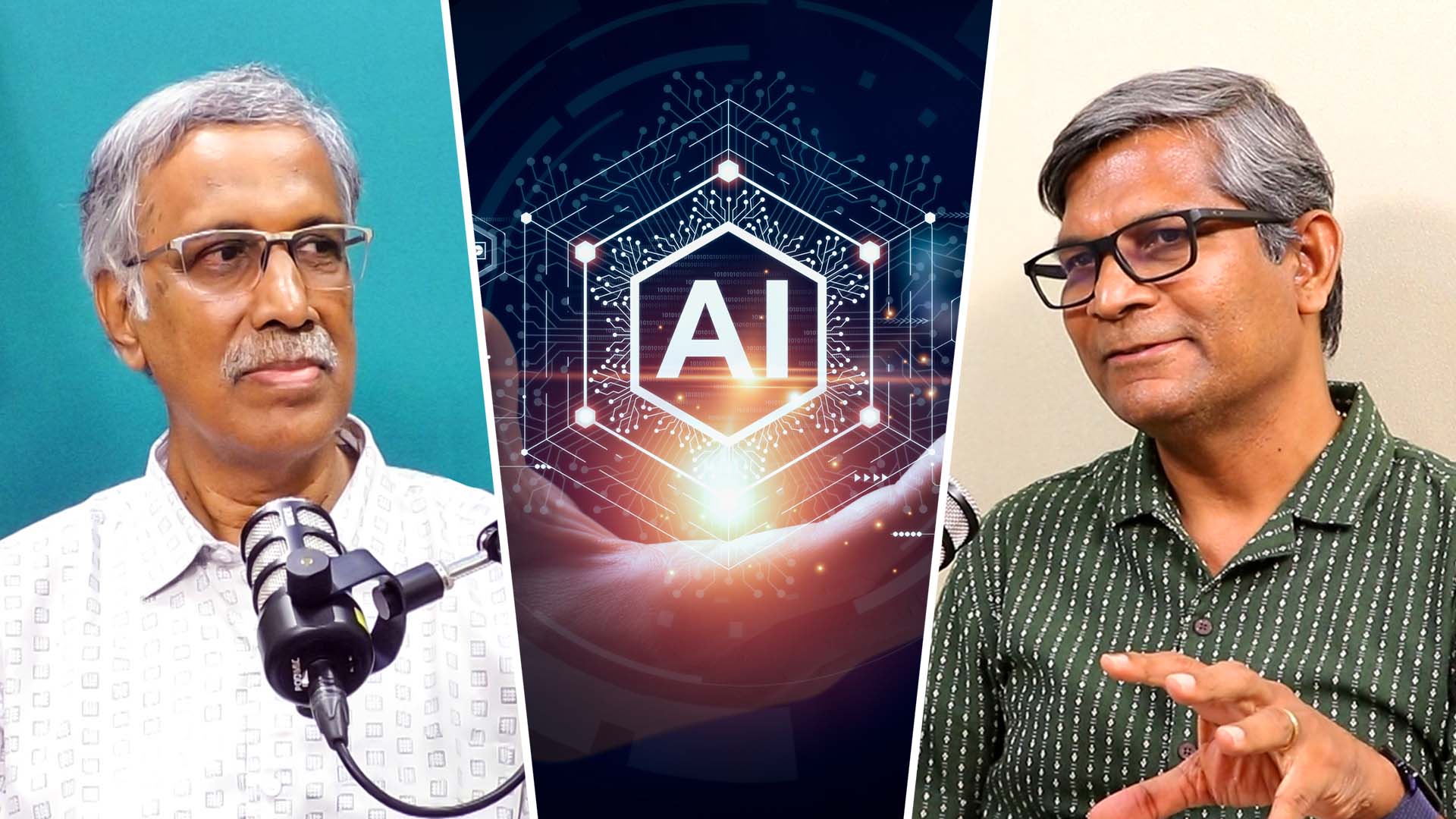

For nearly two years, India’s artificial intelligence debate has been framed by a single question: Where is the country’s own foundational AI model? While the US has produced giants such as OpenAI, Anthropic and Google, and China has demonstrated the disruptive potential of low-cost models such as DeepSeek, India is still searching for its answer.
The absence of a domestic large language model has fuelled concerns that India may be repeating mistakes it made in manufacturing and hardware — emerging as a major consumer of technology without owning the underlying platforms.
But Kumar Vembu, co-founder of Zoho Corp and a renowned investor, believes the question itself may be misplaced.
‘No bus missed’
“I don’t think there is any bus that we missed,” Vembu said on Talking Sense With Srinithe flagship YouTube program of The Federal. Instead of lamenting the lack of a foundational model, India should focus on understanding its own priorities and allocating scarce capital where it matters most, he argued.
Unlike the US, where decades of publicly funded scientific research laid the foundations for today’s AI breakthroughs, India faces a very different set of constraints. “When the science was not proven and a lot of money was pumped into scientific research, a country like India could not have invested at that magnitude,” Vembu pointed out.
The economics of AI have changed, he noted. Much of the science is now proven, many techniques are publicly available, and the challenge has increasingly become an engineering problem rather than a pure research problem. That lowers the capital required to participate.
Scope for latecomers
The discussion comes at a time when concerns about India’s AI ambitions are growing. Government spending on research and development remains among the lowest for major economies, at roughly 0.6% of GDP.
Questions persist over the country’s access to high-end computing infrastructure, including GPUs, while India’s linguistic diversity presents additional hurdles for language-model development.
As AI becomes increasingly embedded in business software and services, there is significant scope for Indian firms to become leaders in adoption.
S Srinivasan, Editor-in-Chief of The Federalpointed out that India had previously overcome similar constraints in strategic sectors such as nuclear science and space technology. The emergence of China’s DeepSeek, which demonstrated that powerful AI systems can be developed at a fraction of the cost of leading Western models, has renewed hopes that latecomers can still compete.
Vembu acknowledged that possibility. “The fact that somebody else has done it means we know it is more an engineering problem today than a science problem,” he said. “Everything is knowledge that is available in the public domain.”
Quality of education
“The fundamental problem is the quality of education,” Vembu added. “We have mastered the art of wasting human talent.”
According to him, India’s difficulties in advanced technology are not primarily caused by a shortage of intelligence or even capital. Rather, they stem from an education system that increasingly prioritises credentials over capability and theory over practical problem-solving.
Watch/Read | The Federal COGNI: How AI is helping leaders decide better, faster, and smarter
Drawing on decades of recruiting engineers, Vembu described graduates who can recite programming concepts but struggle to explain what they have actually built. “People learn everything on the job,” he said. “The entire burden of training falls on employers.”
The AI debate, he suggested, risks distracting policymakers from this deeper structural weakness. While concerns about technological sovereignty and dependence on foreign platforms are valid, India’s long-term competitiveness will ultimately depend on whether it can develop a generation of problem-solvers rather than passive technology users.
Lack of core technologies
Vembu was equally sceptical of the narrative that India can suddenly become a leader in foundational AI despite decades of underinvestment in core technologies.
“We have never worked on the foundation layer or the infrastructure layer for 40 years,” he said, referring to operating systems, programming languages, processors and other foundational technologies. “Suddenly, only when AI comes up, we are asking why we didn’t produce GPUs or large models.”
That does not mean India lacks opportunities.
India’s future in AI will not be determined solely by whether it builds the next ChatGPT. Instead, the more important question may be whether it can fix its education system, nurture innovation and create conditions for technology companies to take risks.
In fact, Vembu argued that the country’s strengths may lie elsewhere. Indian technology companies, he said, have historically excelled in applications rather than foundational research. As AI becomes increasingly embedded in business software and services, there is significant scope for Indian firms to become leaders in adoption.
Potential in AI applications
“Almost every startup I know, every businessman I know, is looking at AI as a tool,” he said. Companies are already racing to automate customer support, improve productivity and expand services using existing AI models.
The challenge, however, extends beyond technology. Vembu argued that India’s startup ecosystem continues to suffer from a shortage of risk-taking customers. Large corporations routinely demand proof that a startup’s product works elsewhere before becoming a buyer, creating a chicken-and-egg problem for young technology firms.
Also read | Why Indian graduate students cannot afford to boo at AI
“We don’t want to be the first customer. Show me somebody else who is using it,” he said, describing a common response startups receive from prospective clients.
Immediate concerns
His prescription was unusual: Treat startup procurement almost like corporate social responsibility. Successful companies should deliberately create opportunities for emerging firms to test products, refine technologies and secure early customers.
As global investors pour billions into AI infrastructure and computing capacity, India’s absence from the first wave of foundational model development remains a concern. Yet Vembu’s message was that the country’s future in AI will not be determined solely by whether it builds the next ChatGPT.
Instead, the more important question may be whether it can fix its education system, nurture innovation and create conditions for technology companies to take risks. “If we focus on education and create more opportunities for innovation,” Vembu said, “we will catch up.”
For a country worried about missing the AI revolution, that may be a more uncomfortable diagnosis than simply lacking a large language model.

Comments are closed.