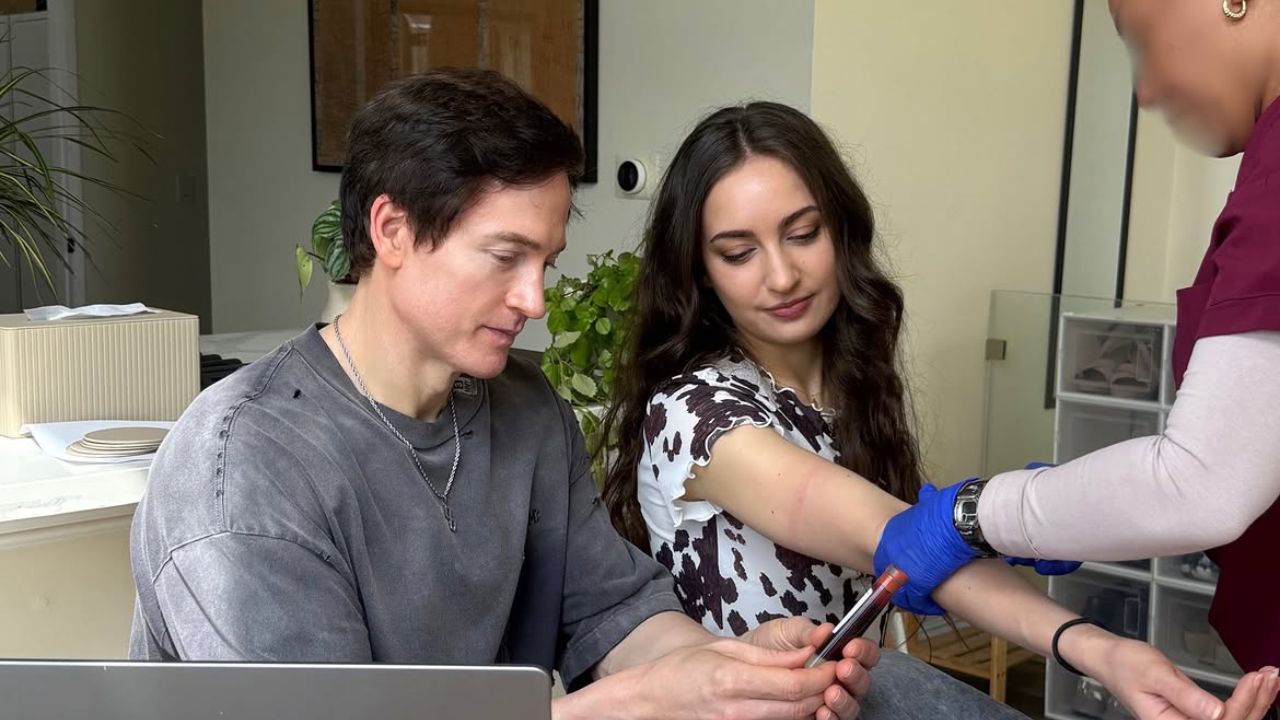
A bizarre health experiment has recently sparked widespread discussion after technology entrepreneur and biohacker Bryan Johnson revealed that he is storing his girlfriend Kate Tolo’s menstrual blood at around -80°C. The unusual practice is part of a larger project focused on collecting extensive data about menstrual cycles and women’s health.
Johnson says the goal is not simply to preserve menstrual blood, but to study it as a potential source of biological information that could help researchers better understand women’s reproductive and overall health.
Who Is Freezing Period Blood and Why?
Bryan Johnson, known for his intensive longevity and health-tracking experiments, is conducting the project with his girlfriend Kate Tolo.
According to reports, Tolo is participating in a large-scale monitoring programme designed to collect millions of data points from her menstrual cycle. Around 10 millilitres of menstrual blood is being stored at approximately -80°C for analysis.
The project is reportedly examining menstrual samples for potential indicators including microplastics, PFAS or “forever chemicals”, endocrine-disrupting substances and other biological information.
What Happens When Period Blood Is Frozen?
Freezing a biological sample at very low temperatures helps preserve its components for later laboratory analysis. However, this does not mean that freezing menstrual blood gives it magical healing properties or turns it into a treatment.
Menstrual fluid is different from ordinary blood because it can contain blood, mucus, vaginal secretions and pieces of the uterine lining. Its composition can also vary throughout the menstrual cycle.
Therefore, researchers may be interested in analysing it as a biological sample rather than treating it like conventional blood collected from a vein.
Can Period Blood Tell Us About Health?
This is one of the most interesting questions behind the project.
Menstrual fluid contains material originating from the reproductive tract, including components of the uterine lining. Researchers have been investigating whether menstrual blood could provide useful information about reproductive health and certain diseases.
However, it is important to distinguish research potential from established medical testing. The fact that a substance can contain biological markers does not automatically mean that a home-collected menstrual sample can reliably diagnose a disease.
Is Frozen Period Blood Dangerous?
The act of freezing a properly collected biological sample for research is not inherently unusual. Extremely low temperatures are routinely used in laboratories to preserve biological materials.
However, people should not try to copy a medical or research protocol at home. Menstrual blood is a biological material, and safe collection, storage, transportation and laboratory handling require appropriate procedures.
Why Is This Story Getting So Much Attention?
Menstrual health has historically received less research attention than many other areas of medicine. Johnson and Tolo say their project aims to generate more detailed information about the menstrual cycle and women’s health.
At the same time, experts and critics have questioned how useful such an intensive self-experiment will ultimately be without rigorous scientific validation and independent research.
Frequently Asked Questions
1. Is period blood the same as normal blood?
No. Menstrual fluid contains blood as well as tissue from the uterine lining and other fluids and secretions.
2. Does freezing period blood make it healthier or more powerful?
No. Freezing is primarily a preservation method for a biological sample. There is no established evidence that frozen menstrual blood has special health benefits.
3. Why use -80°C?
Very-low-temperature freezers are commonly used in research laboratories to preserve biological samples for later testing. The purpose is to slow biological and chemical degradation.
4. Can menstrual blood be used to diagnose diseases?
Researchers are studying its potential as a source of biomarkers, but menstrual blood testing is not a universal substitute for established medical tests.
5. Is storing period blood at home recommended?
No. There is no general health reason for people to collect and freeze their menstrual blood at home. If a doctor requests a menstrual sample for a specific investigation, follow the collection and storage instructions provided by the medical team.
The Bottom Line
The viral story about menstrual blood being frozen at -80°C involves Bryan Johnson’s experimental women’s-health research project with Kate Tolo. The idea is to preserve samples for detailed analysis and investigate whether menstrual fluid can provide useful information about reproductive health, environmental exposures and other biological markers.
However, this remains an experimental research approach, not an established anti-ageing treatment or routine medical procedure. The potential of menstrual blood as a source of health information is an interesting area of research, but much more rigorous scientific evidence is needed before broad medical claims can be made.