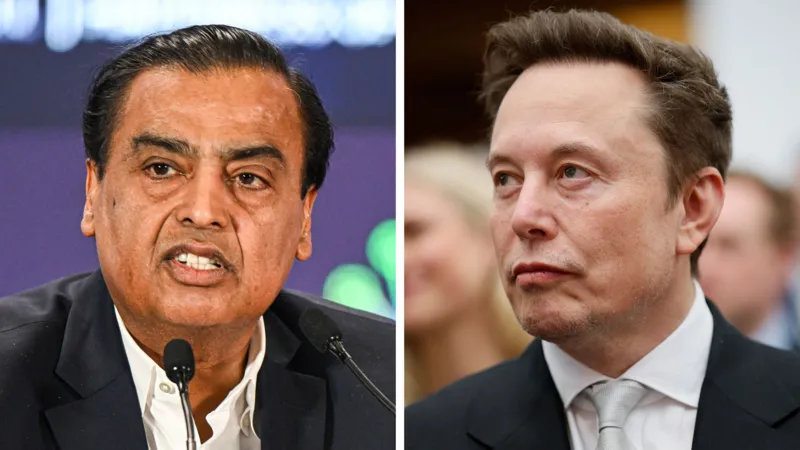
New Delhi: Elon Musk has escalated his dispute over the delayed launch of his satellite internet service in India, directly questioning the influence of billionaire Mukesh Ambani as Starlink waits for final regulatory clearances.
The SpaceX founder first accused unnamed powerful business interests of trying to prevent Starlink from entering India to protect their market dominance. He subsequently singled out Ambani, whose Reliance Industries owns Jio, the country’s largest mobile network operator, asking on social media whether Ambani was the “real boss of India”. The allegations have been rejected by the Indian government, which says satellite communication operators are being assessed under a fair and non-discriminatory regulatory framework. Officials have maintained that Starlink and competing satellite operators are at broadly the same stage of the approval process.
The dispute comes as India prepares for a new phase of competition in satellite broadband, with Starlink, Reliance Jio and Bharti Airtel pursuing opportunities in a market where millions of people still face connectivity challenges.
Why Musk has targeted Ambani
Musk’s criticism centres on the delay in securing the final approvals needed to launch Starlink commercially in India.
Starlink uses a network of satellites in low Earth orbit to provide internet connectivity. The technology can be particularly useful in remote and sparsely populated regions where installing fibre-optic cables or extending conventional mobile networks is expensive or difficult.
India represents a potentially significant market because of its large population and uneven access to reliable high-speed connectivity. Starlink has been trying to enter the country since 2021 and has secured key licences, but it still requires the remaining regulatory approvals before it can begin commercial operations.
Musk argues that the prolonged wait is unjustified. He has said Starlink is licensed in more than 165 countries and claimed that the company has spent five years complying with Indian government requirements.
In a post on X, he questioned why the company was still waiting for approval and asked whether Ambani was effectively exercising influence over the process. Musk has not publicly provided evidence that Ambani or Reliance directly intervened to block Starlink’s entry.
Government rejects allegations of discrimination
India’s Ministry of Communications pushed back against Musk’s allegations, saying the country’s regulatory framework for satellite communications was fair and non-discriminatory.
The ministry said Starlink, Eutelsat OneWeb and Jio Satellite Communications were at broadly the same stage of the process, with security assessments and spectrum-related requirements still to be completed.
Telecom Minister Jyotiraditya Scindia also rejected suggestions that the government was allowing monopolistic behaviour in the sector, saying India did not permit monopolies in any industry.
The distinction is important because obtaining a licence does not automatically permit a satellite operator to begin selling services. Companies must satisfy applicable security requirements and secure the necessary spectrum arrangements before commercial operations can start.
The government’s position is that these requirements apply to competing operators rather than being designed specifically to delay Starlink.
Jio and Airtel are both competitors and partners
The dispute is complicated by Starlink’s existing commercial relationships with Indian telecom companies.
In March 2025, SpaceX signed agreements with Reliance Jio and Bharti Airtel to explore distributing Starlink equipment and services in India, subject to regulatory approval. The companies also indicated that they could explore opportunities to share network infrastructure.
These arrangements suggest that Starlink does not necessarily view India’s established telecom operators only as rivals. Partnerships could help it reach customers through existing distribution networks and local business relationships.
At the same time, Jio and Airtel have their own interests in satellite communications.
Jio is developing its satellite communications business, while Bharti Airtel has a connection to Eutelsat OneWeb, another operator seeking to provide satellite connectivity in India.
The companies are therefore positioned to compete with Starlink even as commercial partnerships could allow them to participate in its distribution.
For Musk, the central concern is whether the regulatory process will allow Starlink to compete on fair terms with businesses that already have a substantial presence in India’s telecom market.
Security clearances remain a key hurdle
Security considerations have been an important part of the debate around Starlink’s entry into India.
In 2024, Indian authorities reported recovering Starlink equipment during a drug-smuggling investigation in the Andaman and Nicobar Islands and during an Army operation in Manipur.
Musk said at the time that Starlink’s service had never been active in India and argued that the recovered equipment could not have been using its satellite network.
Satellite communication systems raise questions about how equipment is authorised, how networks are monitored and how governments can enforce security requirements. These issues are particularly significant in border regions and other sensitive areas.
The government has said that operators must meet the relevant security conditions before launching services. Starlink’s international presence and experience in other markets do not, by themselves, remove the need to comply with India’s domestic requirements.
What the delay means for Indian consumers
Starlink has presented its proposed Indian service as a way to bring high-speed internet to people who cannot easily access conventional broadband.
Satellite connectivity could help households, businesses and institutions in remote locations where mobile coverage is weak or fibre connections are unavailable. It could also support connectivity in geographically challenging areas.
However, affordability remains an important question.
Starlink has not announced official Indian prices for its residential service. In the United States, residential plans start at about $55 a month, with pricing and equipment costs varying by plan and location. Such pricing indicates why affordability could be a challenge for many Indian households if comparable costs applied locally.
The company’s eventual pricing, equipment requirements and coverage would determine how widely the service could be adopted in India.
Greater competition could offer more options for consumers, particularly in underserved regions, but the benefits would depend on the cost of accessing the service and the quality of connectivity it delivers.
A larger battle over India’s digital market
The confrontation reflects a broader contest over the future of India’s digital infrastructure.
Jio and Airtel have established businesses across mobile connectivity and other telecommunications services. Starlink would bring a satellite-based model that could compete for customers in locations where conventional networks are less practical.
The market also presents opportunities for cooperation, as shown by SpaceX’s agreements with both Indian operators. But partnerships do not eliminate competition over customers, regulatory treatment and the future role of satellite broadband.
Musk’s allegations have placed the approval process under public scrutiny, while the government has insisted that all operators must satisfy the same regulatory requirements.
The claims against Ambani remain allegations rather than established findings, and the available public information does not demonstrate that Reliance has blocked Starlink’s approval.
What happens next?
Starlink’s immediate challenge is to complete the remaining regulatory steps required to launch commercial services in India. The government, meanwhile, faces the task of applying its security and spectrum rules while enabling competition in an emerging market.
The outcome will matter beyond the dispute between two high-profile billionaires. It could help determine how quickly satellite broadband becomes available to Indian consumers and how the technology fits alongside existing mobile and fibre networks.
For Musk, India represents a major potential market that remains out of reach until final approvals are secured. For Ambani and other established telecom operators, satellite connectivity is both a potential business opportunity and an emerging source of competition.
The central question is therefore not simply whether Musk and Ambani are at odds. It is whether Starlink can clear India’s remaining regulatory hurdles and compete in the country’s satellite internet market on terms the government considers fair and secure.