
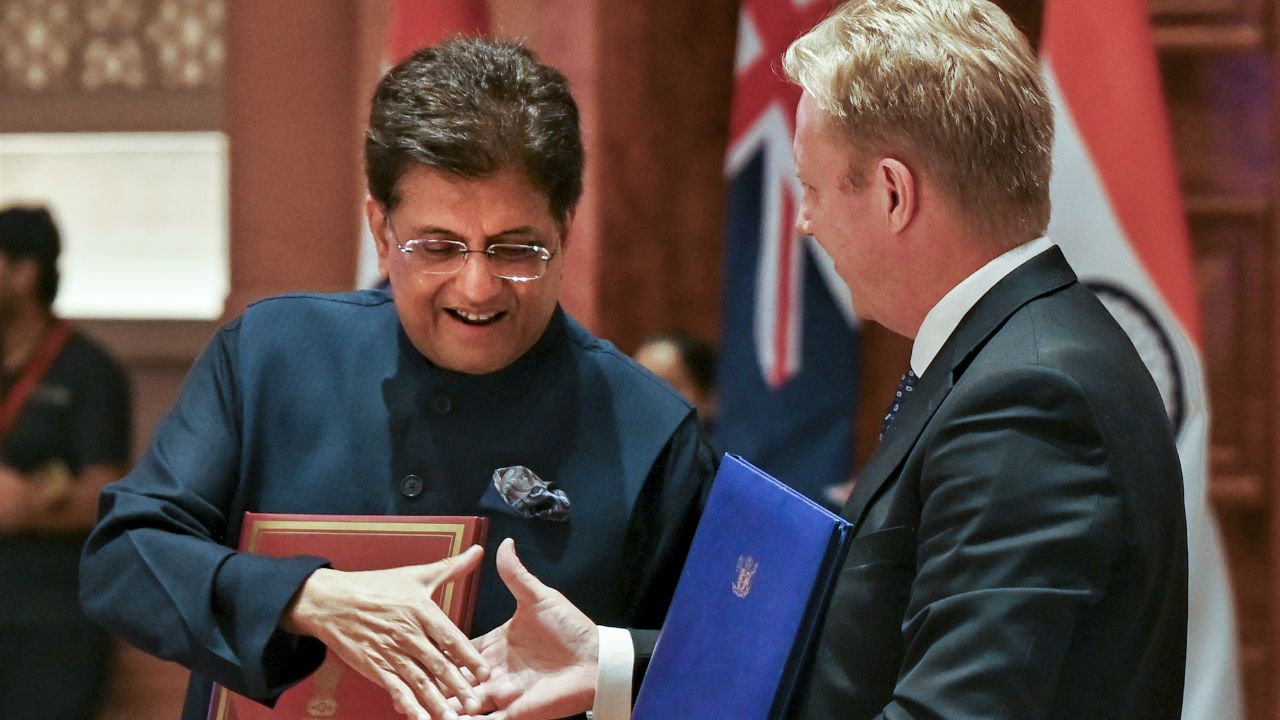

India and New Zealand on Monday signed a Free Trade Agreement (FTA) with the aim of promoting bilateral trade and investment. The agreement was signed in the presence of Commerce Minister Piyush Goyal and New Zealand Trade Minister Todd McClay. This FTA provides duty free access to 100 percent of India’s exports to New Zealand.
This agreement has been signed after the Government of India and New Zealand completed negotiations in last December 2025. This agreement consists of 20 chapters. This includes trade in goods between the two countries, its measures, settlement of earlier disputes between the two countries, and simplification of legal rules.
What did Piyush Goyal say?
After signing the FTA, Piyush Goyal said that the deal between India and New Zealand was completed in nine months. He said this pace reflects ‘the depth of trust and common expectations between our countries’. He said, ‘The signing of this FTA is another important milestone in India’s engagement with the developing world and brings us closer to Prime Minister Narendra Modi’s vision of a developed India 2047.’
Also read: ‘Why did you start living with him without marriage?’ SC made strict comment on live in relationship
Which sector will get a boost?
Also it includes all tariff lines i.e. product categories. This will increase the competitiveness of labour-intensive sectors like textiles, garments, leather, footwear, jewellery, engineering goods and processed foods. This is expected to boost small, medium and medium enterprises (MSME) and employment.
Before this agreement, New Zealand used to impose duty of up to 10 percent on Indian products like ceramics, carpets, motor vehicles and their parts. Now there will be no duty on these, so that by getting market access without any duty, Indian products will be able to compete with the goods of other countries. Under the agreement, India will also get duty free raw materials like wood logs, coking coal and metal scrap for its manufacturing sector, which will reduce production costs and increase global competitiveness.
India’s offer to New Zealand
India, on the other hand, has offered duty concessions on 70.03 per cent of duty categories (which account for 95 per cent of bilateral trade by value) while 29.97 per cent of duty categories have been kept out to protect sensitive sectors.
Also read: ‘This is my last meeting’, what did PM Modi say at the Vijay Sankalp rally in Bengal?
These sensitive products mainly include milk, cream, cheese, other animal products (except sheep meat), agricultural products including onion, gram, peas, maize, almonds, sugar, artificial honey, fats and oils, arms and ammunition, gems and jewellery, copper and aluminium.
India will abolish duty on many categories
India will eliminate duties on about 30 per cent of New Zealand’s tariff categories, including products such as timber, wool, sheep meat and raw leather. Whereas on 35.60 percent duty categories, duty will be abolished in a phased manner in three, five, seven and 10 years. These include petroleum oil, malt extract, vegetable oil, selected machinery etc.
New Zealand products that will get duty concessions include wine, medicines, polymers, aluminium, iron and steel products. Whereas some products like Manuka honey, apple, kiwi fruit and albumin will come under duty rate quota. The agreement also includes a commitment to facilitate investments worth $20 billion in India. Additionally, a rebalancing clause has also been added to establish balance in case the investment targets are not met. In the year 2024, the total bilateral trade in goods and services between the two countries was $2.4 billion.

Comments are closed.