The 30-year-old seized the opportunity, packed her bags and moved to Bangkok, where she rented a 31-square-meter apartment for SGD1,000 (US$788) a month, turning it into a temporary base for work and life, according to The Straits Times.
During those months, she realized that life in the Thai capital offered something she had struggled to find back home: a sense of calm.
Last year, she came back to and quit her job in May. Six months later, she returned to Bangkok and signed a one-year lease for an apartment SGD600 a month.
|
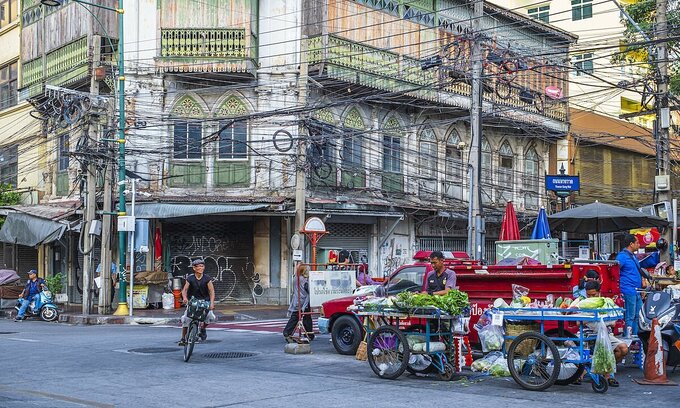
A street in Samphanthawong District, Bangkok, Thailand. Photo by Hemis via AFP |
She is among many young Singaporeans who, without mortgages or other major commitments tying them to the city-state, have chosen to work overseas, aided by greater workplace flexibility, less stress, and reasonable living costs.
Chin got married in September 2024 and owns a four-room resale flat in Punggol in northeast Singapore with her operations manager husband.
The couple share a monthly mortgage of roughly SGD2,000, along with recurring expenses including utilities and car loan payments.
These days, she splits her time between Singapore and Bangkok, spending about two weeks in each location while working as a freelance social media manager and content creator.
For her, the arrangement is an additional financial commitment that is worth the cost.
“I need my own space to recharge and enjoy making content in a space that I’m 100% responsible for,” she says, adding that her husband is fully supportive of her living arrangements.
While there are no publicly available statistics on the number of Singaporeans renting abroad, the number of Singaporeans living abroad grew from about 213,000 in 2016 to more than 221,000 by the end of 2025, according to the Department of Statistics.
A popular destination is Malaysia, which has seen growing interest from foreigners seeking to establish a longer-term base through its Malaysia My Second Home program. The government-backed initiative allows eligible foreigners to live in Malaysia on a long-term, renewable multiple-entry visa.
Data from consultancy Asia Home Services shows that the number of applicants soared from 1,902 in December 2024 to 12,495 in March 2026, the program’s website shows.
Singaporeans make up a small but fast-growing share of this pool. The number of applicants from Singapore seeking to relocate to Malaysia quadrupled from 96 in December 2024 to 383 in March 2026.
Some Singaporeans are looking even farther afield for a second property. In July, Singaporean content creator Rachell Ng posted on TikTok that she had rented a four-room condominium unit in Guangxi, China, for SGD520 a month.
In her video, Ng, who is married and lives in a flat with her husband, says they decided to rent in Guangxi because they travel there “almost every single month” for work.
The couple spent between SGD9,000 and SGD10,000 on minor renovations, such as adding vinyl flooring to their rental unit.
Singapore’s rising property prices are among the reasons for the relocation trend. Public housing resale prices jumped 9.5% in 2024 and 4% in 2025. Only recently has the market started showing signs of moderation, according to property platform Stacked Homes.
At the same time, million-Singapore-dollar flats have gradually increased as a share of total sales volume. The average price of flats transacted at SGD1 million or more rose 2.1% to SGD1.14 million, last year, said Huttons Asia senior director of data analytics Lee Sze Teck, as quoted by The Business Times.
Prices had appreciated 55.7% since bottoming out in the second quarter of 2019, he added.
The number of million-dollar resale flats sold jumped to a new record of 1,594 units in 2025. Wong Siew Ying, head of research and content at PropNex, said this was 54% higher than the previous peak of 1,035 units in 2024.
Home away from home
For Chin, the appeal of living in Thailand was not simply about escaping the office. It also gave her a reprieve from the pressures she associated with life in Singapore.
She says: “Burnout was one thing, but more crucially, I was constantly comparing myself with my peers and I think the pressure was getting overwhelming. You know, the whole Singaporean grind? I kept thinking, ‘Why have I not got a house or a car or a promotion yet?’
“I felt that not as many people talk about these things in Thailand. Instead, they talk about their hopes and dreams.”
Chin applied for the Destination Thailand Visa, which was approved in April. Launched in July 2024, it is a five-year multiple-entry visa that allows eligible individuals such as digital nomads, remote workers and freelancers to stay in Thailand under a flexible, long-term arrangement.
To ensure her lifestyle remained financially viable, she looked for freelance social media management work and secured a few international clients.
Now, having settled into the rhythm of her unique lifestyle over the last four months, she finds that she is more relaxed and enjoys having a second home abroad. It is also cheaper and more convenient than staying in a Thai hotel, she says.
“I leave my clothes there, and I have two of everything like my cosmetics bag and running shoes, one for Singapore and one for Bangkok, so I never really have to travel with any luggage,” she adds.
Still, she does not see herself staying in Bangkok long term. For now, she expects to extend her lease for another year until the end of 2027.
“Now that I’ve taken time for myself, I feel better. I no longer feel the weight of the pressures that once burdened me. I can go back and feel genuinely happy,” she says.
More space, less spending
While Singaporeans like Chin may be renting overseas for respite, others are using the lower cost of living in neighboring countries to stretch their earnings.
One such example is Jim Ng, 31. He and his wife, Catheryn Wong, 32, run a digital marketing agency in Singapore. They also own a three-room flat which they bought through an HDB Sales of Balance exercise in 2018.
In May 2024, they rented out their flat for SGD3,200 a month before moving to Medan, Indonesia, for work. They later moved again to Malaysia.
“We felt there was a cultural mismatch and a language barrier. After we visited KL, we realized that Malaysia was the better choice for us,” Ng says.
 |
|
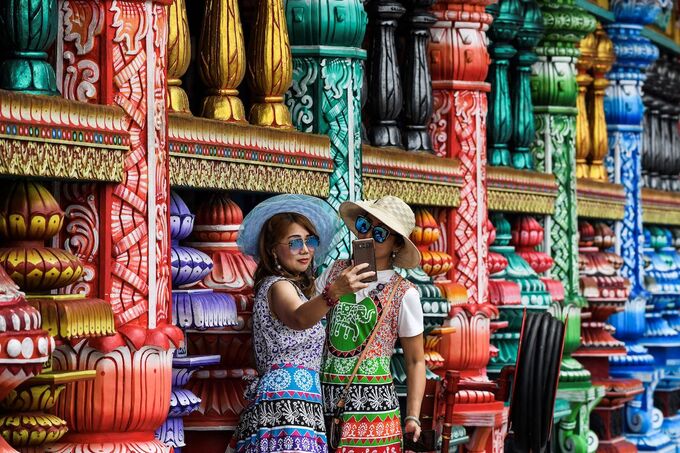
Two tourist take pictures at a temple in Batu Caves, near Kuala Lumpur on August 6, 2019. Photo by AFP |
After viewing units in townships popular with Singaporeans, they decided to rent a 250-sqm two-story house in the gated township of Gamuda Cove in Selangor.
“It was nearly a third of the prices we saw in other townships, although I have to drive around 40 minutes to reach the city center. But not living in the city center gives us better access to nature, and we do not really need to go downtown daily anyway,” he says.
Economically, they are paying less for more space. Their Singapore flat generates SGD3,200 in monthly rental income, while their Malaysian house, which is nearly four times the size of their flat, costs SGD900 a month.
Ng adds: “Essentially, our tenant pays for a landed house we could never dream of affording back home, and still leaves about SGD2,300 in our pocket every month.”
There are, however, trade-offs in living overseas. Some of the everyday conveniences and infrastructure people took for granted in Singapore are not easily replicated elsewhere.
For Chin, one such frustration is making payments in Thailand. As she is there on a tourist visa, she is unable to open a local bank account, leaving her reliant on alternative payment methods.
“The preferred mode of payment here is card-free, using a QR code, but because I’m on a tourist visa, I can’t open a bank account and everyday payments are made more difficult,” she says.
For Ng and Wong, the trade-offs in Malaysia are less about cost and more about safety, convenience and proximity to family.
“The land here is big and the nearest police station can be many kilometers away. We don’t have the same level of reassurance and confidence in law enforcement as we do in Singapore, and that’s definitely a trade-off,” says Ng.
Civil servant Tanya Ong, 32, lived in Nakhon Pathom, about 90 minutes from central Bangkok by public transport, between March 2024 and September 2025.
“My rate of accumulating savings was a lot slower and less comfortable than in Singapore because I was earning less.”
But the benefits outweigh the drawbacks. “Living overseas exposed me to a wider range of people from different backgrounds that helped shape how I thought about living a meaningful life,” Ong says.