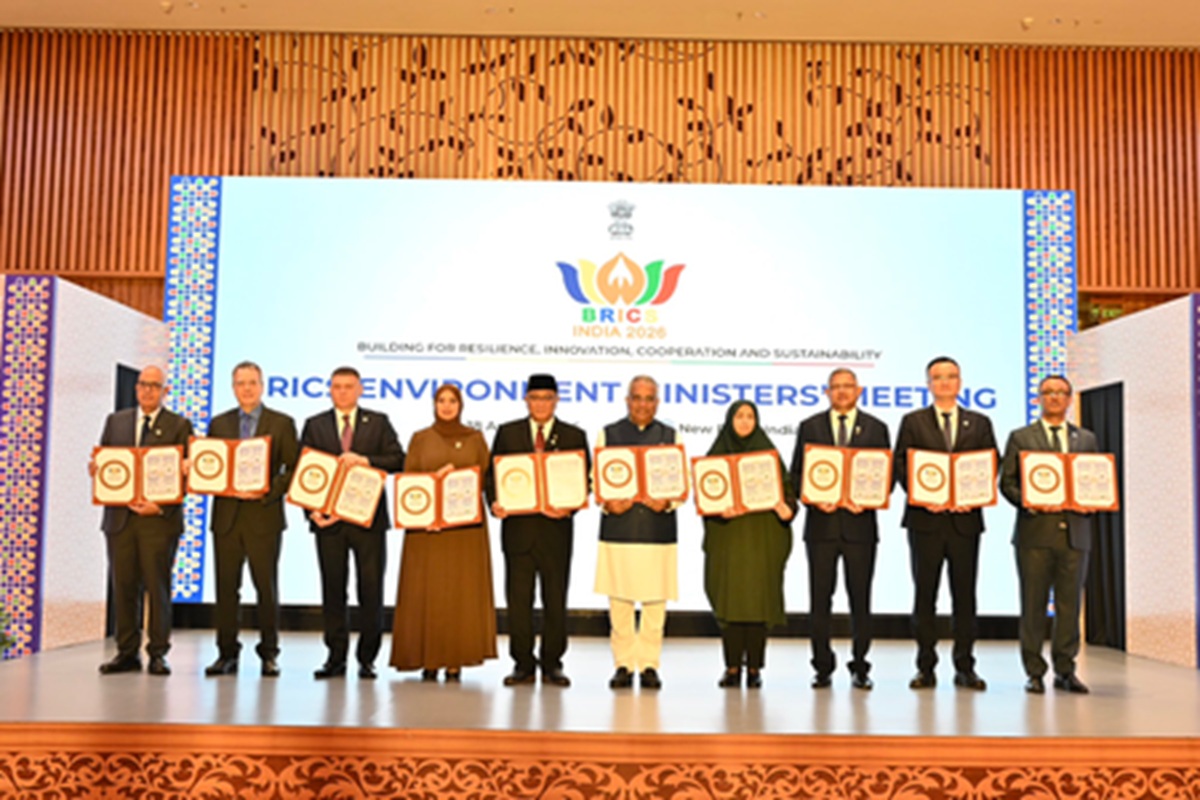
The joint statement also includes the BRICS principles of integrated landscape management to combat desertification, sustainable land management and ecosystem resilience. In addition, it also sets out principles for enhancing climate resilience through people-centred and community-based adaptation based on shared understanding and traditional knowledge on forest fire preparedness and response in BRICS countries.
Bhupendra Yadav, Minister of Environment, Forest and Climate Change, India, said, “Reflecting the spirit of cooperation and mutual learning, the Compendium of the Environment Working Group has been launched during the 12th BRICS Environment Ministers' Meeting under the BRICS Chairmanship of India. These Compendiums present a rich compilation of experiences, innovative approaches, traditional knowledge and shared experiences of the BRICS member countries.
He said India's chairmanship is guided by Prime Minister Narendra Modi's vision that puts the concerns of the Global South at the forefront of the agenda and redefined BRICS as building resilience and innovation for cooperation and stability. In this approach of PM Modi, there is a feeling of giving importance to humanity while keeping the people in mind.
He said the progress made during India's chairmanship is the result of months of dialogue, negotiation and cooperation. He called for building resilience without leaving communities behind, innovating responsibly and putting sustainability at the center of development.
The Climate Change Minister stressed that BRICS can transform cooperation into collective and cooperative capacity through knowledge networks, technical exchanges, training, technology cooperation and strong institutional partnerships.
Bhupendra Yadav emphasized the growing global climate challenges such as climate change, biodiversity loss, pollution and disaster risk, especially for developing countries where environmental sensitivities are often linked to larger development priorities.
They called for further strengthening of BRICS cooperation on forest fire prevention, preparedness, early warning, response and post-fire recovery. Also stressed the importance of climate finance, adaptation and empowering local communities.
Emphasizing India's position in this regard, the Minister said, “Ecological restoration and human development can go hand in hand.” He cited 'Mission Life' and 'Ek Ped Maa Ke Naam' as examples of this, which combine ecological restoration, public participation and community ownership.
The Climate Minister also called for bringing together traditional knowledge and modern science, so that solutions are scientifically sound, locally relevant and socially inclusive.
He highlighted that India's new Nationally Determined Contribution for 2031-2035 reflects an ambitious commitment to advance climate action as well as support inclusive growth and energy security.
The Environment Ministers' meeting also featured panel discussions and side events, including a BRICS high-level dialogue on climate change on the theme of 'people-centred, community-based adaptation'. The discussion on integrated landscape-based greening shared experiences of BRICS countries for resilient landscapes and sustainable development.