
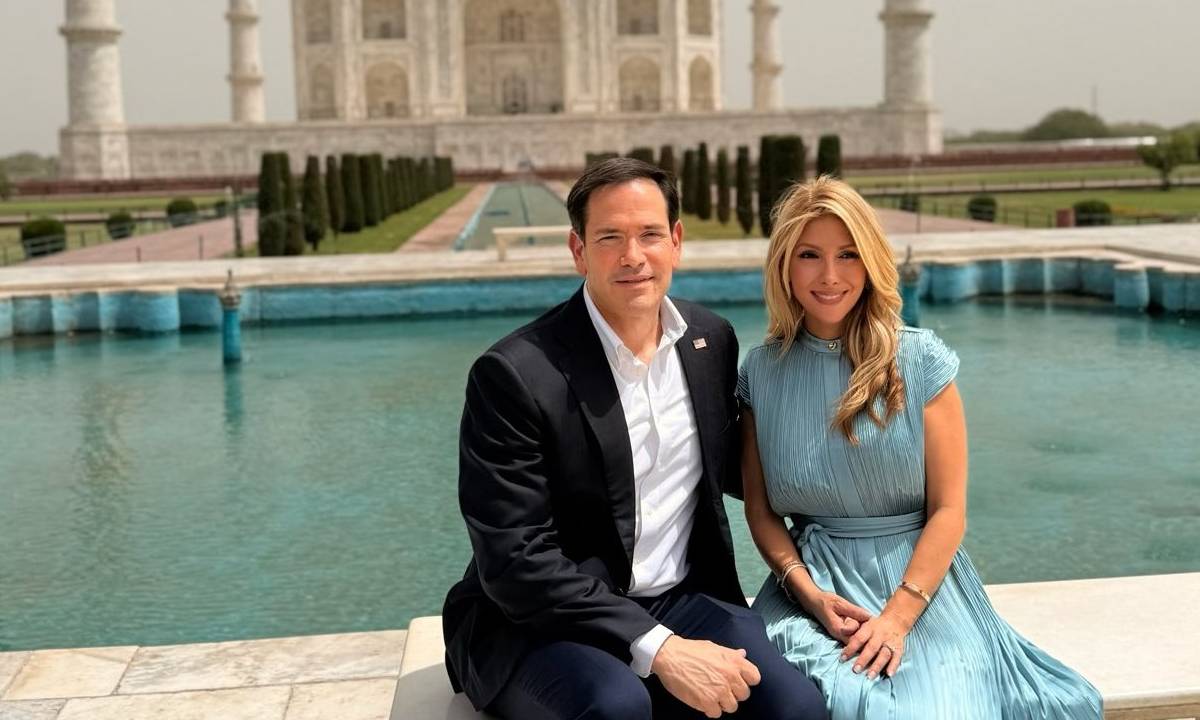

Iran on Rubio Taj Mahal Visit: US Secretary of State Marco Rubio reached Agra during his visit to India and visited the world famous Taj Mahal. However, his visit became a topic of discussion on social media, when Iran targeted him while referring to the historical and cultural heritage of Taj Mahal.
The Iranian Consulate in Hyderabad reacted sharply to the photographs of Marco Rubio and his wife clicked in front of the Taj Mahal. The Iranian Embassy said that if Rubio had proper knowledge of history and architecture, he probably would not have posed for photographs in front of this monument.
What did the Iranian Embassy say?
Iran’s Consulate posted on social media platform This statement has come at a time when talks are going on between the delegations of the two countries to end the ongoing tension between America and Iran.
The Iranian Embassy also said in its statement that Persian culture and art had a deep influence on the Mughal architecture of India. Mughal emperor Shah Jahan built the Taj Mahal in memory of his wife Mumtaz Mahal. Mumtaz Mahal belonged to a family of Persian origin. The Taj Mahal is considered a fine example of Indo-Islamic architecture, which clearly reflects Persian art and design.
Who built Taj Mahal?
According to Britannica, thousands of artisans and laborers from India, Persia and other regions worked in the construction of the Taj Mahal. These people contributed to the preparation of the tomb, its surrounding buildings and intricate decorations. According to the official website of Uttar Pradesh Tourism Department, verses from the Quran have been used for decoration in the Taj Mahal complex. The special thing is that these rectangles have not been painted, but have been cut out of stone and inserted in it.
How much do you know about Mumtaz Mahal?
Mumtaz Mahal’s real name was Arjumand Bano Begum. He was born on 27 April 1593 in Agra. She was the chief wife of the fifth emperor Shahjahan of the Mughal Empire. Mumtaz Mahal’s father Abul-Hassan Asaf Khan held a high position in the Mughal court and his family was of Persian origin. His mother Diwanji Begum also belonged to a Persian noble family. The ancestors of the family came to India from Qazvin (Iran).
His father, Abul-Hasan Asaf Khan, was an influential Persian nobleman who held a high position in the Mughal Empire. His mother Diwanji Begum was also from a Persian family and was the daughter of the famous Persian aristocrat Khwaja Ghiyas-ud-din of Qazvin.
- Asaf Khan’s family came to India in the year 1577 during a period of economic crisis. Later his father Mirza Ghiyas Beg got the opportunity to serve in the court of Mughal Emperor Akbar and gradually the family gained a big identity in the Mughal Empire.
- Mumtaz Mahal was also deeply connected to the Mughal royal family. Asaf Khan was the elder brother of the influential Empress Noorjahan, wife of the Mughal emperor Jahangir. In this way, Mumtaz Mahal was the niece of Noorjahan and later after her marriage with Shahjahan, she also became his step-daughter-in-law.
- Mumtaz Mahal’s elder sister Parwar Khanum was married to Sheikh Farid, who was the son of Nawab Qutubuddin Koka, the governor of Badaun. Qutubuddin Koka was considered the foster brother of Emperor Jahangir.
- Mumtaz Mahal’s brother Shaista Khan also became a very influential person in the Mughal rule. During the reign of Shahjahan, he served as the governor of many provinces including Bengal.
After the death of Mumtaz Mahal, Shahjahan decided to build the Taj Mahal in her memory. Mumtaz Mahal died on 17 June 1631. After this, the construction of Taj Mahal was started on the banks of Yamuna river in Agra, which is today counted among the seven wonders of the world.

Comments are closed.