
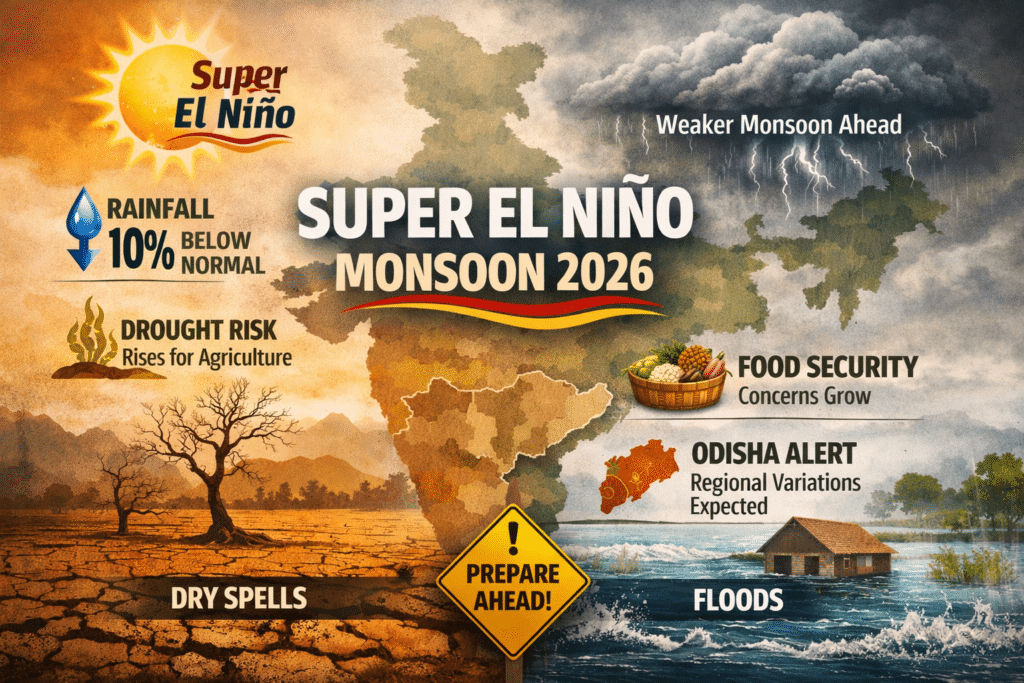

India’s monsoon season is under a cloud of uncertainty as the India Meteorological Department (IMD) has officially warned of below-normal rainfall this year due to the probable formation of a strong El Niño event.
Speaking to the media, IMD Director General Dr Mrutyunjay Mohapatra stated that conditions are favourable for El Niño to develop during the June–September southwest monsoon period. This climate phenomenon is expected to result in approximately 10% deficit rainfall nationwide, potentially affecting agriculture, water resources, and food security.
“Due to the influence of El Niño, rainfall during the monsoon season is likely to be below normal,” Dr. Mohapatra said. In Odisha specifically, northern regions may receive slightly less than normal rainfall, while southern and central parts are expected to see normal or marginally above-normal precipitation. Overall, spatial variability in rainfall will be noticeable, he added.
The central government has swung into action following IMD’s alert. States have been directed to accelerate drought-mitigation measures, ensure availability of short-duration and drought-resistant seeds, focus on moisture conservation, and prepare contingency plans for alternative crops in case of a 2–4 week delay in monsoon onset.
Agricultural experts emphasise that adopting climate-resilient farming practices will be key to minimising the impact. Meanwhile, senior meteorologist Dr. Sarat Sahu recalled the severe 2015 El Niño, which caused a 10% rainfall deficit and triggered extreme heatwaves exceeding 45°C in 2016. He warned that a “Super El Niño” — dubbed “Christ and Little Boy” by some international experts — could bring even harsher consequences for farmers in Odisha and across India.
On the global front, the World Meteorological Organisation (WMO) has raised a strong alert. There is an 80% probability of El Niño developing between June and August, with the event likely to persist at least until November.
WMO cautioned that this powerful El Niño could disrupt weather patterns worldwide, exacerbating droughts in some regions and causing flash floods in others, while further intensifying the effects of climate change.
The southwest monsoon is yet to reach Kerala, and models suggest it may arrive in Odisha after June 15. Farmers and policymakers are now racing against time to prepare for a challenging season ahead.
Comments are closed.