
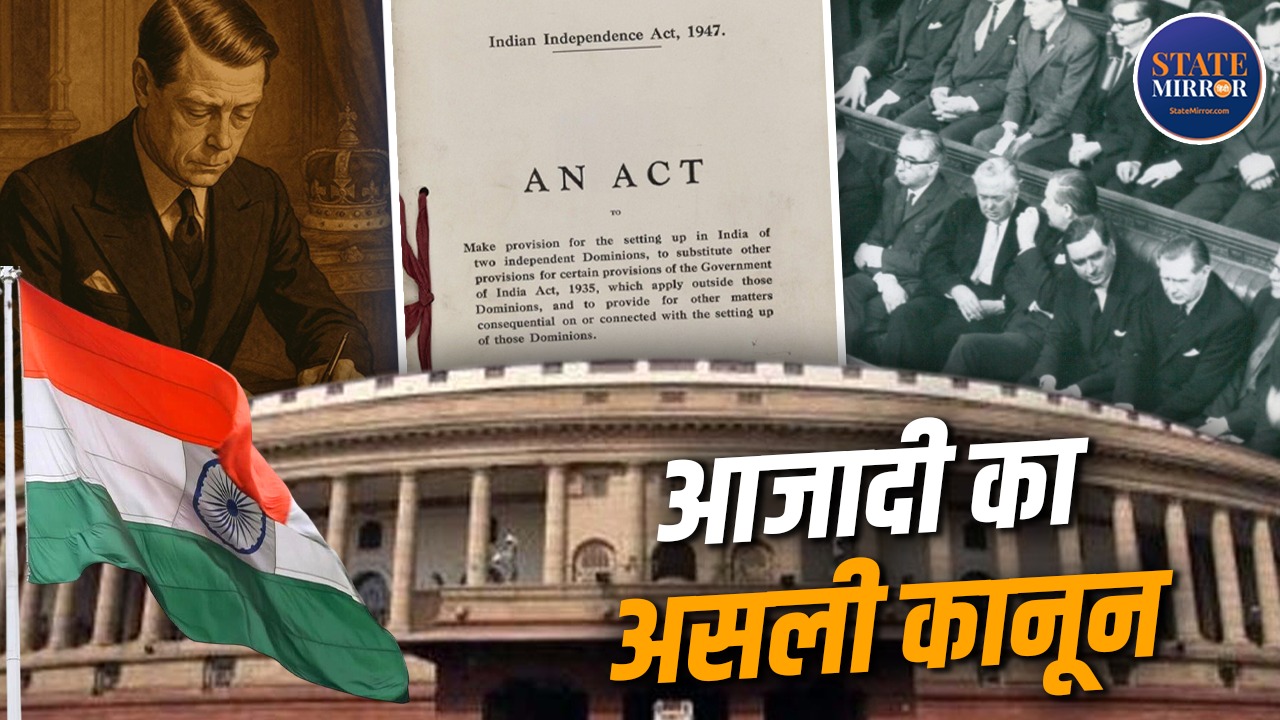
79 years ago on this day, the British King approved the Indian Independence Act, the complete story of the Indian Independence Act 1947.

18 July 1947. Buckingham Palace, London. A document was placed before King George VI of the British Empire, which was not just a law, but the legal result of the decades-long freedom struggle of millions of Indians. As soon as the king signed it, the Indian Independence Act 1947 became law and the farewell to the almost 200-year-old British rule was finalized. Exactly 28 days later, on 15 August 1947, India saw the first morning of independence. Therefore, 18th July is not just a date, but the day which gave legal recognition to India’s independence. Let us know the complete story of that historic act.
18th July: One of the most important dates in the history of independence
India got independence about 79 years ago i.e. on 15 August 1947, but 28 days before that, a legal process was completed which gave a legal basis to this independence. In fact, on July 18, 1947, Britain’s King King George VI gave royal assent to the Indian Independence Act, 1947. After this approval, this bill became law and the path for India and Pakistan to become independent nations was completely cleared. Therefore, 18th July is considered the day of laying the legal foundation of India’s independence.
Buckingham Palace where the constitutional process of Royal Assent was completed.
What was the Indian Independence Act 1947?
The Indian Independence Act, 1947 was a historic law passed by the British Parliament, which ended the British rule that lasted for almost two centuries. Through this Act, British India was divided into two independent Dominions – India and Pakistan. This law was prepared on the basis of the Mountbatten Plan of 3 June 1947. This act decided the legal framework for the transfer of power, determination of boundaries, status of princely states, administrative system and constitutional structure of the new countries.
Who approved the Indian Independence Act?
This Act was first passed by both the houses of the British Parliament – House of Commons and House of Lords. After this, on July 18, 1947, the then Emperor of Britain, King George VI, gave it Royal Assent. According to the British constitutional system, the approval of the monarch was required for any parliamentary bill to become law. That is why the Indian Independence Act officially became law on 18 July 1947.
Why was there a need to bring the Independence Act?
After the Second World War, Britain had become economically and militarily weak. On the other hand, the freedom movement in India had reached its peak. The Quit India Movement of 1942, the Naval Mutiny of 1946, the ever-increasing public pressure and the political deadlock over the transfer of power between the Congress and the Muslim League forced Britain to leave India.
Meanwhile, communal tension was also increasing rapidly. Under these circumstances, the Indian Independence Act was enacted for the partition of India and transfer of power on the basis of the Mountbatten Plan of 3 June 1947.
10 important factors of Indian Independence Act 1947
1. India and Pakistan became two independent Dominions
Under the Indian Independence Act, 1947, British India was divided into two independent Dominions—India and Pakistan—from 15 August 1947. Both India and Pakistan got the right to make their own administration, government and laws. Although both countries were initially Dominions of the British Commonwealth and the British monarch was considered the formal head of state, actual rule came into the hands of elected governments. This provision was the biggest constitutional provision for transfer of power.
The then British Prime Minister Clement Attlee
2. British rule over India and sovereignty of the Crown ended
With the implementation of this Act, the almost 200 years old rule of the British Parliament and the British Crown over India ended. The political and legal control that existed from the era of the East India Company to the British Raj was completely destroyed. Now India was completely independent in its internal and external affairs. Britain had no authority left in India’s administration, judicial system or policy making.
3. Provision of Governor General after abolishing the post of Viceroy
During the British rule, the Viceroy was the representative and supreme administrator of the British Emperor in India. This post was abolished after the Independence Act came into force. In both India and Pakistan, separate Governors General were appointed, who continued to act as constitutional heads until the process of transfer of power was completed. Lord Mountbatten became the first Governor General in India.
4. The right of the British Parliament to make laws for India also ended.
After 15 August 1947, the British Parliament could not make any new law for India or Pakistan. Before this, all major laws related to India were made in the Parliament of London. The Indian Independence Act ended this system. After this, the Constituent Assembly of India got full legislative powers and the laws of the country started being made in India itself.
5. The Constituent Assembly got the right to make the constitution and laws.
This Act gave the Constituent Assembly of India the right to make the Constitution as well as make laws as a temporary parliament. The Constituent Assembly prepared the Indian Constitution after various committees, debates and amendments for about two and a half years. With the implementation of the Constitution on 26 January 1950, India became a sovereign democratic republic and this Constitution became the supreme law of the country.
6. British supremacy over 562 princely states also ended
Under the Indian Independence Act, the supremacy of the British Crown over the ‘Paramountcy’ i.e. native princely states was abolished. After this, more than 562 princely states got the option to join India or Pakistan or remain independent. Later Sardar Vallabhbhai Patel and V.P. Due to the efforts of Menon, most of the princely states were merged into India. This was one of the most important steps towards political unification of independent India.
7. Government of India Act 1935 became temporary constitution
At the time of independence, India’s own constitution was not ready. Therefore, under the Indian Independence Act, the Government of India Act, 1935 was kept in force as a temporary constitutional arrangement with necessary amendments. The administration of the Center and the provinces continued under this legal framework. This system ended after the Indian Constitution came into force on 26 January 1950.
8. Division of properties, army and administration
Not only the territory was divided between India and Pakistan, but the army, government properties, financial resources, railways, postal department, records, government employees and administrative institutions were also divided. Different division councils and committees were formed for this process. This is considered one of the largest administrative reorganization in history.
9. Partition of Punjab and Bengal
Punjab and Bengal were divided under the Act. To decide the new boundaries of both the provinces, a Boundary Commission (Radcliffe Commission) was formed under the chairmanship of Sir Cyril Radcliffe. The Commission determined the boundaries on the basis of religious plurality and administrative grounds. However, after border demarcation, large-scale communal violence, migration and humanitarian tragedy were witnessed, in which lakhs of people were affected.
10. Date of transfer of power 15 August 1947
The Indian Independence Act clearly declared 15 August 1947 as the official date of transfer of power. On this day, the British government handed over the reins of governance to India and Pakistan. In India, Lord Mountbatten became the first Governor General and Pandit Jawaharlal Nehru took charge as the first Prime Minister. This day symbolized not only political independence but also the beginning of a new era for India legally and constitutionally.
What is the historical significance of the Indian Independence Act, 1947?
The Indian Independence Act 1947 was not just a law, but it was the constitutional document that gave the legal basis to India’s independence. Due to this act, British rule ended, India got the right to make its own constitution and the foundation of democratic governance was laid. However, this law also led to the partition of India, which gave rise to one of the biggest human tragedies in history. Despite this, this Act is counted among the most important constitutional documents towards the building of modern India.

Comments are closed.