
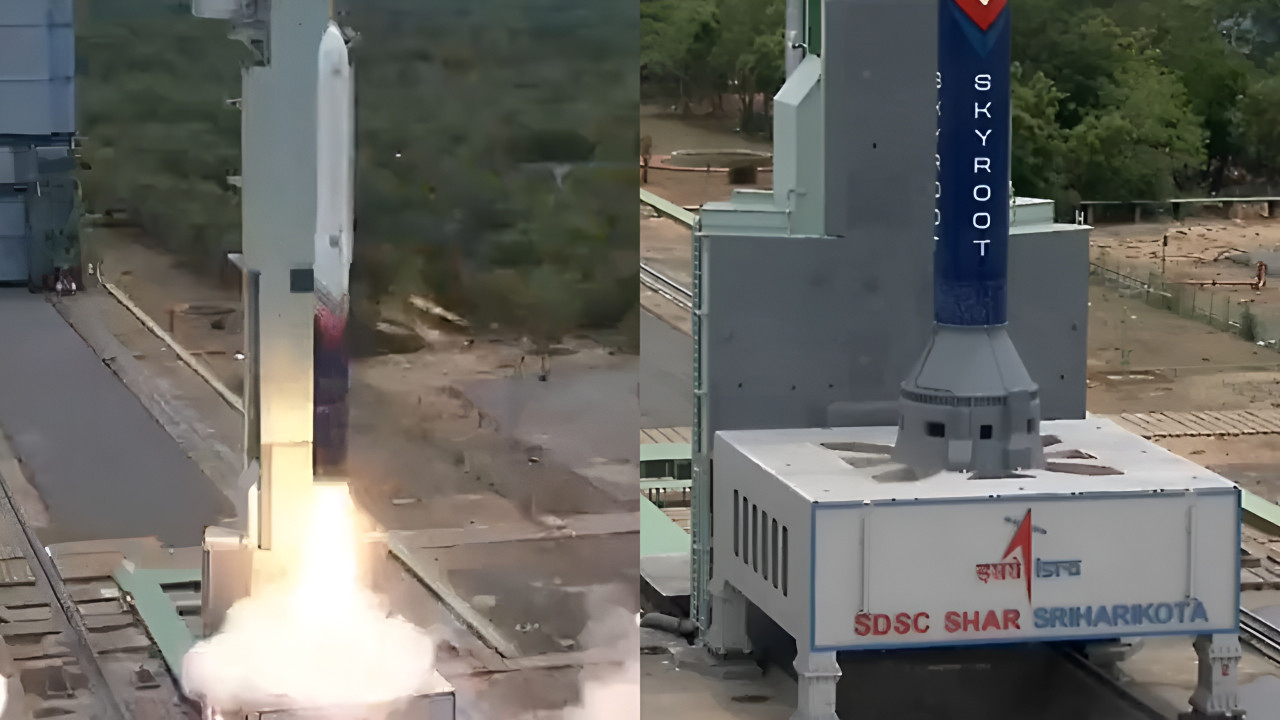

New Delhi:India’s private space sector created a new history on Saturday. Hyderabad-based Skyroot Aerospace successfully launched the country’s first privately developed orbital rocket Vikram-1 from the Satish Dhawan Space Center in Sriharikota, Andhra Pradesh. Let us tell you, after the successful launch of Vikram-1, PM Modi called the entire team of Skyroot and congratulated him. With this launch, India’s private space sector has started a new chapter and has shown that now private companies are also ready to play a bigger role in space missions.
Let us tell you, initially it was to be launched at 11:30, but during the final countdown, the launch was stopped for a few minutes due to technical inspection. After completion of all system checks, the countdown resumed and the rocket took off successfully.
#WATCH | Andhra Pradesh: India’s first privately developed orbital-class rocket, Vikram-1, launched from the Satish Dhawan Space Center in Sriharikota.
Built by Hyderabad-based Skyroot Aerospace, Vikram-1 is powered by three solid-fuel stages and a liquid orbital adjustment… pic.twitter.com/QQC9CPjcxH
— ANI (@ANI) July 18, 2026
mission arrival given name
This mission has been named ‘Mission Arrival’. Its purpose was to test the technology and various systems of the rocket. The rocket also carried several technology payloads, including Graha Space, CosmoServe, DCubed and Skyroot’s own payloads. Apart from this, a special micro-art piece made of 18 carat gold, an artwork named ‘Cosmic Bloom’ and a handwritten ‘Vande Mataram’ postcard of Prime Minister Narendra Modi were also sent to space.
Made from carbon-composite material
Vikram-1, about seven storeys high, is made entirely of light and strong carbon-composite material. It has been fitted with three solid-fuel stages and a liquid orbital adjustment module, which will help in placing the satellites in their fixed orbit. This rocket has the capability to deliver payload of up to 350 kg into the low earth orbit.
Why was the rocket named Vikram?
This rocket has been named in honor of Dr. Vikram Sarabhai, the father of the Indian space program. Skyroot had earlier successfully tested the Vikram-S suborbital rocket in 2022. Started by former ISRO scientists in 2018, this company aims to provide reliable launch services at low cost. Experts believe that the success of Vikram-1 will give a new impetus to India’s space sector, private investment will increase and the country’s position in the global satellite launch market will be further strengthened.

Comments are closed.