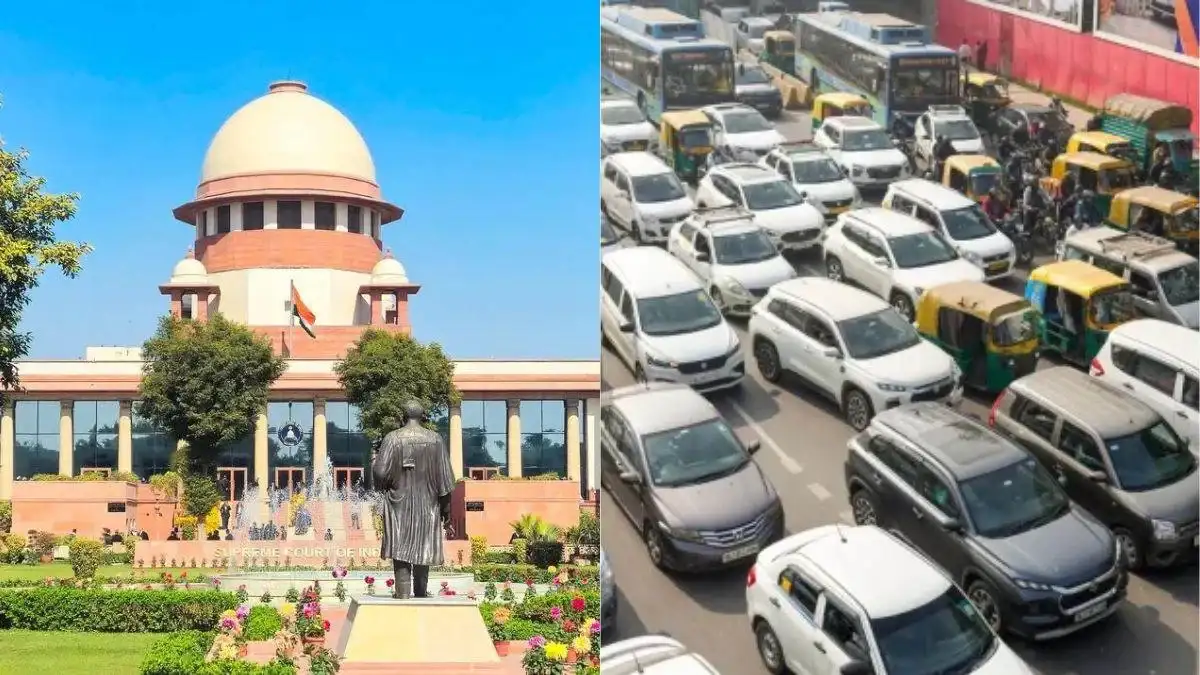
Petrol or diesel should not be given to vehicles which do not have third-party insurance. The Supreme Court has directed the Central Government to prepare a pilot project for this purpose. Under this initiative, vehicles without insurance will not get fuel at petrol pumps. Additionally, the Supreme Court has extended the deadline for mandatory third-party insurance for new vehicles. Let us understand the court's instructions, its implementation and its impact on the common man through questions and answers.
Question 1. What instructions did the Supreme Court give regarding petrol/diesel and car insurance?
Answer: The bench of Justice Sanjay Karol and Justice Prashant Kumar Mishra has directed the Central Government to start a pilot project. Under this project, petrol pumps will be linked to the valid third-party insurance status of the vehicles. If the insurance of the vehicle is found invalid, then petrol or diesel will not be given at the pump. The vehicle will not get fuel until the owner gets the insurance done.
Question 2. Why did the Supreme Court decide to take such a strict step?
Answer: According to the data presented in the court, about 56% of the vehicles plying on the country's roads have no insurance coverage. The report of the Standing Committee on Finance (2024-25) states that when these vehicles are involved in road accidents, the victims or their families do not receive adequate and timely compensation.
Question 3. How will insurance verification be done at petrol pumps?
Answer: As per the directions of the Supreme Court, the Insurance Regulatory and Development Authority of India (IRDAI) and the Ministry of Road Transport and Highways will work together on this pilot project. Automatic Number Plate Recognition (ANPR) cameras will be installed at petrol pumps and main roads. These cameras will automatically verify the insurance status of the vehicle by linking the number plate with the data of the Insurance Information Bureau (IIB) and the vehicle portal of the central government. The Ministry of Petroleum and Natural Gas has given its consent for this system.
Question 4. What changes will there be in the rules of third-party insurance for new car buyers? Answer: The court has extended the period of third-party insurance required at the time of registration of a new vehicle by one more year…
New cars: Now it will be necessary to buy third-party insurance for 4 years instead of 3 years.
New bike/scooter: Now it will be necessary to buy third-party insurance for 6 years instead of 5 years.
The rule of 3 years coverage for cars and 5 years for bikes was implemented in 2018; But, even after so many years, lakhs of vehicles are running without insurance. That is why this period has been extended.
Question 5. How will the police check the presence of insurance during roadside checking?
Answer: At present, state police forces do not have any uniform system to carry out instant insurance verification on the spot. Therefore, the Court has directed that handheld devices or mobile apps be provided to the State Police. These devices will be directly linked to the vehicle portal and Insurance Information Bureau (IIB) database. This will enable the police to instantly check the real-time insurance status of vehicles and issue e-challan.
Question 6. What instructions have been issued to solve the problem of long lines and delays at toll plazas?
Answer: In view of the accidents on National Highways and long lines at toll plazas, the Supreme Court has directed the Central Government to start a pilot project on selected corridors. Under this initiative, the process of stopping vehicles at toll plazas will be abolished and replaced by Automatic Number Plate Recognition (ANPR) system, which will allow vehicles to pass without stopping.
Question 7. What is the impact of uninsured vehicles on the general public and the victims of road accidents?
Answer: Third-party insurance is mandatory under Section 146 of the Motor Vehicle Act (MVA). Its main objective is to provide immediate financial compensation to the victims of road accidents. When the car is not insured, victims or their families have to make repeated trips to court for years to get compensation and fix liability. The situation becomes even more serious when an earning member of the family dies in an accident or becomes permanently disabled.
Question 8. Will vehicle owners get additional insurance options or customization features? Answer: Yes, the Supreme Court has directed IRDA to provide various policy options to private vehicle owners. These should include options like personal accident cover, add-ons and 'own damage' cover, so that people can choose the insurance as per their specific needs.
Question 9. What is third-party insurance?
When your vehicle causes damage to another person (third-party), their vehicle or their property, the insurance company compensates for that loss. Under Section 146 of the Motor Vehicle Act, third-party insurance is legally required for every vehicle. In India, it does not cover damage caused to your own vehicle.