Nearly fifty years ago, in Yash Chopra’s Deewaar, released on January 24, 1975, Amitabh Bachchan delivered what would become one of Hindi cinema’s most enduring lines:
“Tum mujhe dhoondh rahe ho aur main tumhara yahan intezaar kar raha hoon.”
(“You are looking for me, and here I am, waiting for you.”)
The line became the defining expression of the Angry Young Man. Its power lay not in bravado but in the inversion of fear. The hunted refused to hide. Instead, he walked into the enemy’s den and dared those pursuing him to confront them on his own terms. In that single moment, the prey became the challenger.
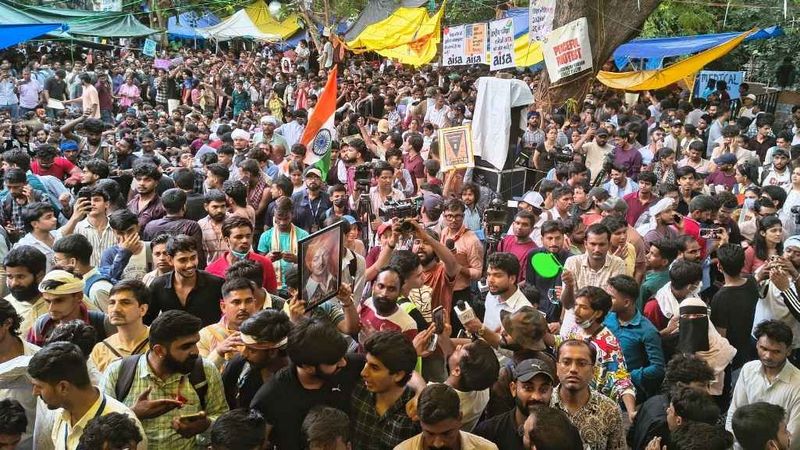
Nearly fifty-one years later, it was no longer one Amitabh Bachchan. Thousands of young men and women descended on Delhi’s Jantar Mantar, barely few kilometres from Parliament. They were not film characters confronting a fictional mafia. They were students confronting the State they believed had ignored, dismissed and criminalised their aspirations. Their slogans seemed to echo Vijay’s similar challenge to power:
“Tum mujhe dhoondh rahe ho aur main tumhara yahan intezaar kar raha hoon.”
The Gen Z was mostly unnoticed and to an extent ridiculed by bloomers and millennials. These youngsters were assumed to be apolitical, hooked to reels and individualistic. When they started trickling down at Jantar Mantar their presence was acknowledged with smirk by the political masters of the NATION. They assumed a handful of “Cockroaches” will either wither away on their own or can be squashed by little finger of the STATE.
But, like the nightmare in Creepshow- an American horror comedy- where a few cockroaches multiply into an overwhelming infestation, the trickle at Jantar Mantar soon turned into a surge. What was dismissed as a passing irritation began to demand attention.
To be young and unheard is not passivity. It is a fuse with a long delay. It was true in Paris in ’68, in Tiananmen in ’89, and in Nepal last year. Youngsters filling the streets didn’t carry manifesto. But what they carried was an insult, reframed.
The “insult” was not a one-off; it was hurled at them repeatedly. Rahul Gandhi had alleged that 152 paper leaks over the past decade affected 7.5 crore students. The government responded it’s investigating. But, the grievance it represents is unmistakable.
To be young is to live with the impatience of possibility. Though, what repeated leaks emphasised was that enduring “injustice” with patience was what it means to be young. Patience and accepting status-quo is the very antithesis of being young.
The spirit of “change” eventually spilled onto the streets. The anger acquired a language of its own. Memes, reels, music, satire and short videos became the new grammar of protest. Dark humour played out in the shadow of Parliament, confronting the sanitised language of formal politics with irreverence, ridicule and wit. The physical crowd had acquired a digital shadow stretching across the country.
The youngsters did not come like a Trojan horse to destroy the city of Troy. They came seeking a “Shastrarth”-a debate, a contest of ideas, in the true spirit of Sanatan Dharma. They were seeking dialogue, not monologue; an argument, not an echo. Their pushback was not against the State itself, but against a unidirectional narrative in which only power speaks.
The “cockroaches” multiplied, mutated and grew stronger. The anti-cockroach arsenal-water cannons, batons and the coercive machinery of the State- lost its potency. Every attempt to “crush” them seemed only to make them more resistant. Even the proverbial “HIT spray” lost its effectiveness.
Jantar Mantar was a spectacle of rage. Even if smaller in magnitude than Black Lives Matter but no less polarising, ideologically fluid and often incoherent. The messaging was raw, immediate and largely unedited.
In Russian, Pravda means “truth”. The official newspaper of the Communist Party of the Soviet Union carried that name. But the “truth” it printed was, in effect, the “truth” sanitised and sanctioned by the State. Soviet dissidents developed “Samizdat”- Sam means “self” and “izdat” means “to publish”. A “self-publishing” system for circumventing the State’s “truth” and disseminating their version of “truth”
To the protesters, much of the mainstream media had come to resemble Pravda. The online world became the new samizdat-a parallel space where their anger, frustration and dissent could disseminate without passing through institutional gatekeepers. The State had its batons and water cannons; the protesters had their phones.
The State, in the vicinity of Jantar Mantar, continued to believe-until it was jolted hard enough-that the protesters would eventually accept its version of “Truth”, its own Pravda. What it failed to comprehend was that Gen Z had circumvented Pravda and had no use for Prada either .
They were unlike the characters in “The Devil Wears Prada”, for whom Miranda Priestly’s approval-the seal of authority from the powerful editor who rules the fashion world-was the currency that validated their choices. These youngsters needed no such validation. They did not wait for anyone to decide when, how, or in what tone and tenor they could question power. They had already granted themselves that permission.
Amitabh Bachchan in Deewar-and in much of the cinema of the 1970s and 1980s-was the hero of a country caught in a whirlpool of economic, social and political churning. He as a “Angry Young Man” fought a system that seemed stacked against the ordinary citizen, giving expression to anxieties over employment, education, inequality and opportunity. Audiences cheered him for taking on the powerful.
About fifty years later, the reel life was played out in real a manner sharing similar anxieties but with slight difference. There was no single Amitabh Bachchan at Jantar Mantar. Each young protester has, in a sense, was an Amitabh in her or his own right. Each one was confronting the system .
One of Vijay’s memorable lines in Deewar, he said to Dawer Seth, was : “Main aaj bhi phenke hue paise nahin leta.” Gen Z emphasised the similar expression by shouting from the lung: We won’t accept crumbs, patronage or favours.
That is perhaps the larger message from Jantar Mantar. The young were demanding accountability in the process, dignity in their lives and the freedom to make their own choices. The State can choose to treat them as an irritation to be managed or recognise them as a force to be engaged. The choice, ultimately, belongs to power.