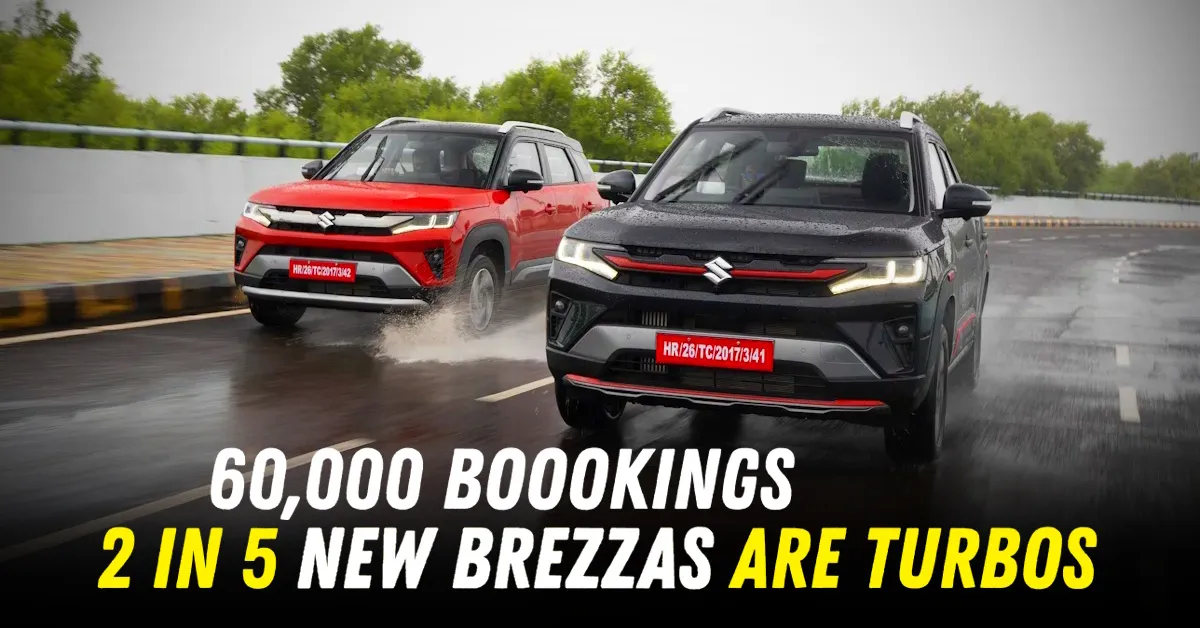
Maruti Suzuki’s decision to put a 1.0-litre turbo-petrol engine back into the Brezza appears to have found customers quickly. More than 40 percent of the 60,000 bookings received for the facelifted Brezza in its first six weeks are for the new turbo-petrol versions. That works out to more than 24,000 bookings.
There is one important qualification to the headline: Maruti’s figure is for bookings, not completed retail sales. But with over two in five orders choosing the turbo, it is already a strong indication of demand. In equivalent manual variants, the smaller turbo engine is actually cheaper than the Brezza’s familiar 1.5-litre naturally aspirated petrol.
The Brezza Turbo starts at Rs 7.40 lakh for the LXi manual. The equivalent 1.5 petrol LXi costs Rs 8.30 lakh, making the turbo Rs 90,000 cheaper. The VXi Turbo is Rs 8.55 lakh against Rs 9.26 lakh for the 1.5 VXi, a difference of Rs 71,000. At ZXi level, the turbo costs Rs 9.85 lakh versus Rs 10.50 lakh for the 1.5 petrol, saving Rs 65,000.
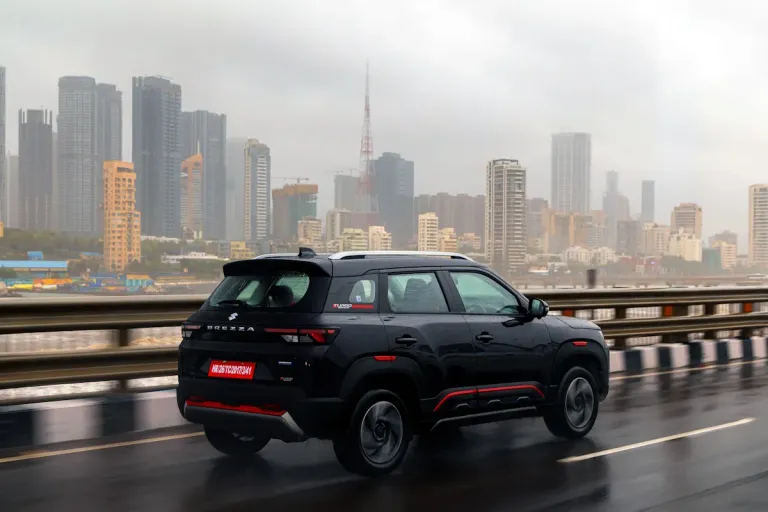
There is also a ZXi+ Turbo at Rs 11.16 lakh. The unusual price relationship comes from taxation. The 1.0-litre turbo Brezza qualifies for the lower 18 percent GST rate, while the 1.5-litre versions attract 40 percent. So the smaller engine is not being positioned merely as an expensive performance upgrade. For several variants, it is the lower-priced petrol choice.
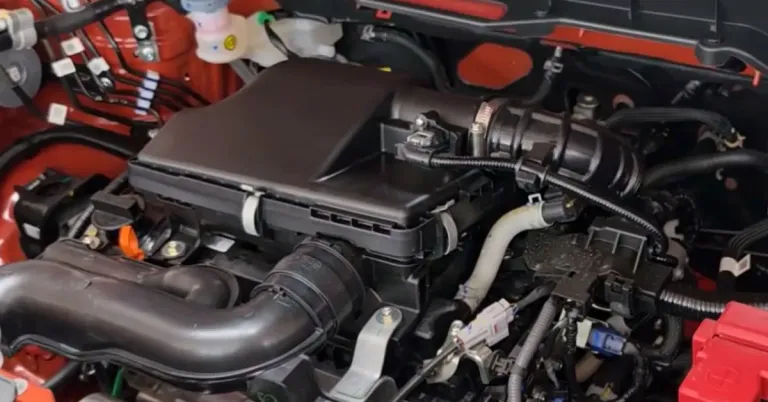
The turbo engine has another advantage. Its 1.0-litre three-cylinder unit produces 110hp and 170Nm. The 1.5-litre four-cylinder naturally aspirated engine makes about 103hp and 139Nm. The trade-off is choice of gearbox.
For now, the turbo is manual-only. Customers wanting an automatic Brezza still need the 1.5-litre petrol, which is available with a torque-converter automatic. Factory CNG also continues with the larger engine.
That leaves Maruti with three distinct Brezza propositions: a cheaper and punchier turbo manual, the smoother four-cylinder 1.5 petrol with manual or automatic options, and CNG for lower running costs.
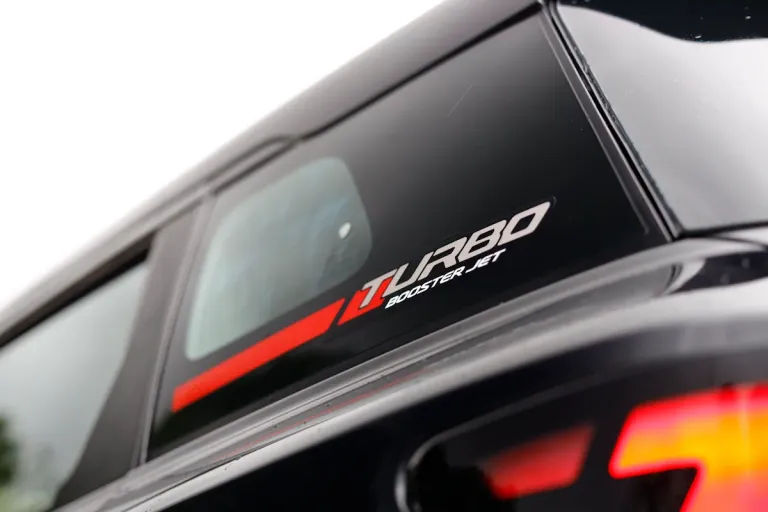
The facelifted Brezza has accumulated 60,000 bookings in roughly a month and a half. Maruti had said around the launch that Brezza sales were running at approximately 15,000 units a month. The current booking bank therefore represents about four months of sales at that earlier monthly rate, although bookings and eventual deliveries do not always convert one-for-one.
Supply is now the immediate constraint. Maruti says vendors and suppliers are working on capacity expansion and expects the ramp-up to take another two to three months. Brezza production takes place at Maruti’s Kharkhoda plant in Haryana, where the company began producing the SUV in 2025. The Victoris is also produced there.
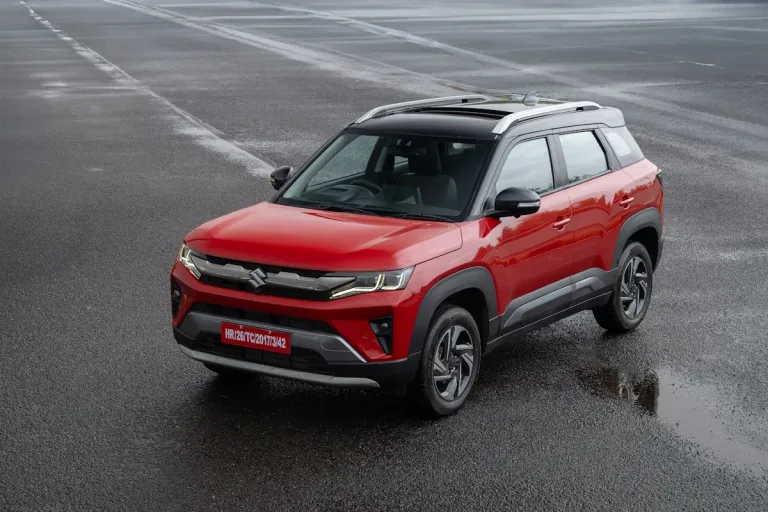
The earlier Brezza range relied on one 1.5-litre petrol engine, with CNG added later. That left Maruti without the small turbo-petrol option offered by many compact-SUV rivals. The 2026 update has changed that, but the more interesting move is how Maruti has used the tax advantage.
A turbo engine normally suggests a higher-priced variant. Here, the LXi Turbo costs Rs 90,000 less than the equivalent 1.5 petrol while producing more power and substantially more torque. That helps explain why more than 24,000 of the first 60,000 bookings have gone to the turbo.
The missing piece is an automatic gearbox. If Maruti eventually pairs the 1.0 turbo with an automatic, its share could move further. For now, though, the early booking mix already shows that customers are not choosing the turbo simply because it is new. In several trims, it is simultaneously the more powerful and less expensive petrol Brezza.