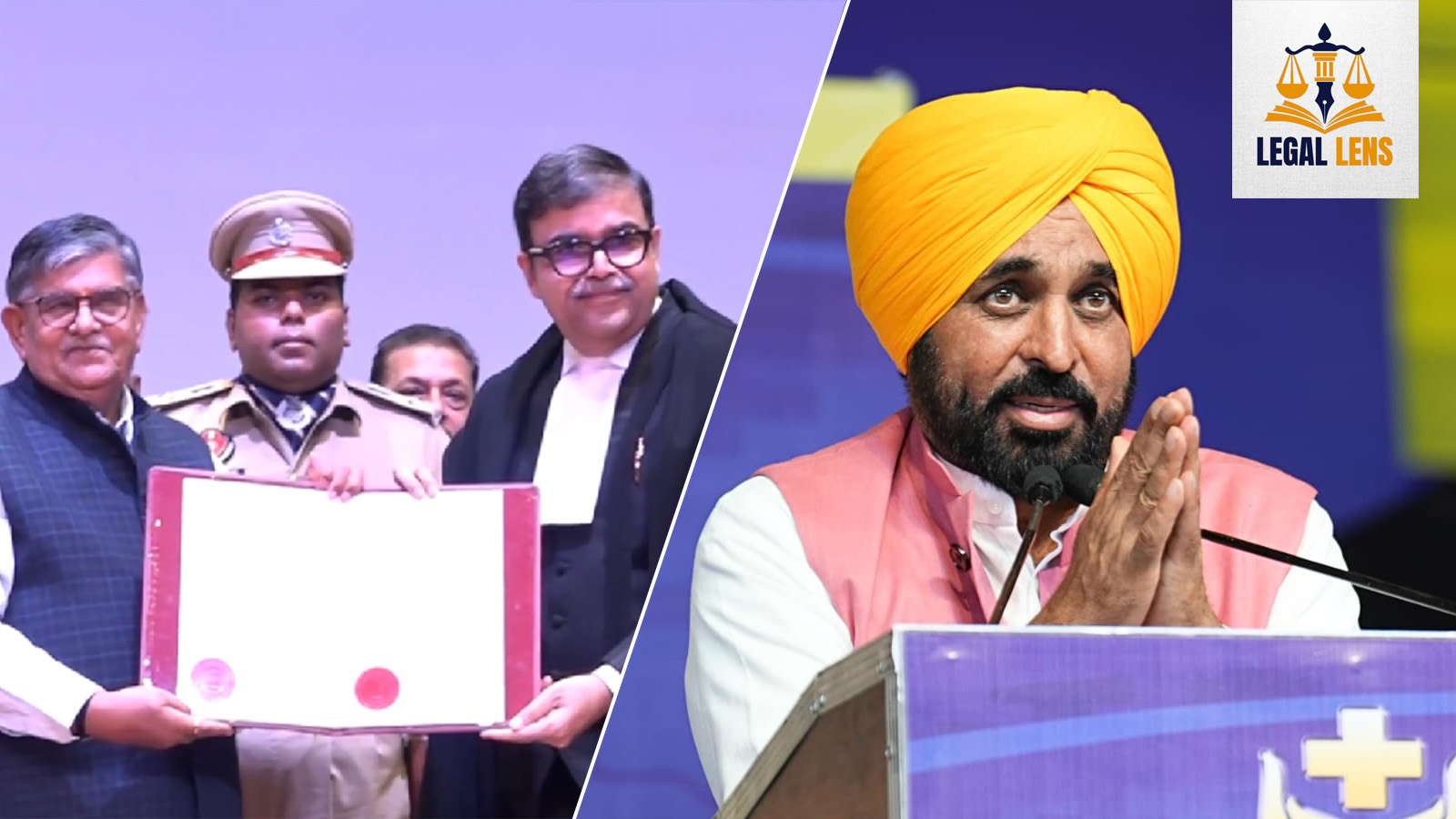
The empty chair reserved for Punjab Chief Minister Bhagwant Mann at the swearing-in ceremony of Punjab and Haryana High Court Chief Justice Ashwani Kumar Mishra on September 7 said more than an official statement could.
Haryana Chief Minister Nayab Singh Saini attended the ceremony at the Punjab Lok Bhavan in Chandigarh. Mann stayed away, a day after his Cabinet had held an emergency meeting demanding that Justice Mishra’s appointment as Chief Justice of the Punjab and Haryana High Court, as well as his oath, be put on hold. Punjab Governor Gulab Chand Kataria went ahead with the ceremony and Justice Mishra assumed office.
What were the real objections?
Punjab’s protest has since been presented as a Centre-state dispute over the state government’s place in the appointment of a high court chief justice. The Mann government says the Centre asked for its views but did not wait to receive them.
There is, however, another question that the controversy has brought into focus: what were the views Punjab wanted the Centre to consider?
Also read: Sikh youth’s alleged custodial torture sparks political storm in Punjab
The Cabinet resolution objects at length to the procedure followed by the Centre. It does not publicly disclose any reservation about Justice Mishra’s integrity, competence or suitability to head the high court. Nor has the government subsequently explained what it would have said about him if, as it demanded, the Centre had waited longer.
That missing part of Punjab’s case matters because the state had been allowed to respond weeks before the appointment was notified.
Punjab was informed in advance
The Supreme Court Collegium recommended Justice Mishra as the high court’s chief justice on August 6. The Union government sought the views of the chief ministers and governors of the concerned states on August 12. Justice Mishra’s appointment was eventually notified on September 5.
Punjab says the Centre should not have proceeded before receiving its reply. Its Cabinet relied on the Memorandum of Procedure governing appointments and argued that the state government’s views are part of the process.
The Supreme Court Collegium recommends a Chief Justice and the Centre obtains the concerned state government’s views. But the state government does not have the final power to accept or reject the Collegium’s candidate.
It also pointed out that the procedure does not specify a response deadline for a state government when a chief justice is being appointed. The Cabinet cited the earlier case of Justice GS Sandhawalia, whose proposed appointment as Madhya Pradesh High Court chief justice remained pending for more than two months while the Madhya Pradesh government’s response was awaited. Punjab said the different treatment strengthened its perception that the state was being discriminated against.
These arguments explain why Punjab objected to the process. But the Mann government is yet to explain why it has objected to Justice Mishra’s appointment.
Also read: Religious storm brews in Punjab as Akal Takht brands CM Mann ‘Guru Dokhi’
That distinction becomes sharper because reports indicate that Bihar, West Bengal and Maharashtra, whose chief justice appointments were being processed at the same time, sent their inputs promptly. Punjab’s response remained pending, and the four appointments were ultimately notified together on September 5.
Punjab has not publicly explained why it did not send its objections during that period, seek additional time, or at least inform the Centre that it had substantive reservations that required further consideration.
Did govt have issues with seniority?
The Cabinet resolution demands that Punjab’s views be “obtained and duly considered”. But it does not tell the public what those views actually were.
This is significant because Justice Mishra was hardly an unfamiliar judge whose record the Punjab government had suddenly been asked to assess.
He had been functioning as Acting Chief Justice of the Punjab and Haryana High Court since June 1, after the elevation of Chief Justice Sheel Nagu to the Supreme Court. Justice Mishra had also served in the high court since his transfer from the Allahabad High Court in July 2025. By the time his permanent appointment was notified, he had already headed the court for about three months.
Punjab had raised no comparable public objection to his functioning as acting chief justice.
There was, however, one political objection soon after the Collegium recommendation. On August 9, AAP national convenor Arvind Kejriwal questioned whether seniority was being bypassed in the Collegium’s choices and asked whether judges should receive Supreme Court elevation “out of turn”.
That statement forms part of the political background, but the Punjab Cabinet did not subsequently present seniority as the reason for opposing Justice Mishra’s appointment. Its formal resolution focused instead on the Centre proceeding without awaiting the state government’s response.
Also read: CJI Surya Kant: Judicial leadership suffers when judges pretend perfection
The distinction is important. A political party leader questioning the Collegium’s choices is different from a state government communicating its constitutionally sought views on a particular appointment.
If Punjab had concerns about seniority, suitability or any other aspect of Justice Mishra’s appointment, it has yet to say whether these were the views it intended to send.
Difficult court order
The timing has inevitably attracted further attention because Justice Mishra had headed a bench that passed a major order against the Punjab government on August 3, three days before the Collegium recommended him as chief justice.
The bench directed Punjab to pay pending dearness allowance and dearness relief to employees and pensioners. It also restrained the state government from undertaking “unproductive expenditures”, including large-scale advertising campaigns, until those dues were cleared.
The high court questioned how Punjab could plead financial constraints while spending public money on advertisements and other discretionary items.
The Centre has questions to answer too. On what basis did it conclude that it had waited sufficiently for Punjab? Why was the period considered adequate when the state says no deadline had been specified?
The financial implications were substantial, and Punjab challenged the decision before the Supreme Court.
The order has consequently become part of the political commentary surrounding the chief justice controversy. Opposition parties and some reports have drawn attention to the confrontation between the Mann government and the high court.
Also read: Justice Dipankar Datta flags instances where SC Collegium failed to protect upright judges
There is, however, no evidence presently available that the DA judgement caused Punjab to oppose Justice Mishra’s appointment. The state government itself has made no such claim. Drawing that conclusion would therefore go beyond the facts.
But the background discloses Punjab’s actual objections more important. If the government’s reservations had nothing to do with Justice Mishra’s judicial decisions, saying clearly what they were would prevent speculation from filling the gap.
Consultation is different from consent
Punjab’s public statements have repeatedly used the word “consent”, suggesting that Justice Mishra was appointed without the state government’s approval. The state’s constitutional role is better understood as one of consultation.
The Supreme Court Collegium recommends a High Court chief justice and the Union government obtains the concerned state government’s views. Those views can bring relevant information and objections into the appointment process. The state government, however, does not have the final power to accept or reject the Collegium’s candidate.
There is a practical reason for this arrangement. High courts routinely hear challenges to state government decisions. Giving a government the power to veto the judge who will head that court could make judicial leadership dependent upon executive approval.
Also read: SC judge flags lack of transparency in judicial appointments, says leads to calling people ‘ants’
The Punjab and Haryana High Court makes this even clearer because it serves two states. Haryana did not join Punjab’s objection and its chief minister attended Justice Mishra’s oath ceremony. Allowing either state government to determine the appointment would create an obvious difficulty for a common high court.
At the same time, consultation has little value unless a state government is given a genuine opportunity to respond. Punjab is therefore entitled to ask why the Centre proceeded without its views.
The Centre, in turn, can reasonably ask how long an appointment should remain pending when a state that has been asked for its opinion does not reply.
The absence of a clearly communicated deadline allowed both sides to claim that the other had acted improperly.
Questions for Punjab govt, Centre
Punjab has linked the episode to its wider disputes with the Centre, including rural development funds, flood assistance and Bhakra Beas Management Board rules. Mann described the appointment as another attack on Punjab’s constitutional rights.
That political disagreement does not answer the narrower questions created by the appointment process.
Did Punjab acknowledge the August 12 request? Did it indicate that its response was being prepared? Did it seek more time? Had the government formulated objections to Justice Mishra before September 5? If so, why were they not sent?
Also read: What Justice Bhuyan’s remarks on judicial transfers reveal about state of judicial independence
The Centre has questions to answer too. On what basis did it conclude that it had waited sufficiently for Punjab? Why was the period considered adequate when the state says no deadline had been specified? Was Punjab informed that the appointments would proceed if it did not respond?
Disclosure of the correspondence would resolve much of the dispute without requiring either side’s political interpretation to be accepted at face value.
Punjab should speak up
Justice Mishra has now taken charge, and the confrontation over his oath has ended. The argument over consultation nevertheless leaves an important issue behind.
Punjab can legitimately insist that when the Centre asks for a state government’s views on its high court chief justice, those views should receive meaningful consideration.
But that principle works both ways. A government demanding to be heard must also use the opportunity it receives to speak.
Punjab has told the country, emphatically, that the Centre did not wait for its views. The empty chair at the swearing-in made that protest impossible to miss.
What remains unclear is the simpler question: what did Punjab actually want to say about Justice Ashwani Kumar Mishra?