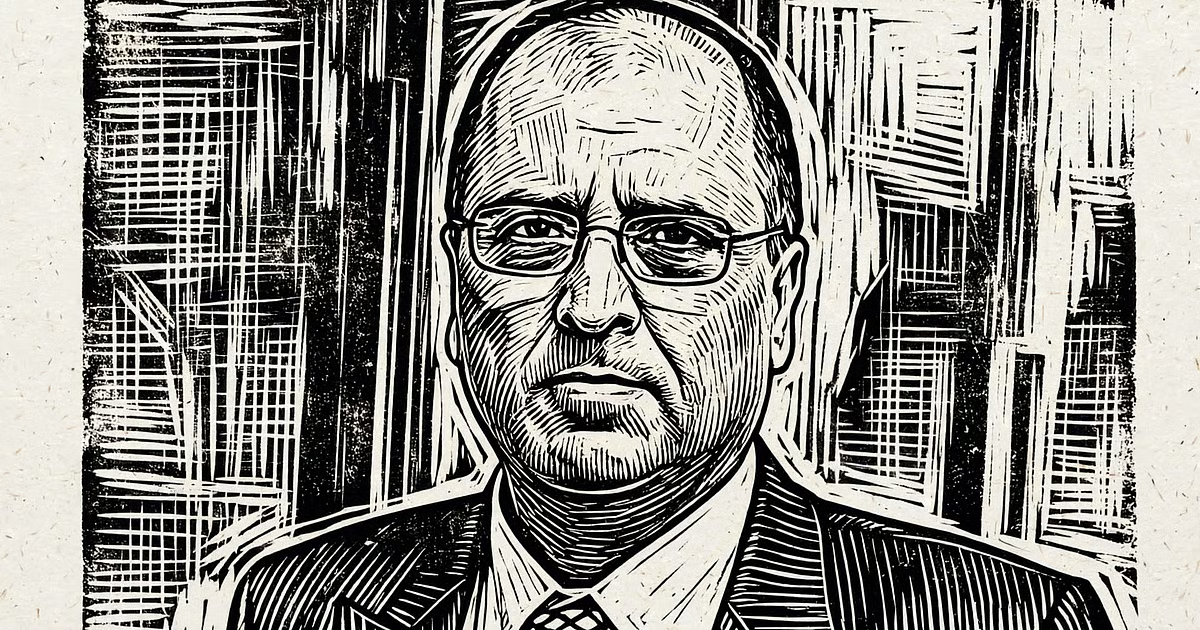
Subhash Chandra Kapoor once ran Art of the Past, a Madison Avenue gallery that traded in South and Southeast Asian antiquities. Investigators later linked his peripatetic network to more than 2,500 stolen objects worth over $143 million.
On September 9, 2026, the Madurai Bench of the Madras High Court ordered his repatriation to Germany, closing one part of a case that began with a temple burglary in Tamil Nadu and grew into a global antiquities conundrum. The order came after Kapoor filed a habeas corpus petition, arguing that the sentence tied to his extradition had already run out, and that his continued detention in India was unlawful.
What did the Madras High Court order on September 9, 2026?
The Madurai Bench of the Madras High Court, comprising justices A D Jagadish Chandira and N Gunasekaran, directed the Union Home Secretary to take custody of Kapoor from Tiruchi Central Prison and arrange his return to Germany. Kapoor had approached the court claiming his detention was now illegal, since he had already served the sentence tied to the case for which Germany extradited him. The bench agreed, and ruled that India could not lawfully hold him on the strength of other, pending idol theft cases without Germany’s consent.
Who is Subhash Kapoor, and what is he accused of?
Kapoor was a New York based antiquities dealer who owned Art of the Past, a gallery specialising in South and Southeast Asian art. US investigators, working with the Manhattan District Attorney’s Office, allege that Kapoor and his associates smuggled illegally procured antiquities into Manhattan and sold them to museums and private collectors worldwide. Between 2011 and 2023, authorities recovered more than 2,500 objects tied to his network, valued above $143 million. Indian investigators traced several of these thefts to temples in Tamil Nadu.
How did his arrest and extradition unfold?
Kapoor was arrested at Frankfurt airport on October 30, 2011, after Interpol issued a Red Corner Notice at India’s request. He was extradited to Chennai on July 13, 2012, to face trial over the theft of idols from the Varadaraja Perumal temple in Suthamalli village, Ariyalur district. A special court in Kumbakonam convicted him on November 1, 2022, for the theft and illegal export of 19 antique idols worth about J94 crore. He received a 10 year sentence, along with five associates.
Why did his sentence expire while other cases against him remained open?
Counting the years Kapoor had already spent in custody since his 2011 arrest, his sentence for the Suthamalli theft ended around October 31, 2022, by his own account. But Tamil Nadu’s Idol Wing wanted to keep him behind bars to pursue roughly 10 more idol theft cases pending against him. India’s extradition arrangement with Germany would not permit this without Berlin’s assent, and Berlin proved obdurate on several of the requests.