With housing prices on the rise across the United States, camper and RV living is arguably more tantalizing than ever in terms of the potential economics of it. And if that wasn’t enough incentive, you also have the living side of it — the more expensive vehicles you’ll see are genuinely far nicer and have better amenities than some permanent houses. Of course, like the houses they emulate, that’s at the far end of the spectrum, and there’s a massive variety in between. You have all sorts of mobile homes with just as varied pricing and levels of functionality.
In this article, we’ll be taking a look at several different levels of mobile homes designed with permanent living in mind, basically apartment buildings on wheels. That isn’t to say that it’s comprehensive, either. You have literal houses on wheels at one end, and converted kei trucks and small vans on the other. Van life remains a lucrative lifestyle choice here, despite the common myths surrounding it. Similarly, there’s a vast amount of appeal based on budget and personal choices. Some of these vehicles were built with frugality in mind, whereas others simply ooze luxury.
Given that they’re so all over the place, there’s no one category for a “true” mobile home. You could just as easily call a homemade converted sedan a mobile home. So we’re narrowing this list down to stuff you can outright buy with no assembly required, with different categories based on what type of vehicle it is — van, RV, truck chassis, trailer, and so on. Let’s have a look.
Class B stealth van conversion: Paradigm Longhorn
If you’re looking to get into that true van life experience and have money to splurge on skipping the DIY, this is probably what you’ll end up getting. The way it works is you start off with a new Ford Transit, which is then shipped to Paradigm Van Conversions for the work. Pricing will obviously vary depending on what you order, with starting prices around $72,965 for a 148″ T-350 with AWD. Short and extended-length versions are supported, with varying degrees of amenities.
It’s those amenities that really makes this option stand out. This is as basic a permanent, purpose-built mobile home can reasonably get while still being comfortable enough for most people to live out of. Naturally there’s always bound to be something smaller or cheaper, such is the way with the sheer variety of these builds. Something mid-range like this offers you plenty of comfortable, familiar living implements for your daily needs — a kitchenette, plumbing, solar charging, customizable furniture, removable bed, and more.
Ultimately, there’s only so much you can do here. It’s still a van, at the end of the day, so don’t expect anything fancier like expanding body panels and roof, accommodations for larger beds, or full shower without getting crazy with the sawzall. The point is to be stealth but retain enough comfort to permanently live in, which this van accomplishes perfectly adequately. For one or two van lifers, something like this parked in an innocuous spot won’t get a second look, which helps mitigate one of the many downsides of van life; finding parking.
Class C truck chassis: Jayco Greyhawk
Unlike more luxurious offerings by companies like Newmar, the Jayco Greyhawk remains fairly down-to-Earth and within reach of someone with enough money to put down on a starter home. It’s basically a Ford E-450 with an extended wheelbase and large, modern camper on the back, filled with all the amenities one would expect from a sub-$200,000 motorhome. It’s not the cheapest option offered by Jayco; that title goes to the Redhawk SE, which lacks many features like telescoping body panels without opting for a bigger floor plan. The Greyhawk simply packs all those in a slightly more refined package, with room for seven people at most.
This is most representative of that classical “house” vibe without being astronomically-equipped, so don’t expect a ton of luxury options. At a glance, the Greyhawk looks more like a modern, generously-spacious New York City apartment on wheels, with room for queen-size bedding, a full living room, wardrobe, kitchen, stand-in shower and full bathroom, and more. It’s also relatively monotone, with even the most premiere 31F floor plan being filled with grays and blacks throughout for a more minimalistic color palette.
As for the truck itself, the Ford E-450 is a fairly versatile platform as far as commercial work goes. It boasts the venerable 7.3-liter Godzilla V8, one of the most reliable modern Ford engines ever produced. It’s also got a 7,500-lb rated tow hitch and a GCWR — Gross Combined Weight Rating — of 22,000 pounds, which while not industry-leading, is still good enough to comfortably haul a whole family’s worth of stuff plus a separate vehicle.
Adventure truck: Winnebago ARKA
If you’re an outdoorsperson looking for a more rugged option, this has probably come across your desk (or tree stump) at one point or another. The Winnebago ARKA ups the price once again to over $330,000 for a “base” model, which is a lot of scratch for what is ostensibly a Ram pickup with a camper on the back. So what’s so special about it?
Like other adventure RVs in its class, the ARKA is sold around the idea of taking a small condo with you anywhere. Literally anywhere, in this case, with reviews praising the truck’s off-road capability thanks to its chunky 41-inch tires providing generous ground clearance. Moreover, it’s got enough insulation that Winnebago lists it as good between -10 to 120 degrees Fahrenheit. It’s not quite a “true” overland truck, in the sense that it’s a full conversion and not just an adaptation, but it carries all of the amenities one would need for daily life without the hassle of buying and modifying an overlander.
The sole 20Z floor plan comes with a bevy of options, ranging from different bed sizes, off-grid architecture like high-capacity power sources, insulated heated water tank, 15,000 lbs towing capacity, and more. It’s certainly more cramped than a Class B, with the main floor plan only extending the width of the truck, so it’s only really good for a few people at most. But for a traveling couple of means, or someone looking to live off-grid, it’s a solid choice, albeit a bit more specialized in terms of a permanent living solution.
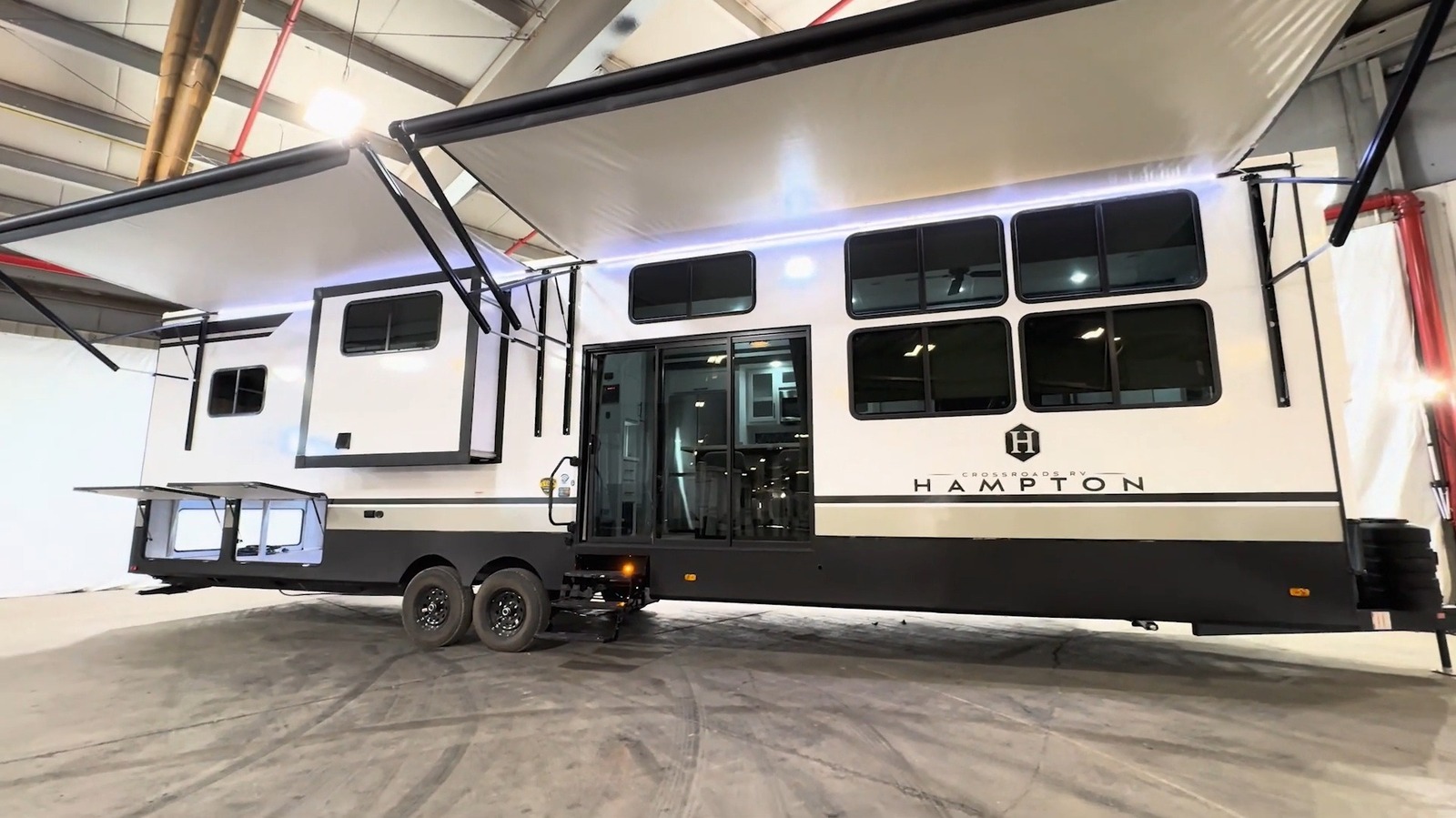
Trailer-based mobile homes: Crossroads Hampton
If you already have a medium-duty truck and are on a tighter budget than something like an ARKA would allow, this is your go-to. The Crossroads Hampton brings the price back down to Earth, with the basic floor plans starting at just below $100,000. It’s obviously not as stealth as something like a Class B despite being in a similar price range, but it more than makes up for that in spaciousness. Being unencumbered by the truck chassis means you have a lot more flexibility in terms of length, sides, and general layout.
Let’s use the absolute top-line example, the 410PVL, which comes in at a hefty 12,814 lbs with a listed maximum 15,500-lb limit. It’s just over 45 feet long with a pair of lofts on either side, 54 gallons of fresh water and 80 gallons of greywater, plenty of room for a full-size kitchen, living room, master bedroom with a king-size bed, and more. It’s quite literally the size of a small family home, condensed enough to be towable by a large pickup truck.
Given its price range and amenities, this is the classical example of a “true” mobile home. You could feasibly park this thing at any suitable park and live there full-time if you wanted, or keep on the road with equal levels of versatility. Of course, the main downside is you still need a vehicle to pull it, and large pickups aren’t cheap these days. Even accounting for that, however, this is still excellent value-for-money, especially paired with all the useful RV life gadgets that are out there.
Class A luxury home: Newmar Dutch Star
If you have a bulge in your wallet shaped suspiciously like $618,570 that you desperately want to be rid of, you could do worse than to drop it on a Newmar Dutch Star. And if that seems a bit low to you, don’t worry, the price only goes up from there. Granted, it’s a name that’s been around for decades, so you can probably snatch a used example for significantly cheaper.
Assuming you’ve never seen one of these before, a Class A luxury home is basically just a big bus that’s actually a motorhome. An extremely well-appointed motorhome, granted; you’re looking at the equivalent of a luxury one or two-bedroom apartment. Depending on the trim level, expect lots of hard-wood furniture and leather upholstery, plenty of open space to stretch out, windows aplenty for natural lighting, and all-season living. Moreover, despite the steep price tag, reviewers often praise the Dutch Star for its remarkable capability. Sure, it’s not the seven-figure star-level Class A’s that are out there, like this one owned by Brad Pitt, but there’s a reason why the Dutch Star is so ubiquitous and popular.
Overall, if you’re looking for a permanent home that’s a step up from a fifth-wheel and you have suburban family home money to splurge, this is probably your best option. It’s also just as customizable as a regular home is, with dozens of individual combinations of color, material, and floor plans to suit different tastes. The bigger floor plans in particular offer enticing features like an oversize shower, bunk beds for family living, retractable OLED TV, and even cathedral seating. Basically a house on wheels.
Our methodology
Given that each of these categories has a plethora of options, we went with a mid-range, popular package that best represented a modern, reasonable choice for mobile home living. There are far cheaper, more expensive, and more niche models on the market in all of these categories; instead, we went with a more generalized approach and split it by the general size and vehicle classification to give potential buyers a baseline expectation from each.
We went with the assumption that “permanent” meant that the vehicle had to function in all four seasons and operate anywhere in the continental United States without complaint in terms of climate. If this is your de-facto house, it must be equipped as such, with a fully functional bathroom, bedroom, enough space to do work, a kitchen able to cook full meals, and enough storage to haul a family’s belongings.
Our main sources were the company websites and brochures, listing facts such as prices, standard equipment, and floor plans in some cases. Reviews were taken either from long-term owners posting about their experiences or accredited RV journals discussing the nuances of these vehicles.