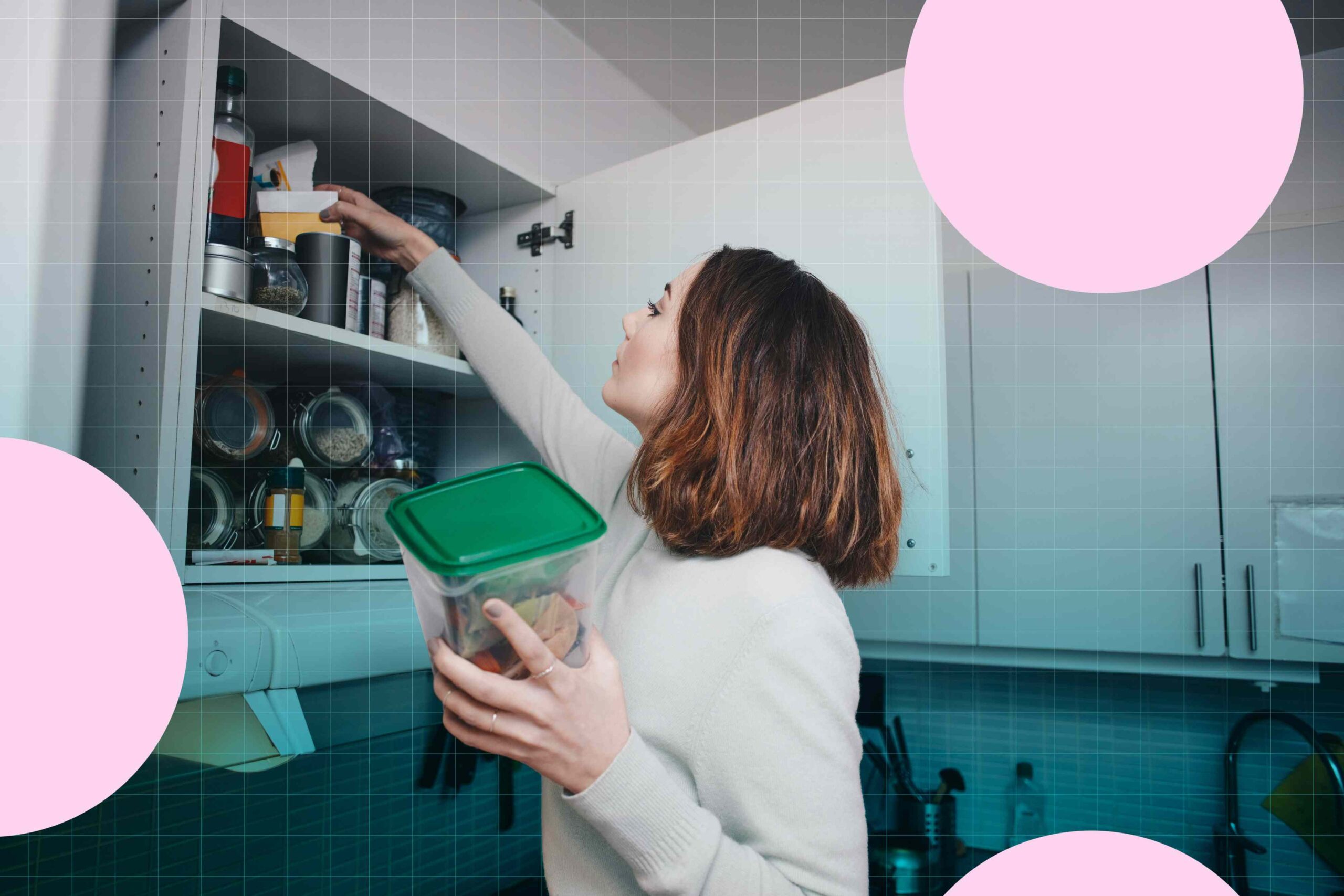
There’s a good chance you’ve got all of these items sitting around your house.
Reviewed by Dietitian Mandy Enright, M.S., RDN, RYT
Key Points
- Downsizing starts by reducing items in your home down to what you actually need and use.
- Excess gadgets, unused pantry items, water bottles and wellness items frequently get tossed.
- Wait and assess the need, purpose and longevity of your intended purchases before buying.
While most people don’t set out to live in a cluttered home, when our houses are filled with things we don’t use, it can overcomplicate many aspects of our day-to-day lives. Just ask Katie Swinsona real estate agent who helps clients downsize their spaces. Swinson says clutter happens because most of us unintentionally hold on to stuff we no longer need.
“If you think about it,” says Swinson, “clutter isn’t really a storage problem, it’s a decision-making problem. Every item in your home is something you had to decide to keep, and most of us never think to revisit that decision, so we just default to keeping things.”
What’s more, Abigail Roewho works with clients who are downsizing, says people tend to gather items in their home based on concepts, like their past selves or future imagined selves, and are hesitant to get rid of most of these things—just in case. But Roe and Swinson both agree, “downsizing” isn’t a bad word or something we should avoid in our homes.
“To me,” says Roe, “downsizing is reducing your household inventory until the amount you own is actually manageable for the life you live. It doesn’t necessarily mean moving into a smaller home or trying to own as little as possible. When we keep less, we’re not just creating physical space; we’re freeing up time, energy and attention for the things we actually want to be doing.”
But where should people who want to try downsizing even start? We chatted with Roe and Swinson about the items they most often see clients getting rid of when they take on a downsizing project. To begin your journey toward a clutter-free house, check your own home for these common items that frequently get tossed. Our experts also shared their top questions to ask yourself before making any future purchases.
Excess (or Duplicate) Kitchen Utensils & Gadgets
We’ve all had our “Impulse Buy” button triggered by crafty kitchen tools, but our experts say those items tend to sit in drawers and cabinets. “Anything like an avocado tool, egg slicer or mango cutter gadget,” notes Swinson. “All those nifty things given as a gift or [purchased as] an impulse buy from Amazon or QVC? We might use them a few times until the novelty wears off and they get stuffed to the back of a drawer and we end up using the handy-dandy kitchen knife to do the job.”
It’s also important to get rid of kitchen tools you own more than one of. “Kitchens accumulate duplicates incredibly quickly because every individual item is easy to justify,” says Roe. “Nobody thinks a spatula is useless, but very few households need 12 of them, and we tend to reach for the same favorites anyway.”
Expired (or Unused) Spices, Supplements & Pantry Items
Swinson and Roe also suggest raiding those pantries and spice cabinets, searching for expired items and anything that hasn’t been used in five years. “You can tell by the layer of dust,” jokes Swinson.
“Think spices, vitamins, supplements,” Swinson explains, “anything in the back of the pantry, fridge or even the garage. We buy these things because we have a spurt of optimism that it might solve a problem, but then we forget about them and they sit taking up space and building mental clutter.”
Roe says it’s important not to feel bad about trashing these unused items. “People often feel guilty throwing them away because they spent money on them,” she says. “But keeping something you’re never going to consume doesn’t recover the money or prevent the waste; it just means you’re storing the waste, too. I’d rather use that discovery as information about what I probably don’t need to buy again.”
Water Bottles & Food Storage Containers
As someone whose husband frets constantly over the messy cabinet where my teens and I throw our collection of water bottles, this one hurt. Still, Roe says those water bottles are a great place to start clearing room in your home and your brain. “These almost always come into our homes with good intentions, but somehow one becomes eight while we continue using the same favorite every day,” she says. “I like giving categories physical boundaries: if water bottles get one shelf, the shelf is the limit. When they stop fitting, that doesn’t necessarily mean you need a better storage solution; it may just mean you have too many water bottles.”
And those food storage containers? With all their mismatched lids? Swinson says to make like Elsa and let it go. “If it doesn’t have a matching top or bottom, it should be thrown away,” she insists. “Same goes for reused takeout containers—we think they might be useful but we only truly need a few of these to thrive in a week.”
“Someday” Fitness Equipment & Wellness Items
While this may be a tough category for some to get honest with themselves about, our experts say it’s important for lots of reasons. “Workout equipment, specialty appliances, supplements and other wellness products often belong to what I call our ‘Fabricated Self’: the person we imagine we’re going to become rather than the person we actually are,” says Swinson. “We buy the juicer because we’re going to make fresh juice every morning, or the workout equipment because this is finally going to be the thing that gets us exercising consistently. Letting go of an item that doesn’t fit your actual habits isn’t giving up on being healthier; it’s acknowledging that this particular method wasn’t right for you.”
“I’m a big proponent of doing an exercise that makes you feel good mentally and physically,” Roe agrees. “If you actually enjoy it, you are going to stick with it. So, if a piece of fitness equipment like resistance bands, a stationary bike or a trampoline has been sitting around unused for at least a year, it’s time to get rid of it and maybe reevaluate what actually brings you joy while simultaneously moving your body.”
Things to Ask Yourself Before You Buy
Roe uses a program with her Downsize Upgrade clients that she calls the “Deliberation Station,” a series of 14 questions you should ask yourself before making the decision to purchase a new item. “A pause between wanting it and buying it,” she says.
- Have I thought about it for at least two weeks? Giving the initial excitement time to wear off helps separate genuine wants from impulses.
- Does it solve a problem I’ve genuinely noticed? Make sure you noticed the problem before someone tried to sell you the solution.
- Do I already own something similar? Something you already have may do the job just fine.
- Is buying it worth giving up progress toward my next financial goal? Consider what else that money could do for you.
- Where will it be in five years? Fast-forward past the excitement of buying it and picture the reality of owning it.
- Do I have a place in mind to put it? Every new item needs a home.
- How long will I have to work in order to pay for it? Thinking of a price in terms of hours worked can completely change how expensive it feels.
- Can I be productive and happy without it? Ask whether you actually need the object to get the outcome you’re hoping for.
- What is the cost of it per use? Something inexpensive that you rarely use can be a worse value than something costly you use constantly.
- Does it support my priorities? A perfectly good item can still be the wrong purchase for the life you want to live.
- Is this the best way for me to obtain it? Could you borrow it, buy it secondhand, rent it or use something you already own?
- Is it a high-quality item with a reasonable price tag? If you’re going to bring something home, consider whether it’s made to last.
- What is my current mental state? Stress, boredom, excitement, comparison and urgency can all influence what feels necessary in the moment.
- What is the real reason I’m considering it? Get honest about whether you want the item itself or what you hope buying it will make you feel or become.
The Bottom Line
Our experts agree, just because you brought something into your home doesn’t mean you have to keep it there long-term. Taking time to think about how you use your space and which items you actually need around you can make a huge difference in your overall happiness and mental state. Plus, in the process of getting rid of clutter, you may find that the things you bought to help you achieve a goal are actually weighing you down and stopping you from being successful.
According to our experts, good items to go through to get started with downsizing are water bottles and food storage containers, duplicate and unused kitchen gadgets, fitness and wellness items you haven’t used in a year or more, and old pantry items.
Once you’ve conquered these items, you can always try Swinson’s tried-and-true method for downsizing a home, something she calls the “Post-It Test.”
“Pick one room, and put a Post-It note on each item within the room,” Swinson explains. “Give yourself one week— if you use an item in that room within one week, remove the Post-It. At the end of the week anything with a Post-It note still on should go through a more conscious deliberation.”