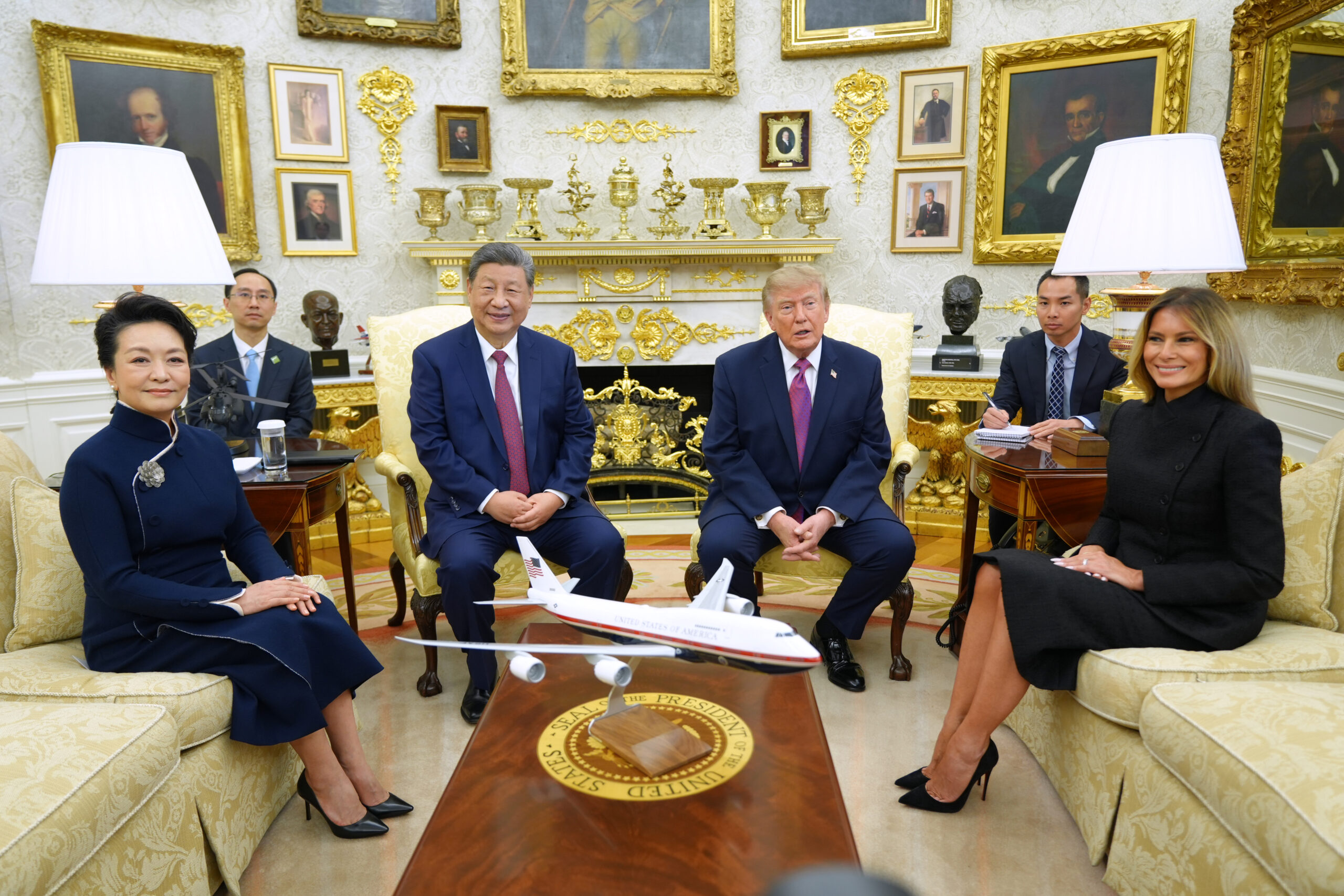
Trump Hails ‘Truly Great Friendship’ With Xi as White House Summit Begins/ TezzBuzz/ WASHINGTON/ J. Mansour/ President Donald Trump welcomed Chinese President Xi Jinping to the White House, praising their “truly great friendship.” The leaders began talks covering trade, artificial intelligence, Iran and Taiwan after extending a fragile tariff truce. Xi urged Washington and Beijing to avoid confrontation while announcing new educational exchanges and the arrival of two pandas in Atlanta.


Quick Look
- Trump hosted Xi for formal talks and a state dinner in Washington.
- The two countries extended their trade truce for two months.
- Trump and Xi discussed AI development and the need to keep it under human control.
- Major disagreements remain over Iran, advanced computer chips and Taiwan.
- Xi announced educational exchanges for 100,000 American youths.
- China will send two pandas to an Atlanta zoo.
- Some lawmakers criticized the lavish welcome given to Xi.


Deep Look
Trump emphasizes his personal relationship with Xi
WASHINGTON — President Donald Trump praised his relationship with Chinese President Xi Jinping on Thursday as the two leaders began a closely watched White House summit focused on trade, artificial intelligence and global security.
Trump placed their personal connection at the center of his opening remarks, describing it as a relationship built over nearly a decade.
“From the time of my first election in 2016, President Xi and I have forged a friendship, a truly great friendship, actually, built on mutual respect and the vital interests of our people,” Trump said.
Xi’s state visit comes as the United States and China compete for technological, economic and military influence while trying to prevent their rivalry from escalating into a broader confrontation.
Xi calls for competition without confrontation
Xi acknowledged the competition between the world’s two largest economies but argued that it should remain controlled and constructive.
He said competition “should be a healthy one and should be kept within bounds.”
“It should be a race of catching up with one another, not a wrestle in which one either wins or loses,” Xi said.
The Chinese leader also announced that Beijing would invite 100,000 young Americans to China for study and exchange programs over the next five years.
Xi said two pandas would soon be sent to an Atlanta zoo. He described the animals as an “envoy of friendship” and said they would meet the American public in a “few days.”
Artificial intelligence emerges as a central issue
AI was among the summit’s most consequential subjects as Washington and Beijing compete to develop increasingly powerful models, advanced semiconductors and data-center infrastructure.
Trump has sought to rebrand artificial intelligence as “superintelligence” and signaled that he does not favor restrictions that could slow American development.
“I want to leave it exactly where it is,” Trump wrote. “That is China’s position also.”
Xi emphasized the need to ensure that advanced technology remains under human direction.
“We have both the capability and responsibility to develop and manage AI for good and ensure that a development of AI is always under human control and serves the well being of the people,” he said.
Finance officials from both countries have discussed a possible notification system through which Washington and Beijing could alert each other about AI incidents affecting national security.
However, it remained unclear whether the summit would produce a formal agreement on that proposal.
Trade truce extended for another two months
Shortly before the talks, the United States and China agreed to extend their trade truce by two months. The arrangement had been scheduled to expire on Nov. 10.
Under the truce, both governments have reduced some tariffs and refrained from imposing additional restrictions while negotiations continue.
Treasury Secretary Scott Bessent said the extension could provide time for the two sides to negotiate a larger agreement by January. They could also decide to extend the temporary arrangement again.
Both leaders have political and economic reasons to prevent another disruptive trade fight. Trump’s Republican Party is approaching the midterm elections, while Xi is managing an uneven Chinese economy marked by weak domestic demand but strong technology exports.
Disagreements remain over Chinese purchases of American agricultural products, access to critical minerals and restrictions on advanced computer chips.
Iran remains a major source of tension
Trump has pressured China to use its economic influence over Tehran to help end the nearly seven-month war with Iran on terms acceptable to Washington.
China relies heavily on oil imported from the Persian Gulf, giving it a significant stake in restoring stability to regional shipping routes. But Beijing has condemned U.S. and Israeli military operations against Iran.
Xi previously warned that recent American foreign policy risked encouraging the “law of the jungle.”
China was also unsettled by the U.S. military operation that removed Venezuelan President Nicolás Maduro and transported him to New York to face narcoterrorism and drug-trafficking charges.
Despite these disagreements, Beijing has avoided steps that could cause a complete rupture in its relationship with Washington.
Taiwan remains the most sensitive dispute
Taiwan continues to be perhaps the most dangerous point of disagreement between the two governments.
China considers the democratically governed island part of its territory and has vowed to take control of it by force if necessary. U.S. law requires Washington to provide Taiwan with sufficient defensive equipment to deter an attack.
Beijing has pressed Trump to permanently end American weapons sales to Taiwan. Trump previously delayed final approval of a record $14 billion arms package and described the weapons sales as a “very good negotiating chip.”
Xi did not directly mention Taiwan during his public remarks Thursday but said the United States and China “must hold the line of no conflict and no confrontation.”
“We can certainly find the right path for two great countries to get along on this planet we both call home,” Xi said.
White House offers Xi an elaborate welcome
Trump arranged an unusually elaborate reception for the Chinese leader. He ensured that a new helicopter landing pad on the White House South Lawn was completed before the visit and personally greeted Xi and his wife, Peng Liyuan, when they arrived at Joint Base Andrews.
Xi also received a formal White House arrival ceremony and military review. First lady Melania Trump later accompanied Peng to the Smithsonian’s National Museum of Asian Art.
The state dinner was scheduled for the East Room because Trump’s planned White House ballroom had not yet been completed.
According to the first lady, the dinner’s décor “draws on the color red’s longstanding cultural significance throughout Chinese history.” The opening toast was designed to commemorate the historic “Toast to Peace” between President Richard Nixon and Chinese Premier Zhou Enlai in 1972.
The guest list included Amazon founder Jeff Bezos, Nvidia CEO Jensen Huang and Meta CEO Mark Zuckerberg, reflecting the prominence of technology and AI in the summit.
Lawmakers question the lavish reception
The ceremonial welcome drew criticism from lawmakers concerned about China’s military expansion, human rights record and support for American adversaries.
Sen. Roger Wicker, the Republican chairman of the Senate Armed Services Committeesaid Trump should not have offered Xi such an elaborate reception.
“Quite frankly, had the White House asked me for advice, I would have suggested the president not invite Xi Jinping to Washington for such a lavish welcome here in the United States of America based on all of the troubling issues we have with President Xi and the Chinese Communist Party,” Wicker said.
Despite those objections, the administration argued that direct talks between the two leaders were necessary to manage one of the world’s most important and potentially volatile relationships.
More on US News