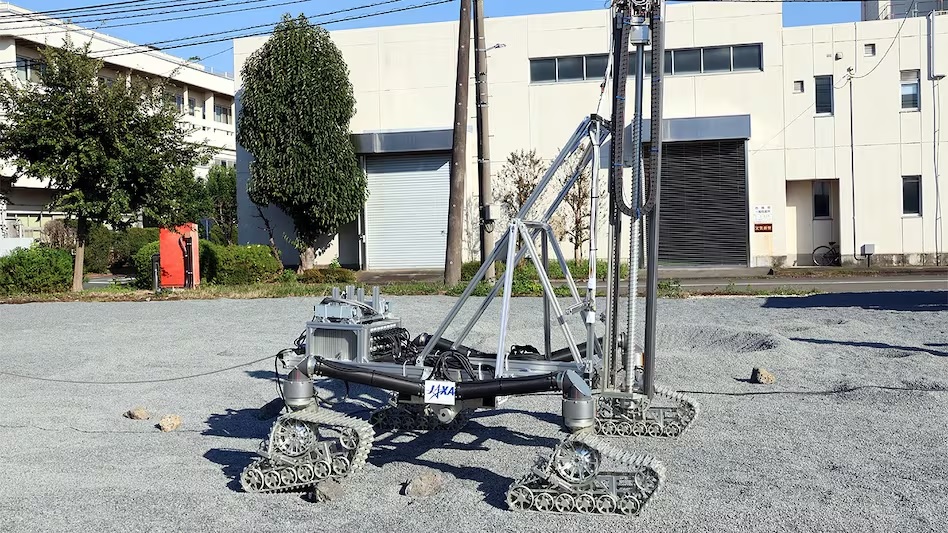
New Delhi: India and Japan are together preparing to understand the mysteries of the Moon, the answers to which can be very important for future space missions and human settlements. Japan's space agency JAXA presented the prototype of the rover of India-Japan joint lunar mission Chandrayaan-5 i.e. LUPEX. This rover weighing about 350 kg will help in detecting the presence of water and ice by moving on the lunar surface. The special thing about this mission is that it will not be limited to just taking pictures of the Moon or doing a general study of its soil, but will also analyze the samples by digging about 1.5 meters below the surface.
This mission is an example of a major partnership between India's Chandrayaan program and Japan's space technology. In this, the rover is being made by Japan, while the responsibility of the lander is with the Indian Space Research Organization (ISRO). The European Space Agency (ESA) and the American space agency NASA are also contributing to this through scientific instruments. Chandrayaan-5 is also known as LUPEX i.e. Lunar Polar Exploration Mission. It is planned to be launched by Japan's H3 rocket in 2028. It will be launched from Tanegashima Space Center in Japan. The entire mission will weigh approximately 6.5 tonnes at the time of launch.
After landing on the moon, its normal operating time has been kept at three and a half months, although if conditions are favourable, it can be extended to one year. The main goal of this mission is to detect water and water ice in the polar region of the Moon. The south pole of the Moon holds special importance for scientists, because there are some craters where little or no sunlight reaches. The temperature remains very low in these areas. Scientists estimate that water ice can remain safe in such cold and dark areas for billions of years. However, direct scientific study is necessary to find out its actual quantity, depth and distribution.
How will a 350 kg rover work?
JAXA displayed a prototype of the rover at the Chofu Aerospace Center in Tokyo. It is not a vehicle running on wheels like a normal car or rover. It has a belt-like crawler track system, which will help it move on the rough and uneven lunar surface. During the demonstration, scientists also showed its movement on the artificial lunar surface.
Seven scientific instruments will be installed in the rover. It will move on a pre-determined path around the landing site. ISRO and JAXA will jointly determine its path, so that suitable locations can be selected for scientific experiments, measurements and battery recharge. Its work will not be to collect data just by standing at one place, but will have to go to different places and study the lunar soil and surrounding environment.
Why is the search for water on the Moon so important?
The presence of water on the Moon could be one of the most important discoveries in space science. The water can be used for drinking and other needs of astronauts in future. If scientists can develop technology to separate water into hydrogen and oxygen, then it can also be used to prepare rocket fuel and breathable oxygen. This can reduce the dependency on taking every essential resource from the Earth to the Moon.
But it is important to know where the water ice is, how much it is and in what form it exists. Merely finding signs of water on the surface will not be enough. If ice is deposited between soil particles or underground, its identification and quantity will have to be determined using different scientific techniques. This is why the LUPEX mission will investigate at both surface and underground levels.
Data will be collected from seven scientific instruments
The instruments installed in the rover will examine the lunar soil and its surrounding environment in different ways. In these, ground penetrating radar will help in understanding the structure beneath the ground, while neutron spectrometer will look for signs of hydrogen present in the soil. The presence of hydrogen may be a sign of water or water ice. Apart from this, instruments to study the temperature, soil properties and extremely thin outer atmosphere of the Moon are also part of the mission. According to JAXA, the rover will also have a drilling system to extract samples up to 1.5 meters. A comprehensive survey will be conducted first in the mission.
The rover will visit different places and collect data related to temperature, light and geological formations. Based on this, scientists will decide which place will be most useful to dig. After this, samples of lunar soil i.e. regolith will be taken out at the selected location and analyzed. In this way, scientists will not only search for signs of water, but will also try to understand in what form water exists and what its quantity can be.