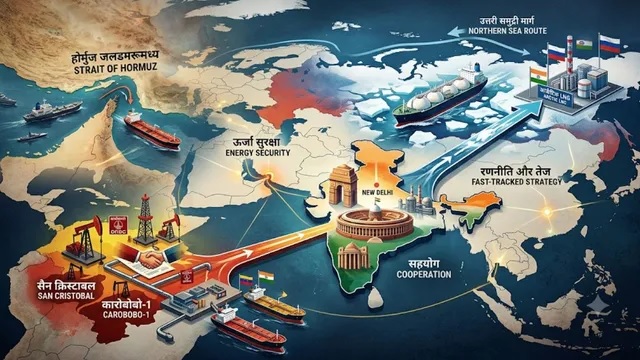
New Delhi. Since the Hormuz Crisis, India has intensified its strategy to ensure its energy security. In view of the risk of disruption of fuel supply from the Gulf countries, India is preparing to import LNG from Russia’s Arctic region on one hand and take over the operation of two large Venezuelan boilers on the other. Russian Deputy Foreign Minister Andrei Rudenko recently said that India is showing keen interest in oil and gas development in the Arctic region and increasing cooperation in the Northern Sea Route.
On the one hand, a 2029 tax cooperation program is finalized between India and Russia. On the other hand, under new Venezuelan law, ONGC is set to enter into an agreement for operational control of the San Cristobal and Carabobo-1 oil blocks. Until now, India had been receiving limited crude oil from Venezuela, only to recover past outstanding dividends. The new provisions give ONGC complete freedom to directly operate wells and produce regularly, without the legal risk of US sanctions.
Benefits of the Arctic Deal:
The Chennai-Vladivostok route is 5,600 kilometers shorter than the Suez route. This journey will take 16 days less and save 35% fuel.
By not passing through the Suez Canal, tolls of up to ₹42 million will be saved.
Being outside the war zone will also eliminate additional insurance.
There will be an opportunity to manage 20 new Arctic ports.
The advantages of the Venezuelan deal include
a 100% safer route than the war-torn Straits of Hormuz.
Extracting oil directly from wells instead of buying it at a higher price would save $5 to $10 per barrel.
Economic strength and energy security are key.
India’s record oil imports from Russia reflect not just favorable market conditions. It signals a broader strategic approach in which economic strength and energy security are more important than external political pressures. With global energy markets remaining volatile and trade flows constantly shifting due to geopolitical conflicts, Russia will remain a cornerstone of India’s crude oil import strategy for the foreseeable future.