
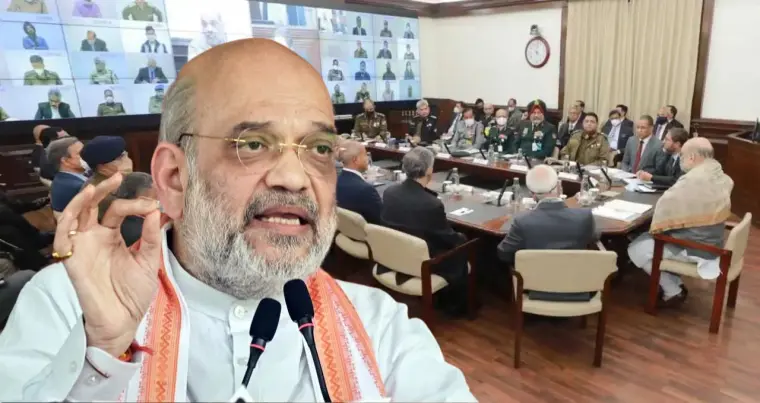

Amidst the monsoon session of Parliament, Union Home Minister Amit Shah held a high-level meeting at his office in Parliament House late on Tuesday evening. Home Secretary Govind Mohan and Intelligence Bureau (IB) chief Mahesh Dixit were also present in this meeting.
New Delhi: Amidst the monsoon session of Parliament, Union Home Minister Amit Shah held an important high-level meeting in his office located at Parliament House. Union Home Secretary Govind Mohan and Intelligence Bureau (IB) Director Mahesh Dixit attended this meeting. This meeting held late on Tuesday evening is being considered very important in view of the current political and security scenario.
Although no official information has been shared by the government regarding the agenda of the meeting or the topics of discussion, but amidst the Parliament session, recent protests and issues related to the internal security of the country, this meeting has intensified the discussion in political and administrative circles.
Important meeting held between Parliament session
The monsoon session of Parliament in India is known for the discussion on many important bills and national issues. At such a time, the meeting of the Home Minister with the top security officials of the country is being considered as an indication that the Central Government is constantly monitoring the security arrangements and law and order situation during the proceedings of the Parliament.
The presence of Home Secretary Govind Mohan and IB chief Mahesh Dixit in the meeting indicates that topics like national security, intelligence inputs, situation in sensitive areas and security of the Parliament complex may have been reviewed. However, these possible discussions have not been officially confirmed.
Increased sensitivity amid recent protests
This meeting has taken place at a time when student movements and political protests have become a topic of discussion in different parts of the country. There have been demonstrations at many places, especially over controversies related to competitive examinations and alleged paper leak cases. In such a situation, it is considered important for the central government to maintain law and order and coordination with security agencies. Political analysts believe that regular review of security preparations during the Parliament session is part of the normal administrative process of the government.
Opposition raised questions on police action
Meanwhile, opposition parties have sought answers from the central government regarding police action during the recent student protests. During the discussion on anti-paper leak law in Parliament, Congress MP and Deputy Leader of Opposition in Lok Sabha Gaurav Gogoi criticized the government and raised the issue of the protest at Jantar Mantar in New Delhi on July 20.
Gogoi alleged that the police used force against the protesters during the demonstration. He also raised questions from at what level the order for the use of measures like pellet guns, tear gas and lathi charge was allegedly given. He demanded a clear answer from the Union Home Minister on this entire incident.
No official statement came from the government
So far, no detailed official response to these allegations has been issued by the Home Ministry or the Central Government. Similarly, no official statement has come out regarding the issues discussed in the high-level meeting of Home Minister Amit Shah. The agenda of the meeting has also not been confirmed by government sources. Therefore, the information coming out regarding the possible topics of the meeting should be seen only as estimates until official confirmation is received.
Special vigilance is taken regarding security arrangements in the national capital during the Parliament session. During this period, the security of the Parliament complex, important government institutions and sensitive areas of the capital is regularly reviewed. The Home Ministry, central security agencies and intelligence departments continuously coordinate and assess potential security challenges.
Comments are closed.