
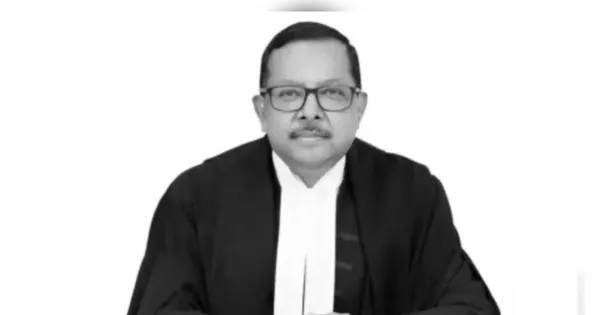
Space for dissent is shrinking in India, peaceful demonstration is fundamental right of citizens: Justice Ujjal Bhuiyan

New Delhi: Supreme Court judge Justice Ujjal Bhuiyan said that there is no law to ban eating chicken above the river Ganga. Referring to the arrest of the youth for eating chicken biryani on a boat during Iftar, he said, “I firmly believe that eating chicken biryani is not a crime. It cannot be a crime. Yet he was arrested for the same reason and had to stay in jail for three months.”
4th Justice G.P. Held at National Law Institute University (NLIU), Bhopal. In the Singh Memorial Lecture, Justice Bhuiyan said that peaceful protest and expression of dissent is extremely important in a democracy, but today even normal civic activities have started being seen as a crime.
He said, “The right to express one’s views and the right to demonstrate peacefully are fundamental liberties of citizens. Debate and dissent are the essence of democracy. Unfortunately, today even normal activities are being criminalized.”
Mentioned environmental activists and students
Justice Bhuiyan said that people demanding environmental protection are often treated like criminals. He said that people who raise concerns about the damage being done to the environment are also chased away as if they were criminals.
He also expressed concern over the condition of students protesting on university campuses. According to him, in many cases students are arrested and do not get bail for 30 to 40 days. Not only this, many students are also suspended, after which they have to resort to courts to resume their studies.
Questions raised on strict bail conditions
Justice Bhuiyan said that courts ultimately grant bail, but sometimes there is unnecessary delay. He said that what is even more worrying are the stringent conditions imposed on bail. He questioned, “Are the courts indirectly discouraging citizens from expressing their dissent through such restrictive bail conditions?”
He said that in many cases, people granted bail are prevented from attending public meetings or even posting on social media. According to him, such conditions seriously undermine the fundamental freedoms and personal liberties of citizens.
Mentioned the decision on ‘bulldozer justice’
Justice Bhuiyan also referred to the Supreme Court’s judgment of 2024, which had banned the practice of bulldozing as a punitive action. He said the decision was welcome, but “it came two years late.”
Also commented on the demonstration in support of Palestine
He also referred to the decision of the Bombay High Court, which had refused to allow a demonstration in support of Palestine. He said he found the court’s remarks “quite strange”, asking why people wanted to protest over incidents in Gaza and not over India’s issues. He said that India has been recognizing Palestine for a long time and the Palestinian Embassy is also present in New Delhi.
Concern over political role of judges after retirement
Justice Bhuiyan also expressed concern over the issue of retired judges going into politics. He said that when a former Chief Justice says that he is going to Rajya Sabha to reduce the distance between the judiciary and the executive, it is fundamentally wrong thinking. According to him, there is a fundamental flaw in this argument.
Appeal to law students to adopt critical thinking
At the end of his address, Justice Bhuiyan asked the law students to have the courage to question all institutions including the judiciary. He said that the decisions of the court should be studied seriously and if necessary, they should also be criticized.
He said, “Criticizing a decision does not amount to criticizing the judge.”
Justice Bhuiyan also said that the credibility of the judiciary is not determined by its own claims, but by the trust of the public. He expressed confidence that today’s new generation of lawyers and law students are more committed to the Constitution and the rule of law than earlier generations.

Comments are closed.