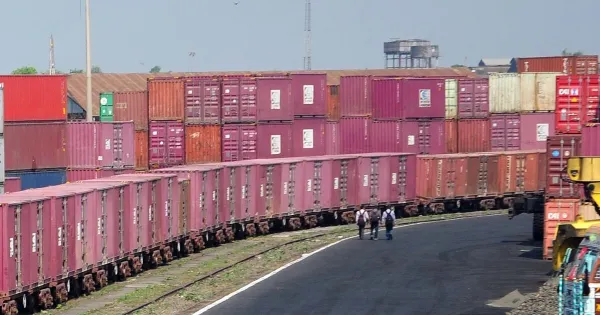
New Delhi. The central government is working rapidly towards making India a major center of global trade and logistics. Industry, policy experts and trade organizations on Monday said projects like modern ports, better road and rail networks and the India-Middle East-Europe Economic Corridor (IMEC) will play an important role in taking the country’s exports to new heights. Also, improvement in ease of doing business, reduction in compliance burden and steps to promote startups will further accelerate India’s economic growth.
National Traders Welfare Board Chairman Sunil J. Speaking to news agency IANS, Singhi said that under the leadership of Prime Minister Narendra Modi, there has been rapid expansion of highways, roadways, waterways and other infrastructure in the country. He said that ports have now become the backbone of trade and logistics, reducing the time of movement of goods and making goods reach traders faster through warehousing facilities.
He said, “Logistics turnaround time will further reduce in the times to come as the government is continuously implementing reforms. More than 40,000 compliances for traders have been removed and through the ‘Jan Vishwas Bill’ around 1,000 such provisions have been removed which could have caused traders to face unnecessary harassment or jail-like situations.”
Singhi expressed confidence that India is rapidly increasing its export potential and will be among the major exporting countries of the world in future. He said that the entire system of delivering goods from Indian traders to exporters is becoming stronger and more effective than before.
While talking to IANS, Abhijeet Singh, National Program Director of ‘Ease of Doing Business’ and Project Director of NHEV, said that the IMEC corridor is an important part of Prime Minister Modi’s vision of making India a transshipment hub.
He said, “A large part of the world economy depends on sea routes and India’s eastern and western coasts are going to play a decisive role in this. When this corridor will reach Europe via Dubai and major Indian ports like Kandla, JNPA and Mundra will be connected to Jebel Ali and Abu Dhabi Port, then India’s transshipment capacity and strategic importance will increase significantly.”
Abhijit Singh further said that some geopolitical challenges currently existing in the India-Middle East region need to be resolved at the diplomatic level. However, he also said that the part of IMEC which has already been developed should be made operational soon and further strengthened.
He said that in view of the increasing global trade and demand for freight transportation, it is very important for India to develop modern transshipment ports. Till now a large part of this region has been with Sri Lanka, but India is rapidly strengthening its position.
At the same time, Dr. Soumen Roy, Professor of the Indian Council for Research on International Economic Relations (ICRIER), told IANS that despite global uncertainties, there has been a significant improvement in India’s export performance.
He said, “If we look at the data of the last six months, India’s exports have registered a growth of about 20 percent. India is now exporting engineering products to markets like China, while the demand for Indian products is also increasing in Singapore and other countries. There has also been a significant increase in electronics exports.”
Dr. Roy said that despite the challenges related to the Strait of Hormuz, rising tariffs and global trade barriers, India’s exports are continuously growing, which reflects the country’s economic potential and global competitiveness.
Along with this, former NITI Aayog member Dr. Arvind Virmani, while talking to IANS, said that deep-tech startups are going to be the biggest foundation of India’s future growth.
He said, “For the last several decades, we have been talking about credit availability for small and medium companies. But the real key to the future lies in deep-tech startups. I myself have met many such startups who are doing remarkable work in the field of new technologies. These companies can make India a global innovation power in the future.”
Virmani further said that the next story of India’s growth will not be written by traditional industries alone, but by technological innovation, research and innovative startups.