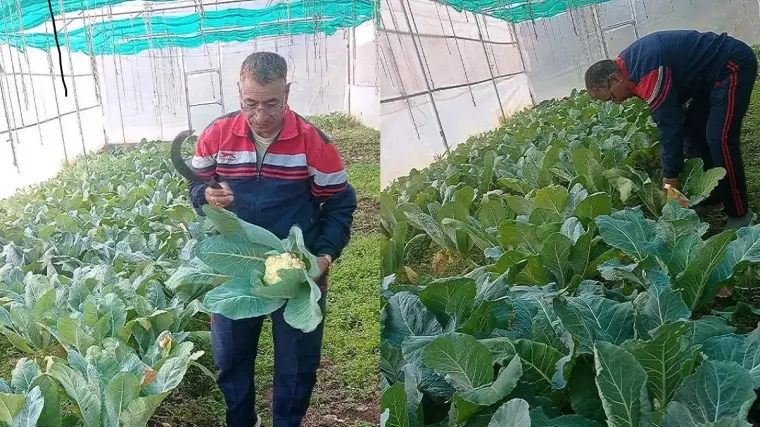
To make farming more profitable in the hilly districts of Uttarakhand, emphasis is being laid on protected farming. In this series, NABARD Polyhouse Scheme in Champawat district has brought a new opportunity for farmers to increase their income. The process of providing polyhouses to farmers under the scheme has started and till now 130 farmers of the district have applied for it. The special thing is that a major part of the total cost of the polyhouse will be made available through the scheme, while the farmer will have to pay only the prescribed contribution. This can make it easier for small and marginal farmers to do modern farming.
In a hilly district like Champawat, farming is affected by many natural challenges. There is a risk of damage to crops in open fields due to rain, change in temperature, strong sunlight, cold and sudden change of weather. In such a situation, polyhouse gives farmers the option to cultivate vegetables and other garden crops in a controlled and protected environment. Its objective is not only to provide polyhouse infrastructure, but also to connect farmers with such farming in which better production and quality crops can be achieved on limited land.
Under the scheme, polyhouses of 50 square meter, 100 square meter and 500 square meter area are to be established in Champawat. Polyhouses will be selected based on the needs of the farmers and the prescribed standards. Small size polyhouses can be especially useful for those farmers who have less land and want to start protected farming along with traditional farming. At the same time, vegetable and garden crops can be produced in more area through large size polyhouse.
The most attractive thing about the scheme is the limited contribution of farmers. According to the available information, the farmer will have to bear 20 percent of the fixed cost himself. The farmer's contribution for a 50 square meter polyhouse is said to be around Rs 19 thousand and for a 100 square meter polyhouse it is around Rs 35 thousand. That means the farmer will not have to bear the entire cost alone. For this reason, the scheme can also become an opportunity for small farmers to take steps towards modern farming. However, the actual contribution may vary depending on the offer accepted and applicable costs, so it is important to confirm the current terms and conditions with the relevant department before applying.
The application process for this scheme has been kept online. Interested farmers can apply through 'Apni Sarkar' portal. According to District Horticulture Department officials, so far 130 farmers have applied in Champawat. After the rainy season ends, preparations are being made to take forward the process of polyhouse installation. This indicates that there is interest among farmers regarding the scheme and a large number of farmers want to move towards protected farming.
The biggest advantage of polyhouse farming is that the farmer can protect the crop from adverse weather conditions to a great extent. While in open fields the crop can be affected by continuous rain, hailstorm, strong wind or sudden change in temperature, a relatively controlled environment can be created for the crop inside a polyhouse. This can help in reducing the risks of farming. Along with this, the farmer can focus on such vegetables and garden crops which have good demand in the market.
In a hilly area like Champawat, the land size is often small and the fields are sloping. In such a situation, it becomes important for the farmers to achieve more production per unit area. Protected farming is considered a useful technique in this direction. If the farmer selects the crop according to the market demand, decides the right time of production and makes better marketing arrangements with the local market, then polyhouse can help in increasing his agricultural income. However, the income from this is not fixed and depends on many factors like crop, market price, production cost, management and sales system.
One of the objectives of promoting polyhouse based farming through NABARD scheme is to make agriculture in hilly areas more sustainable and profitable. A large number of people in Champawat are dependent on agriculture and related activities. If small farmers also increase vegetable production by adopting modern technology, it can strengthen the rural economy. Increasing production at the local level also increases the possibility of connecting farmers to the market and creating new avenues of agriculture-based income.
In polyhouse, farmers can generally do protected cultivation of flowers and other garden crops in addition to vegetables. However, which crop will be grown in which polyhouse depends on the local climate, market demand, technical capability of the farmer and departmental advice. Therefore merely getting a polyhouse is not enough. For better results, the farmer will also need information about crop selection, seeds, irrigation, nutrition, disease control, temperature management and access to the market.
The next step for farmers applying for the scheme will be related to eligibility and scrutiny of the proposal. After getting the approval, the polyhouse will be established as per the prescribed procedure. The available government scheme related documents mention the process of construction through listed companies after approval for protected cultivation and payment of assistance after departmental inspection. However, for the exact procedure and applicable conditions of the current NABARD scheme in Champawat, the farmer should take information from the District Horticulture Department.
It is also important for the farmers not to fall prey to any unauthorized person or agent. All information related to online application, eligibility, farmer contribution, size and construction of polyhouse should be obtained through official departmental channel only. If additional amount is asked from a farmer in the name of the scheme, then it would be better to verify from the concerned horticulture officer before making the payment.
The application of 130 farmers in Champawat is an indication that farmers of hilly areas are also showing interest in adopting modern technology along with traditional farming. If the scheme is implemented on time and helps farmers in getting technical training and connecting them to the market, then in the future, polyhouse farming can become an important source of income in the rural areas of the district. Especially for those farmers who have limited land but want to cultivate high value vegetables or horticultural crops, this model can prove useful.
Farmers wishing to take advantage of the scheme should make complete preparations regarding their land, irrigation facilities and farming plan before applying. After investing in a polyhouse, regular care is required. It is also important to understand the demand and sales system of the crop in advance, because with the increase in production, if there is no access to the market, the farmer may not get the expected profit. Therefore, it would be more beneficial to look at protected farming not just as a subsidy or low-cost structure, but as a complete agribusiness plan.
At present, the application process under the scheme is going on in Champawat and 130 farmers have applied. There are plans to set up polyhouses of 50, 100 and 500 square meters. Farmer contribution is said to be around Rs 19 thousand for 50 square meter and around Rs 35 thousand for 100 square meter. The installation work is expected to proceed after the rainy season ends. Through the scheme, efforts are being made to provide farmers with weather-safe farming, better quality production and an opportunity to increase income.