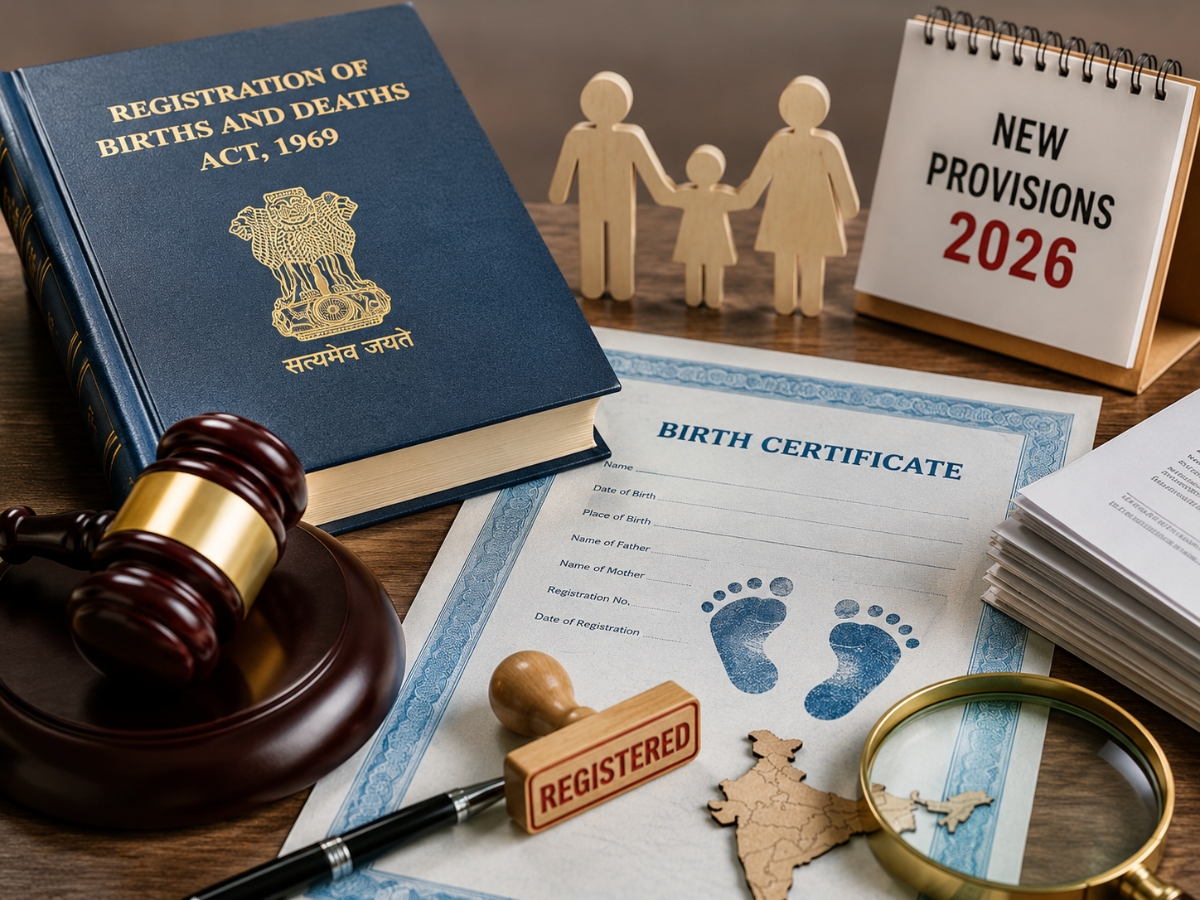
India’s birth and death registration process could soon become much stricter for people who delay reporting these events. The government on July 29 introduced in Lok Sabha the Registration of Births and Deaths (Amendment) Bill, 2026, to tighten control over registrations of births and deaths made after two years or more of actual birth or death.
If passed by the Parliament, this new law will be of great use to those families who want to register a birth or death in retrospect after two years. Now not only will the district administration be answerable but it will not come under the sole jurisdiction of the Judicial Magistrate First Class (JMFC), as they earlier needed their consent.
What is the Birth and Death Registration (Amendment) Bill, 2026?
The new law seeks to amend Section 13(3) of the Registration of Births and Deaths Act, 1969 (as amended in 2023). The government’s aim is to promote timely registration of births and deaths while tightening rules for delayed registrations.
The proposed change follows nearly three years after a major overhaul of India’s civil registration system in 2023 that included digital records of birth and death certificates. The rule says a birth certificate will be the only accepted proof of a person’s date and place of birth for anyone born on or after October 1, 2023.
What Will Change Under the New Rules?
The most significant proposed change is the new two-tiered approach being stipulated for belated birth/death registration.
For registrations reported between one and two years after the incident(s), the process will remain almost the same as it is now, with permission given by the District Magistrate (DM), Sub-Divisional Magistrate (SDM) or an Executive Magistrate authorised by the DM after checking the facts. The payment of the prescribed fees will continue to be a prerequisite.
However, any reporting of an event beyond two years of the incident will have to go through the Judicial Magistrate First Class, and judicial verification of the case will have to be done by him.
Reporting of deaths or births within the first year will continue to be handled by local registration authorities, such as gram panchayats and municipal bodies.
Why is the Government Strengthening Controls?
The Statement of Objects and Reasons of the Bill says that the amendment is to discourage registration after a reasonable point of time and thereby improve the quality of civil registration records in India.
Birth and death data is crucial to countries’ plans for welfare schemes and public health projects. They are also essential for a country’s statistical studies on demographics, welfare benefits and various government databases. Delayed or disputed entries pose problems in many such applications.
Through judicial examination of long belated registrations, the government aims to mitigate any opportunity for fake or incorrect registrations.
Who Will Be Affected?
People applying for passports or inheritance and other government documents and services like pensions and school admissions will be affected if they apply for a belated death or birth certificate, as they will be required to spend extra time applying for the document, which has now become a judicial procedure.
Legal experts also predict that the move will result in more court-based legal proceedings that may deal with family and identity disputes.
What Happens Next?
So far the bill has only been introduced in Parliament. It still has to pass both houses of parliament and the president before it can come into effect.
Until then, the current regulations will remain in force. However, if the amendment receives enactment, it will add another layer to India’s civil registration system, sending a clear signal that delaying any birth or death registration has just become tougher.
Also Read: Missed July 31 ITR Deadline? These 5 Hidden Costs Could Hurt More Than Rs 5,000 Late Fee
Priyanka Roshan
Priyanka Roshan is a business writer and assistant editor at the NewsX website who tracks everything from stock market swings and corporate earnings to personal finance trends and policy shifts. Known for turning fast-moving business developments into sharp, reader-friendly stories, she combines speed, accuracy, and a data-driven approach to break down complex financial news for everyday audiences.
With over 9.5 years of newsroom experience, Priyanka has worked with leading media organisations, including Bussiness, Times Now, and Ping Digital, covering diverse beats such as business, politics, technology, auto, travel, sports, and the world. From live breaking news desks to SEO-led digital storytelling, she specialises in creating engaging content that keeps readers informed without overwhelming them.
The post Birth Certificate Rule Set To Change? What New Provisions Of Registration Of Births And Deaths Bill Mean appeared first on NewsX.