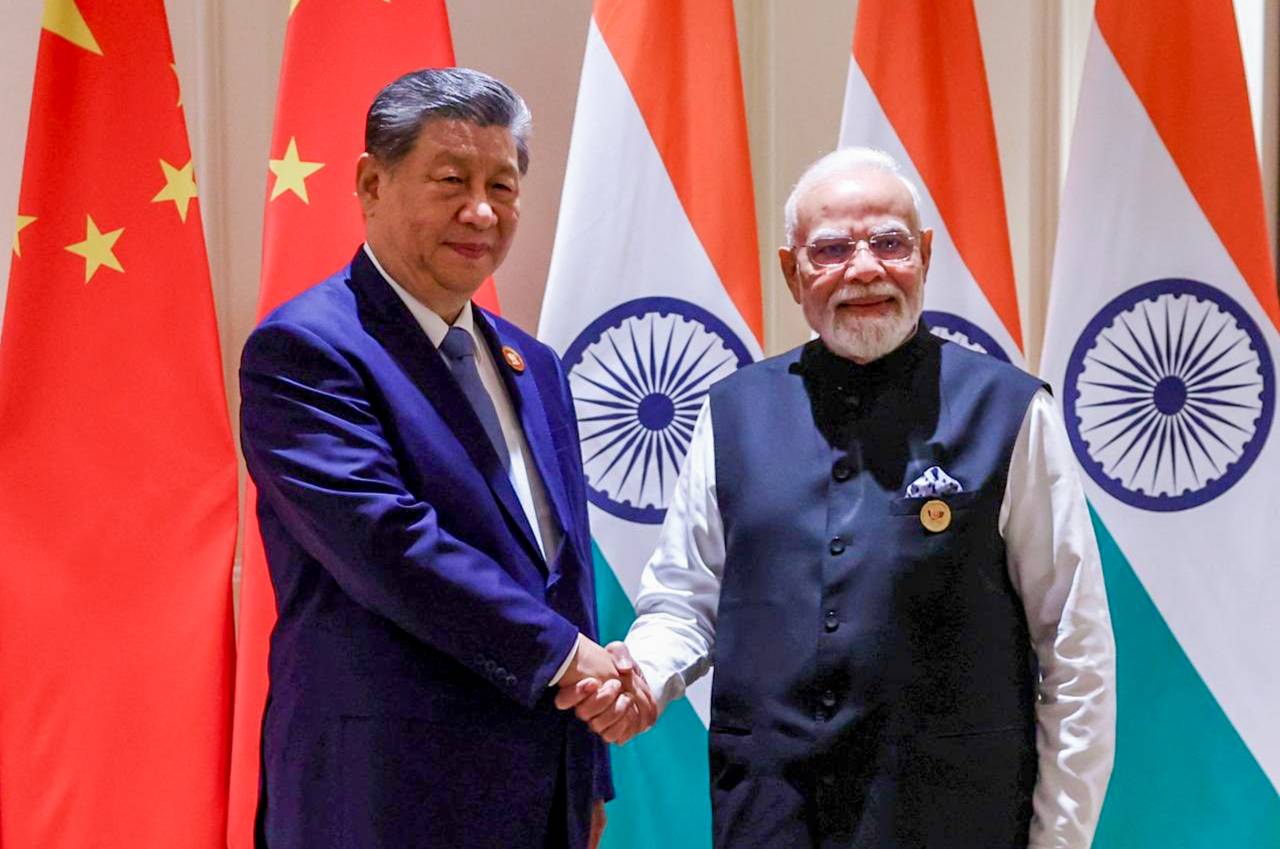
The much-anticipated meeting between Prime Minister Narendra Modi and China’s President Xi Jinping on the sidelines of the BRICS Summit did not result in any big-bang announcement or claims of a breakthrough. That was never on the cards.
Effort to rebuild ties
The conversation was part of a process that was set in motion in October 2024 to de-escalate tension between Asia’s two most populous countries, scarred by the military confrontation in Ladakh in the summer of 2020. Since then, the trust deficit remains constant. Nearly 50,000 troops continue to remain in place on both sides of the Line of Actual Control (LAC).
“The fact that Chinese President Xi travelled to India and had a bilateral with Prime Minister Modi sends out the right kind of signal. Foreign ministers, National Security Advisors (NSAs) and senior officials may meet, but a summit sets the political frame that then percolates through the system,” says Alka Acharya, director at the Institute of Chinese Studies.
Also read/watch: BRICS Summit | Modi-Xi meeting: ‘India-China border row remains key hurdle to ties’
What matters is that the two leaders have now put the relationship on a more predictable track. At the same time, there is a clear effort to rebuild the broader relationship through greater people-to-people exchanges, business links, mobility and more predictable market access.
India, China set economic priorities
Prime Minister Modi emphasised that peace and tranquility in the border areas remain an essential basis for the continued development of bilateral relations. He underlined the need for both sides to observe existing agreements and understandings on border-related issues. President Xi emphasized that “India and China are partners rather than rivals,” according to a Chinese readout. The MEA statement added, “They reaffirmed that both countries should take a strategic and long-term perspective on their ties. Differences should not become disputes.”
While China had long held the view that bilateral ties should not be held hostage to the border dispute, since 2020, India has been reluctant to do so. But now that the de-escalation along the five points of infringement in Ladakh is done, and the pressure from India’s business leaders that normalisation of trade is a must for industry, the government is moving towards gradually opening up. Chinese inputs are a must not just for India but for most of the world’s manufacturing sector.
“The meeting shows a gradual normalisation of the bilateral relations. The priorities of both countries are, however, clear; economic and global priorities for China and resolving bilateral issues for India show that there is a long road ahead for furthering India-China cooperation,” says MS Prathibha of the IDSA.Associate Fellow at the East Asia Centre.
Still not friends, but China wants peace
The message from the Modi-Xi meeting is not that India-China ties are back to normal. They are not. Rather, both sides appear to have recognised that they have a common interest in preventing the relationship from sliding back into confrontation. More so as the world is in flux, US President Donald Trump’s disruptive tariffs, rising protectionist barriers that the US has set up, and the two wars in West Asia and Europe have led to political and economic churn around the world.
Also read: India’s BRICS tightrope: Navigating China, Trump, and Middle East crises
The China-US rivalry, despite the current thaw, has also made Xi look at alternative markets including the large Indian market. Xi will be in the US later this month and, having a BRICS declaration under his belt – which, without naming the US, emphasises the importance of the World Trade Organisation (WTO) and opposes trade barriers – will be a positive. A less confrontational relationship with India serves China’s wider interest in strengthening BRICS and the Global South.
For India, this is also about managing a complicated geopolitical environment. With Washington’s policies increasingly unpredictable and India seeking greater room for manoeuvre, New Delhi has an interest in stabilising its most consequential Asian relationship.
Spectre of border issue
The unmarked 3,488 km border is at the core of the India-China dispute. The border is neither demarcated nor delineated on maps. A short border conflict in 1962, when the People’s Liberation Army poured into Arunachal Pradesh and as abruptly left, remains etched in India’s historical memory. After 25 rounds of boundary talks, not much has moved.
Also read/watch: Is China hijacking BRICS? | Ex-diplomat TS Tirumurti interview
The August talks in Beijing between NSA Ajit Doval and China’s Wang Yi led to positive signals and the announcement of an eight-point proposal. There is some buzz about a likely agreement on the middle sector of the border, but so far nothing has been publicly announced. The boundary issue hangs heavy over India-China ties.
Saturday’s meeting between Modi and Xi provided for excellent optics. The real test will come after the feel-good factor fades. Can the two sides translate the carefully calibrated political understanding into progress on the boundary, reduce the trade imbalance and restore enough confidence for a broader economic relationship?
For now, the answer is still uncertain. What the Modi-Xi meeting has achieved is something more modest and perhaps more important: it has kept the process of repairing the relationship on track.